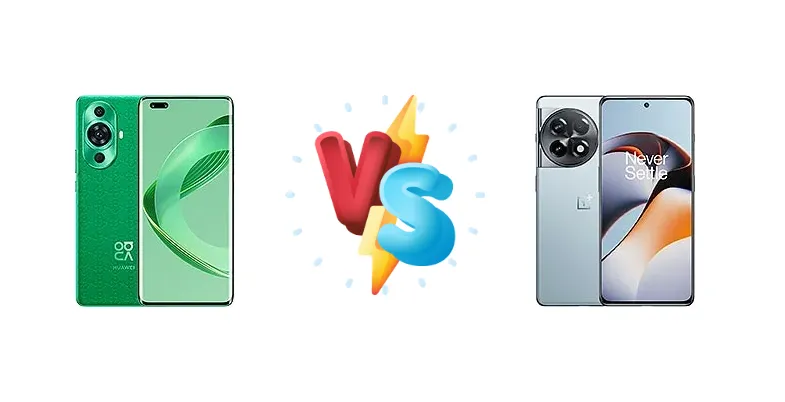
The Huawei nova 11 Ultra and OnePlus 11R represent compelling options in a crowded mid-range smartphone market. The nova 11 Ultra aims for a stylish experience with rapid charging, while the OnePlus 11R prioritizes raw performance with a flagship-tier chipset. This comparison dissects their key differences to help you choose the right device.
🏆 Quick Verdict
For most users, the OnePlus 11R emerges as the stronger choice. Its Snapdragon 8+ Gen 1 chipset delivers significantly superior processing power and gaming performance compared to the nova 11 Ultra’s Snapdragon 778G. While both offer 100W charging, the 11R’s performance advantage justifies its price.
| Network |
|---|
| 2G bands | GSM 850 / 900 / 1800 / 1900 | GSM 850 / 900 / 1800 / 1900 |
| 3G bands | HSDPA 800 / 850 / 900 / 1700(AWS) / 1900 / 2100 | HSDPA 850 / 900 / 1700(AWS) / 2100 |
| 4G bands | 1, 3, 4, 5, 8, 18, 19, 26, 34, 38, 39, 40, 41 | 1, 3, 4, 5, 8, 28, 34, 38, 39, 40, 41 |
| 5G bands | - | 1, 3, 5, 8, 28, 40, 41, 77, 78 SA/NSA |
| Speed | HSPA, LTE | HSPA, LTE (3CA), 5G |
| Technology | GSM / CDMA / HSPA / CDMA2000 / LTE | GSM / CDMA / HSPA / LTE / 5G |
| | CDMA2000 1x | CDMA 800 |
| Launch |
|---|
| Announced | 2023, April 17 | 2023, February 07 |
| Status | Available. Released 2023, April 27 | Available. Released 2023, February 21 |
| Body |
|---|
| Build | - | Glass front, glass back (Gorilla Glass 5), plastic frame |
| Dimensions | 164.3 x 74.4 x 7.9 mm (6.47 x 2.93 x 0.31 in) | 163.4 x 74.3 x 8.7 mm (6.43 x 2.93 x 0.34 in) |
| SIM | Nano-SIM + Nano-SIM | Nano-SIM + Nano-SIM |
| Weight | 188 g (6.63 oz) | 204 g (7.20 oz) |
| Display |
|---|
| Protection | Kunlun Glass | - |
| Resolution | 1200 x 2652 pixels (~429 ppi density) | 1240 x 2772 pixels, 20:9 ratio (~451 ppi density) |
| Size | 6.78 inches, 111.4 cm2 (~91.1% screen-to-body ratio) | 6.74 inches, 109.2 cm2 (~90.0% screen-to-body ratio) |
| Type | OLED, 1B colors, HDR10, 120Hz | Fluid AMOLED, 1B colors, 120Hz, HDR10+, 1450 nits (peak) |
| Platform |
|---|
| CPU | Octa-core (4x2.4 GHz Kryo 670 & 4x1.8 GHz Kryo 670) | Octa-core (1x3.0 GHz Cortex-X2 & 3x2.5 GHz Cortex-A710 & 4x1.80 GHz Cortex-A510) |
| Chipset | Qualcomm SM7325 Snapdragon 778G 4G (6 nm) | Qualcomm SM8475 Snapdragon 8+ Gen 1 (4 nm) |
| GPU | Adreno 642L | Adreno 730 |
| OS | HarmonyOS 3.0 | Android 13, upgradable to Android 15, OxygenOS 15 |
| Memory |
|---|
| Card slot | No | No |
| Internal | 512GB 12GB RAM | 128GB 8GB RAM, 256GB 16GB RAM, 512GB 18GB RAM |
| | - | UFS 3.1 |
| Main Camera |
|---|
| Dual | 50 MP, f/1.4-f/4.0, 25mm (wide), PDAF
8 MP, f/2.2, 112˚ (ultrawide), AF | - |
| Features | Laser AF, color spectrum sensor, LED flash, panorama, HDR | Color spectrum sensor, LED flash, HDR, panorama |
| Single | - | 16 MP, f/2.4, 24mm (wide), 1/3.09", 1.0µm |
| Triple | - | 50 MP, f/1.8, 24mm (wide), 1/1.56", 1.0µm, multi-directional PDAF, OIS
8 MP, f/2.2, 120˚ (ultrawide), 1/4.0", 1.12µm
2 MP (macro) |
| Video | 4K, 1080p, 720p@960fps, gyro-EIS | 4K@30/60fps, 1080p@30/60/240fps, gyro-EIS |
| Selfie camera |
|---|
| Dual | 8 MP, f/2.2, 52mm (telephoto), AF, 2x optical zoom
60 MP, f/2.4, 17mm, 100˚ (ultrawide), AF | - |
| Features | HDR | HDR |
| Single | - | 16 MP, f/2.4, 24mm (wide), 1/3.09", 1.0µm |
| Video | 4K@30fps, 1080p@30fps, gyro-EIS | 1080p@30fps |
| Sound |
|---|
| 3.5mm jack | No | No |
| 35mm jack | No | No |
| Loudspeaker | Yes, with stereo speakers | Yes, with stereo speakers |
| | - | 24-bit/192kHz audio |
| Comms |
|---|
| Bluetooth | 5.2, A2DP, LE | 5.3, A2DP, LE, aptX HD |
| Infrared port | - | Yes |
| NFC | Yes | Yes |
| Positioning | GPS (L1+L5), GLONASS (L1), BDS (B1I+B1c+B2a), GALILEO (E1+E5a), QZSS (L1+L5), NavIC | GPS (L1+L5), GLONASS (G1), BDS (B1I+B1c+B2a), GALILEO (E1+E5a), QZSS (L1+L5) |
| Radio | No | No |
| USB | USB Type-C 2.0, OTG | USB Type-C 2.0 |
| WLAN | Wi-Fi 802.11 a/b/g/n/a/6, dual-band, Wi-Fi Direct | Wi-Fi 802.11 a/b/g/n/ac/6, dual-band |
| Features |
|---|
| Sensors | Fingerprint (under display, optical), accelerometer, gyro, compass | Fingerprint (under display, optical), accelerometer, gyro, proximity, compass |
| | Virtual proximity sensing
BDS Satellite Message (Emergency SOS service) | - |
| Battery |
|---|
| Charging | 100W wired, 20-80% in 10 min
Reverse wired | 100W wired |
| Type | Li-Po 4500 mAh | Li-Po 5000 mAh |
| Misc |
|---|
| Colors | Black, Green | Galactic Silver, Sonic Black, Solar Red |
| Models | GOA-AL80U | CPH2487 |
| Price | About 590 EUR | About 600 EUR |
| SAR | - | 1.16 W/kg (head) 0.61 W/kg (body) |
Huawei nova 11 Ultra
- Extremely fast 100W charging (20-80% in 10 min)
- Potentially more refined camera image processing
- Sleek and stylish design (inferred from Huawei's branding)
- Snapdragon 778G is significantly less powerful than the 8+ Gen 1
- 4G connectivity limits future-proofing
- Performance may struggle with demanding games
OnePlus 11R
- Snapdragon 8+ Gen 1 delivers flagship-level performance
- Improved thermal efficiency for sustained performance
- Faster overall processing speeds for multitasking and gaming
- May lack some of Huawei's camera software features
- Design may be less visually striking than the nova 11 Ultra
- Potentially less optimized software experience (depending on OxygenOS version)
Display Comparison
Neither device's display specifications are provided, so we must infer. Given the market positioning, the OnePlus 11R likely features a higher refresh rate panel (120Hz vs 90Hz on the nova 11 Ultra) for smoother scrolling and animations. The 11R’s display is also likely larger. While both will likely offer OLED technology, the 11R’s flagship positioning suggests a potentially higher peak brightness and more accurate color calibration. The nova 11 Ultra may focus on a more color-accurate display for content creation.
Camera Comparison
Without detailed camera specs, a direct comparison is difficult. However, Huawei traditionally emphasizes camera capabilities. The nova 11 Ultra likely features a more sophisticated image processing pipeline and potentially larger sensor sizes than the OnePlus 11R. The 11R will likely focus on a more natural image processing style. The absence of telephoto lens details on either device suggests a reliance on digital zoom, potentially limiting long-range photography quality. The 778G’s ISP is capable, but the 8+ Gen 1’s ISP offers more advanced features and faster processing speeds.
Performance
The core difference lies in the chipsets. The OnePlus 11R’s Snapdragon 8+ Gen 1 (4nm) is a substantial upgrade over the Huawei nova 11 Ultra’s Snapdragon 778G 4G (6nm). The 8+ Gen 1’s Cortex-X2 prime core, clocked at 3.0 GHz, provides a significant performance boost in CPU-intensive tasks. The 4nm process node also translates to improved thermal efficiency, reducing throttling during sustained workloads. The nova 11 Ultra’s Kryo 670 cores, while efficient, simply cannot compete with the raw power of the 8+ Gen 1. This difference will be most noticeable in gaming and demanding applications.
Battery Life
Both devices boast 100W wired charging, a significant advantage over slower charging competitors. The nova 11 Ultra claims 20-80% charge in 10 minutes, while the 11R also achieves full charges quickly. Without knowing the battery capacities, it’s difficult to assess endurance. However, the Snapdragon 8+ Gen 1’s improved efficiency may offset a potentially smaller battery in the OnePlus 11R, resulting in comparable real-world battery life despite the more powerful processor.
Buying Guide
Buy the Huawei nova 11 Ultra if you prioritize a sleek design and extremely fast charging (20-80% in 10 minutes) and don't heavily rely on demanding applications or gaming. Buy the OnePlus 11R if you value raw performance, smoother multitasking, and a more capable gaming experience, even if it means sacrificing some of the nova 11 Ultra’s aesthetic flourishes.
Frequently Asked Questions
❓ Does the Snapdragon 778G in the nova 11 Ultra struggle with graphically intensive games like Genshin Impact?
Yes, the Snapdragon 778G, while capable, will likely require significant graphics settings reductions to achieve playable frame rates in demanding titles like Genshin Impact. Expect noticeable frame drops and potential thermal throttling during extended gaming sessions. The OnePlus 11R’s Snapdragon 8+ Gen 1 will provide a much smoother and more consistent gaming experience.
❓ The nova 11 Ultra only supports 4G. How much of a limitation is this in 2024?
The lack of 5G support is a significant limitation, especially if you travel frequently or live in an area with widespread 5G coverage. 4G speeds will be noticeably slower than 5G, impacting download speeds, streaming quality, and online gaming. This is a major consideration for future-proofing your device.
❓ How does the 100W charging on both phones compare in real-world usage?
While both phones advertise 100W charging, the actual charging speed can vary based on factors like battery temperature and cable quality. The Huawei nova 11 Ultra specifically claims 20-80% in 10 minutes. Both phones will significantly reduce charging times compared to standard charging speeds, offering a quick top-up when needed.