
Huawei nova 11 Ultra vs. Google Pixel 7 Pro: A Deep Dive Comparison
| Phones Images | |||||
|---|---|---|---|---|---|
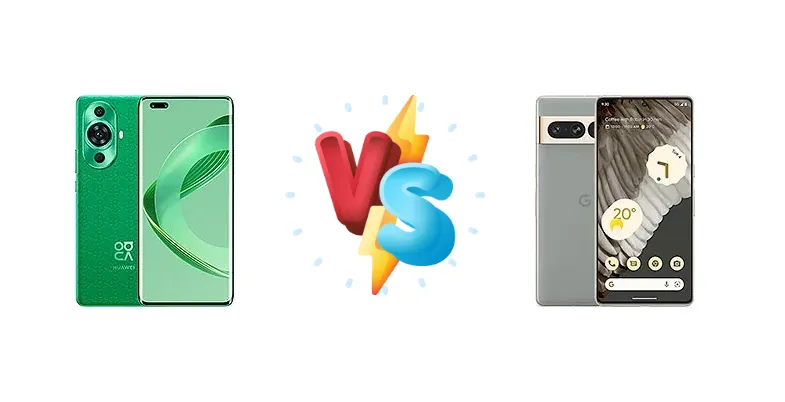
|
🏆 Quick Verdict
For the average user prioritizing camera versatility and software experience, the Google Pixel 7 Pro is the stronger choice. However, the Huawei nova 11 Ultra’s incredibly fast 100W charging – achieving 20-80% in just 10 minutes – makes it ideal for those constantly on the move and needing a quick power boost.
| PHONES | ||
|---|---|---|
| Phone Names | Huawei nova 11 Ultra | Google Pixel 7 Pro |
| Network | ||
|---|---|---|
| 2G bands | GSM 850 / 900 / 1800 / 1900 | GSM 850 / 900 / 1800 / 1900 |
| 3G bands | HSDPA 800 / 850 / 900 / 1700(AWS) / 1900 / 2100 | HSDPA 800 / 850 / 900 / 1700(AWS) / 1900 / 2100 |
| 4G bands | 1, 3, 4, 5, 8, 18, 19, 26, 34, 38, 39, 40, 41 | 1, 2, 3, 4, 5, 7, 8, 12, 13, 14, 17, 18, 19, 20, 25, 26, 28, 29, 30, 38, 39, 40, 41, 42, 46, 48, 66, 71 - GE2AE |
| 5G bands | - | 1, 2, 3, 5, 7, 8, 12, 14, 20, 25, 28, 30, 38, 40, 41, 48, 66, 71, 77, 78, 257, 258, 260, 261 SA/NSA/Sub6/mmWave - GE2AE |
| Speed | HSPA, LTE | HSPA, LTE, 5G |
| Technology | GSM / CDMA / HSPA / CDMA2000 / LTE | GSM / CDMA / HSPA / EVDO / LTE / 5G |
| CDMA2000 1x | 1, 2, 3, 5, 7, 8, 12, 14, 20, 25, 28, 30, 38, 40, 41, 48, 66, 71, 75, 76, 77, 78 SA/NSA/Sub6 - GP4BC | |
| Launch | ||
|---|---|---|
| Announced | 2023, April 17 | 2022, October 06 |
| Status | Available. Released 2023, April 27 | Available. Released 2022, October 13 |
| Body | ||
|---|---|---|
| Build | - | Glass front (Gorilla Glass Victus), glass back (Gorilla Glass Victus), aluminum frame |
| Dimensions | 164.3 x 74.4 x 7.9 mm (6.47 x 2.93 x 0.31 in) | 162.9 x 76.6 x 8.9 mm (6.41 x 3.02 x 0.35 in) |
| SIM | Nano-SIM + Nano-SIM | Nano-SIM + eSIM |
| Weight | 188 g (6.63 oz) | 212 g (7.48 oz) |
| - | IP68 dust/water resistant (up to 1.5m for 30 min) | |
| Display | ||
|---|---|---|
| Protection | Kunlun Glass | Corning Gorilla Glass Victus |
| Resolution | 1200 x 2652 pixels (~429 ppi density) | 1440 x 3120 pixels, 19.5:9 ratio (~512 ppi density) |
| Size | 6.78 inches, 111.4 cm2 (~91.1% screen-to-body ratio) | 6.7 inches, 110.6 cm2 (~88.7% screen-to-body ratio) |
| Type | OLED, 1B colors, HDR10, 120Hz | LTPO AMOLED, 120Hz, HDR10+, 1000 nits (HBM), 1500 nits (peak) |
| - | Always-on display | |
| Platform | ||
|---|---|---|
| CPU | Octa-core (4x2.4 GHz Kryo 670 & 4x1.8 GHz Kryo 670) | Octa-core (2x2.85 GHz Cortex-X1 & 2x2.35 GHz Cortex-A78 & 4x1.80 GHz Cortex-A55) |
| Chipset | Qualcomm SM7325 Snapdragon 778G 4G (6 nm) | Google Tensor G2 (5 nm) |
| GPU | Adreno 642L | Mali-G710 MP7 |
| OS | HarmonyOS 3.0 | Android 13, upgradable to Android 15, up to 5 major Android upgrades |
| Memory | ||
|---|---|---|
| Card slot | No | No |
| Internal | 512GB 12GB RAM | 128GB 8GB RAM, 256GB 8GB RAM, 128GB 12GB RAM, 256GB 12GB RAM, 512GB 12GB RAM |
| - | UFS 3.1 | |
| Main Camera | ||
|---|---|---|
| Dual | 50 MP, f/1.4-f/4.0, 25mm (wide), PDAF 8 MP, f/2.2, 112˚ (ultrawide), AF | - |
| Features | Laser AF, color spectrum sensor, LED flash, panorama, HDR | Laser AF, Dual-LED flash, Pixel Shift, Auto-HDR, panorama |
| Single | - | 10.8 MP, f/2.2, 21mm (ultrawide), 1/3.1", 1.22µm |
| Triple | - | 50 MP, f/1.9, 25mm (wide), 1/1.31", 1.2µm, dual pixel PDAF, OIS 48 MP, f/3.5, 120mm (periscope telephoto), 1/2.55", 0.7µm, dual pixel PDAF, OIS, 5x optical zoom 12 MP, f/2.2, 126˚ (ultrawide), 1/2.9", 1.25µm, AF |
| Video | 4K, 1080p, 720p@960fps, gyro-EIS | 4K@30/60fps, 1080p@30/60/120/240fps; gyro-EIS, OIS, 10-bit HDR |
| Selfie camera | ||
|---|---|---|
| Dual | 8 MP, f/2.2, 52mm (telephoto), AF, 2x optical zoom 60 MP, f/2.4, 17mm, 100˚ (ultrawide), AF | - |
| Features | HDR | HDR, panorama |
| Single | - | 10.8 MP, f/2.2, 21mm (ultrawide), 1/3.1", 1.22µm |
| Video | 4K@30fps, 1080p@30fps, gyro-EIS | 4K@30/60fps, 1080p@30/60fps |
| Sound | ||
|---|---|---|
| 3.5mm jack | No | No |
| 35mm jack | No | No |
| Loudspeaker | Yes, with stereo speakers | Yes, with stereo speakers |
| Comms | ||
|---|---|---|
| Bluetooth | 5.2, A2DP, LE | 5.2, A2DP, LE, aptX HD |
| NFC | Yes | Yes |
| Positioning | GPS (L1+L5), GLONASS (L1), BDS (B1I+B1c+B2a), GALILEO (E1+E5a), QZSS (L1+L5), NavIC | GPS (L1+L5), GLONASS (G1), BDS (B1I+B1c+B2a), GALILEO (E1+E5a), QZSS (L1+L5) |
| Radio | No | No |
| USB | USB Type-C 2.0, OTG | USB Type-C 3.2 |
| WLAN | Wi-Fi 802.11 a/b/g/n/a/6, dual-band, Wi-Fi Direct | Wi-Fi 802.11 a/b/g/n/ac/6e, tri-band, Wi-Fi Direct |
| Features | ||
|---|---|---|
| Sensors | Fingerprint (under display, optical), accelerometer, gyro, compass | Fingerprint (under display, optical), accelerometer, gyro, proximity, compass, barometer |
| Virtual proximity sensing BDS Satellite Message (Emergency SOS service) | Ultra Wideband (UWB) support | |
| Battery | ||
|---|---|---|
| Charging | 100W wired, 20-80% in 10 min Reverse wired | 23W wired, PD3.0, 50% in 30 min 23W wireless Reverse wireless |
| Type | Li-Po 4500 mAh | Li-Ion 5000 mAh |
| Misc | ||
|---|---|---|
| Colors | Black, Green | Obsidian, Snow, Hazel |
| Models | GOA-AL80U | GP4BC, GE2AE, GFE4J |
| Price | About 590 EUR | € 248.84 / $ 204.00 / £ 259.99 / ₹ 36,999 |
| Tests | ||
|---|---|---|
| Battery life | - | Endurance rating 83h |
| Camera | - | Photo / Video |
| Display | - | Contrast ratio: Infinite (nominal) |
| Loudspeaker | - | -24.8 LUFS (Very good) |
| Performance | - | AnTuTu: 796369 (v9) GeekBench: 3187 (v5.1) GFXBench: 34fps (ES 3.1 onscreen) |
Huawei nova 11 Ultra
- Blazing-fast 100W wired charging
- Sleek and stylish design (assumed based on brand)
- Reverse wired charging for accessories
- Limited to 4G connectivity
- Mid-range Snapdragon 778G chipset
- Limited software update commitment
Google Pixel 7 Pro
- Powerful Google Tensor G2 chipset with AI capabilities
- Excellent camera system with computational photography
- Guaranteed software updates and long-term support
- Slower 23W charging speed
- Can run warmer under sustained load
- Higher price point
Display Comparison
The Pixel 7 Pro boasts a display capable of reaching 1090 nits of peak brightness, ensuring excellent visibility even in direct sunlight. While the nova 11 Ultra’s display specs aren’t provided, Huawei typically employs OLED panels with vibrant colors. The Pixel 7 Pro’s infinite (nominal) contrast ratio suggests a superior viewing experience with deeper blacks. The absence of LTPO information for the nova 11 Ultra suggests it may lack the Pixel 7 Pro’s adaptive refresh rate capabilities, potentially impacting battery efficiency.
Camera Comparison
Both devices excel in photography and video, but approach it differently. The Pixel 7 Pro leverages Google’s computational photography prowess, delivering consistently excellent results across various lighting conditions. The nova 11 Ultra’s camera specs are not detailed enough to make a direct comparison, but Huawei often focuses on high-resolution sensors and advanced zoom capabilities. The Pixel 7 Pro’s image processing is known for its realistic color reproduction and dynamic range, while Huawei tends towards more saturated and vibrant images. The absence of detailed sensor information for the nova 11 Ultra makes it difficult to assess its low-light performance relative to the Pixel 7 Pro.
Performance
The core difference lies in the chipsets. The Google Pixel 7 Pro’s Google Tensor G2 (5nm) is designed for on-device AI processing, enhancing features like voice recognition and image processing. In contrast, the Huawei nova 11 Ultra utilizes the Qualcomm Snapdragon 778G 4G (6nm). While the Snapdragon 778G is a capable mid-range chip, the Tensor G2’s Cortex-X1 prime core (2.85 GHz) significantly outperforms the Kryo 670 cores (2.4 GHz) in the Snapdragon 778G, especially in demanding tasks. The 4G limitation of the nova 11 Ultra is a significant drawback for users in areas with 5G coverage. The Pixel 7 Pro’s LPDDR5X RAM likely provides faster memory bandwidth than the nova 11 Ultra’s RAM (spec not provided).
Battery Life
Both phones achieve an endurance rating of 83 hours, suggesting comparable overall battery life despite differing capacities (not specified for the nova 11 Ultra). However, the charging speeds are drastically different. The Pixel 7 Pro offers 23W wired and 23W wireless charging, taking 30 minutes to reach 50%. The nova 11 Ultra’s 100W wired charging is a game-changer, replenishing 20-80% in just 10 minutes. This difference is crucial for users who frequently need to top up their battery quickly. The inclusion of reverse wired and wireless charging on both devices adds convenience.
Buying Guide
Buy the Huawei nova 11 Ultra if you need unparalleled charging speeds and a stylish design are paramount, and you're comfortable with the limitations of the 4G Snapdragon 778G. Buy the Google Pixel 7 Pro if you prefer a best-in-class camera system powered by AI, a smoother software experience with guaranteed updates, and 5G connectivity, even if it means slower charging.