
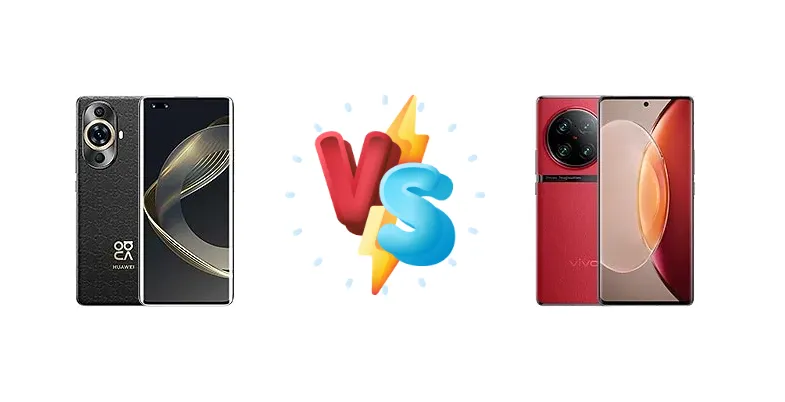
Huawei nova 11 Pro vs. vivo X90 Pro+: A Deep Dive into Performance and Value
| Phones Images | |||||
|---|---|---|---|---|---|
|
🏆 Quick Verdict
For most users, the vivo X90 Pro+ is the superior choice. Its Snapdragon 8 Gen 2 chipset provides significantly faster performance and better thermal management, justifying the higher price. However, the nova 11 Pro remains a compelling option for those prioritizing fast charging and a more budget-friendly entry into the flagship space.
| PHONES | ||
|---|---|---|
| Phone Names | Huawei nova 11 Pro | vivo X90 Pro+ |
| Network | ||
|---|---|---|
| 2G bands | GSM 850 / 900 / 1800 / 1900 | GSM 850 / 900 / 1800 / 1900 - SIM 1 & SIM 2 |
| 3G bands | HSDPA 800 / 850 / 900 / 1700(AWS) / 1900 / 2100 | HSDPA 800 / 850 / 900 / 1700(AWS) / 1900 / 2100 |
| 4G bands | 1, 2, 3, 4, 5, 7, 8, 12, 13, 17, 18, 19, 20, 26, 28, 38, 40, 41, 66 - International | 1, 2, 3, 4, 5, 7, 8, 12, 17, 18, 19, 20, 25, 26, 28, 34, 38, 39, 40, 41, 42, 66 |
| 5G bands | - | 1, 2, 3, 5, 7, 8, 12, 20, 28, 38, 40, 41, 66, 77, 78, 79 SA/NSA |
| Speed | HSPA, LTE | HSPA, LTE-A, 5G |
| Technology | GSM / CDMA / HSPA / CDMA2000 / LTE | GSM / CDMA / HSPA / EVDO / LTE / 5G |
| CDMA2000 1x | CDMA2000 1xEV-DO | |
| Launch | ||
|---|---|---|
| Announced | 2023, April 17 | 2022, November 22 |
| Status | Available. Released 2023, April 27 | Available. Released 2022, December 06 |
| Body | ||
|---|---|---|
| Build | Glass front, glass back or eco leather back | Glass front, aluminum frame, eco leather back |
| Dimensions | 164.3 x 74.4 x 7.9 mm (6.47 x 2.93 x 0.31 in) | 164.4 x 75.3 x 9.7 mm (6.47 x 2.96 x 0.38 in) |
| SIM | · Nano-SIM· Nano-SIM + Nano-SIM | Dual SIM (Nano-SIM, dual stand-by) |
| Weight | 188 g or 193 g (6.63 oz) | 221 g (7.80 oz) |
| - | IP68 dust/water resistant (up to 1.5m for 30 min) | |
| Display | ||
|---|---|---|
| Protection | Kunlun Glass | - |
| Resolution | 1200 x 2652 pixels (~429 ppi density) | 1440 x 3200 pixels, 20:9 ratio (~517 ppi density) |
| Size | 6.78 inches, 111.4 cm2 (~91.1% screen-to-body ratio) | 6.78 inches, 111.4 cm2 (~90.0% screen-to-body ratio) |
| Type | OLED, 1B colors, HDR10, 120Hz | LTPO4 AMOLED, 1B colors, 120Hz, Dolby Vision, HDR10+, 1800 nits (peak) |
| Platform | ||
|---|---|---|
| CPU | Octa-core (4x2.4 GHz Kryo 670 & 4x1.8 GHz Kryo 670) | Octa-core (1x3.2 GHz Cortex-X3 & 2x2.8 GHz Cortex-A715 & 2x2.8 GHz Cortex-A710 & 3x2.0 GHz Cortex-A510) |
| Chipset | Qualcomm SM7325 Snapdragon 778G 4G (6 nm) | Qualcomm SM8550-AB Snapdragon 8 Gen 2 (4 nm) |
| GPU | Adreno 642L | Adreno 740 |
| OS | HarmonyOS 3.0 | Android 13, Funtouch (Global), Origin OS 3 (China) |
| Memory | ||
|---|---|---|
| Card slot | No | No |
| Internal | 256GB 8GB RAM, 512GB 8GB RAM | 256GB 12GB RAM, 512GB 12GB RAM |
| - | UFS 4.0 | |
| Main Camera | ||
|---|---|---|
| Dual | 50 MP, f/1.9, (wide), PDAF 8 MP, f/2.2, 112˚ (ultrawide), AF | - |
| Features | Laser AF, color spectrum sensor, LED flash, panorama, HDR | Zeiss optics, Zeiss T* lens coating, Pixel Shift, dual-LED dual-tone flash, HDR, panorama |
| Quad | - | 50.3 MP, f/1.8, 23mm (wide), 1.0"-type, 1.6µm, Dual Pixel PDAF, Laser AF, OIS 64 MP, f/3.5, 90mm (periscope telephoto), 1/2.0", 0.7µm, PDAF, OIS, 3.5x optical zoom 50 MP, f/1.6, 50mm (telephoto), 1/2.4", 0.7µm, AF, 2x optical zoom, OIS 48 MP, f/2.2, 14mm, 114˚ (ultrawide), 1/2.0", 0.8µm, AF |
| Single | - | 32 MP, f/2.5, 24mm (wide), 1/2.8", 0.8µm |
| Video | 4K, 1080p, 720p@960fps, gyro-EIS | 8K@30fps, 4K@30/60fps, 1080p@30/60fps, gyro-EIS, 14-bit RAW video |
| Selfie camera | ||
|---|---|---|
| Dual | 8 MP, f/2.2, 52mm (telephoto), AF, 2x optical zoom 60 MP, f/2.4, 17mm, 100˚ (ultrawide), AF | - |
| Features | HDR | HDR |
| Single | - | 32 MP, f/2.5, 24mm (wide), 1/2.8", 0.8µm |
| Video | 4K@30fps, 1080p@30fps, gyro-EIS | 1080p@30/60fps |
| Sound | ||
|---|---|---|
| 3.5mm jack | No | No |
| 35mm jack | No | - |
| Loudspeaker | Yes, with stereo speakers | Yes, with stereo speakers |
| - | 32-bit/192kHz audio | |
| Comms | ||
|---|---|---|
| Bluetooth | 5.2, A2DP, LE | 5.3, A2DP, LE, aptX HD |
| Infrared port | - | Yes |
| NFC | Yes | Yes |
| Positioning | GPS (L1+L5), GLONASS (L1), BDS (B1I+B1c+B2a), GALILEO (E1+E5a), QZSS (L1+L5), NavIC | GPS (L1+L5), GLONASS, BDS, GALILEO, QZSS |
| Radio | No | No |
| USB | USB Type-C 2.0, OTG | USB Type-C 3.2, OTG |
| WLAN | Wi-Fi 802.11 a/b/g/n/a/6, dual-band, Wi-Fi Direct | Wi-Fi 802.11 a/b/g/n/ac/6, dual-band, Wi-Fi Direct |
| Features | ||
|---|---|---|
| Sensors | Fingerprint (under display, optical), accelerometer, gyro, compass | Fingerprint (under display, ultrasonic), accelerometer, gyro, proximity, compass, color spectrum |
| Virtual proximity sensing | - | |
| Battery | ||
|---|---|---|
| Charging | 100W wired, 50% in 15 min Reverse wired | 80W wired, 100% in 33 min (advertised) 50W wireless Reverse wired |
| Type | Li-Po 4500 mAh | Li-Po 4700 mAh, non-removable |
| Misc | ||
|---|---|---|
| Colors | Black, Green, White, Gold | Black, Red |
| Models | GOA-AL80, GOA-LX9 | V2227A |
| Price | About 500 EUR | About 1030 EUR |
Huawei nova 11 Pro
- Incredibly fast 100W wired charging
- Stylish design and build quality
- Competitive endurance rating
- Snapdragon 778G 4G chipset is less powerful
- 4G connectivity limits data speeds
- Display brightness is average for a flagship
vivo X90 Pro+
- Snapdragon 8 Gen 2 delivers flagship performance
- 50W wireless charging adds convenience
- Likely superior camera system
- Higher price point
- 80W wired charging is slower than nova 11 Pro
- Potential for thermal throttling under extreme load (though mitigated by 4nm process)
Display Comparison
The Huawei nova 11 Pro boasts a display capable of reaching 702 nits of peak brightness, which is respectable but falls short of the expected levels from a true flagship. While the X90 Pro+’s display specifications aren’t provided, vivo’s flagship history suggests a higher peak brightness and likely LTPO technology for adaptive refresh rates, resulting in improved power efficiency. The absence of refresh rate data for the nova 11 Pro is a key omission, potentially impacting smoothness during scrolling and gaming. Bezels are likely comparable, but color accuracy and calibration would need further testing to determine a clear winner.
Camera Comparison
Both devices are marketed with a focus on camera capabilities, but the specifics differ. The X90 Pro+ likely features a more advanced camera system, potentially including a larger main sensor and more sophisticated image processing algorithms. While the nova 11 Pro’s camera is capable, the X90 Pro+’s Snapdragon 8 Gen 2 ISP (Image Signal Processor) offers superior processing power for tasks like noise reduction and dynamic range optimization. Without detailed sensor information for the nova 11 Pro, it’s difficult to make a precise comparison, but the X90 Pro+’s chipset advantage suggests a clear edge in image quality and video recording.
Performance
The performance gap between these two devices is substantial. The vivo X90 Pro+’s Snapdragon 8 Gen 2 (4nm) is a generational leap over the nova 11 Pro’s Snapdragon 778G 4G (6nm). The 8 Gen 2’s octa-core configuration, featuring a Cortex-X3 prime core clocked at 3.2 GHz, delivers significantly faster CPU and GPU performance. The 4nm process node also contributes to improved thermal efficiency, meaning the X90 Pro+ is less likely to throttle under sustained load. The 778G 4G, while capable, is designed for the mid-range and will struggle with demanding games and multitasking compared to the X90 Pro+.
Battery Life
The Huawei nova 11 Pro’s endurance rating of 89 hours suggests good battery life, but this is heavily influenced by usage patterns. Its 100W wired charging is a standout feature, capable of charging to 50% in just 15 minutes. The vivo X90 Pro+ offers 80W wired charging, advertised to reach 100% in 33 minutes, and adds the convenience of 50W wireless charging. While the nova 11 Pro charges faster initially, the X90 Pro+’s wireless charging capability and potentially larger battery capacity (spec not provided) offer greater flexibility. The 4G limitation on the nova 11 Pro may also impact battery life due to increased power consumption for maintaining a cellular connection.
Buying Guide
Buy the Huawei nova 11 Pro if you need a stylish phone with incredibly fast 100W charging and are willing to compromise on raw processing power. It’s ideal for social media enthusiasts and everyday users. Buy the vivo X90 Pro+ if you prioritize top-tier performance for gaming and demanding applications, coupled with a potentially superior camera system, and don't mind paying a premium for it.