
Huawei Nova 11 Pro vs Samsung Galaxy A54: The Ultimate Showdown
| Phones Images | |||||
|---|---|---|---|---|---|
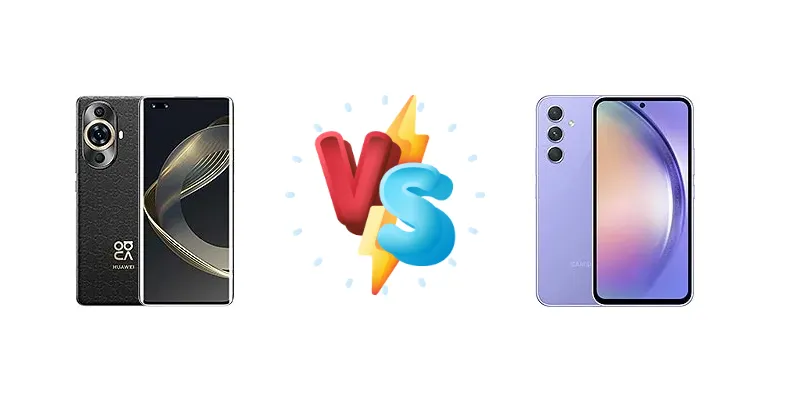
|
🏆 Quick Verdict
The Samsung Galaxy A54 takes the crown overall, thanks to its superior display brightness, significantly faster charging, and longer active battery life. While the Nova 11 Pro boasts impressive endurance ratings and a sleek design, the A54's more well-rounded performance and Samsung's software ecosystem give it the edge.
| PHONES | ||
|---|---|---|
| Phone Names | Huawei nova 11 Pro | Samsung Galaxy A54 |
| Network | ||
|---|---|---|
| 2G bands | GSM 850 / 900 / 1800 / 1900 | GSM 850 / 900 / 1800 / 1900 |
| 3G bands | HSDPA 800 / 850 / 900 / 1700(AWS) / 1900 / 2100 | HSDPA 850 / 900 / 1700(AWS) / 1900 / 2100 |
| 4G bands | 1, 2, 3, 4, 5, 7, 8, 12, 13, 17, 18, 19, 20, 26, 28, 38, 40, 41, 66 - International | 1, 2, 3, 4, 5, 7, 8, 12, 17, 20, 26, 28, 32, 38, 40, 41, 66 - International |
| 5G bands | - | 1, 3, 7, 8, 20, 28, 38, 40, 41, 77, 78 SA/NSA/Sub6 - International |
| Speed | HSPA, LTE | HSPA, LTE, 5G |
| Technology | GSM / CDMA / HSPA / CDMA2000 / LTE | GSM / HSPA / LTE / 5G |
| CDMA2000 1x | 25, 41, 66, 71 SA/NSA/Sub6/mmWave - USA | |
| Launch | ||
|---|---|---|
| Announced | 2023, April 17 | 2023, March 15 |
| Status | Available. Released 2023, April 27 | Available. Released 2023, March 24 |
| Body | ||
|---|---|---|
| Build | Glass front, glass back or eco leather back | Glass front (Gorilla Glass 5), glass back (Gorilla Glass 5), plastic frame |
| Dimensions | 164.3 x 74.4 x 7.9 mm (6.47 x 2.93 x 0.31 in) | 158.2 x 76.7 x 8.2 mm (6.23 x 3.02 x 0.32 in) |
| SIM | · Nano-SIM· Nano-SIM + Nano-SIM | · Nano-SIM + eSIM· Nano-SIM + Nano-SIM |
| Weight | 188 g or 193 g (6.63 oz) | 202 g (7.13 oz) |
| - | IP67 dust/water resistant (up to 1m for 30 min) | |
| Display | ||
|---|---|---|
| Protection | Kunlun Glass | Corning Gorilla Glass 5 |
| Resolution | 1200 x 2652 pixels (~429 ppi density) | 1080 x 2340 pixels, 19.5:9 ratio (~403 ppi density) |
| Size | 6.78 inches, 111.4 cm2 (~91.1% screen-to-body ratio) | 6.4 inches, 100.5 cm2 (~82.9% screen-to-body ratio) |
| Type | OLED, 1B colors, HDR10, 120Hz | Super AMOLED, 120Hz, HDR10+, 1000 nits (HBM) |
| Platform | ||
|---|---|---|
| CPU | Octa-core (4x2.4 GHz Kryo 670 & 4x1.8 GHz Kryo 670) | Octa-core (4x2.4 GHz Cortex-A78 & 4x2.0 GHz Cortex-A55) |
| Chipset | Qualcomm SM7325 Snapdragon 778G 4G (6 nm) | Exynos 1380 (5 nm) |
| GPU | Adreno 642L | Mali-G68 MP5 |
| OS | HarmonyOS 3.0 | Android 13, up to 4 major Android upgrades, One UI 7 |
| Memory | ||
|---|---|---|
| Card slot | No | microSDXC (uses shared SIM slot) |
| Internal | 256GB 8GB RAM, 512GB 8GB RAM | 128GB 4GB RAM, 128GB 6GB RAM, 128GB 8GB RAM, 256GB 6GB RAM, 256GB 8GB RAM |
| Main Camera | ||
|---|---|---|
| Dual | 50 MP, f/1.9, (wide), PDAF 8 MP, f/2.2, 112˚ (ultrawide), AF | - |
| Features | Laser AF, color spectrum sensor, LED flash, panorama, HDR | LED flash, panorama, HDR |
| Single | - | 32 MP, f/2.2, 26mm (wide), 1/2.8", 0.8µm |
| Triple | - | 50 MP, f/1.8, 23mm (wide), 1/1.56", 1.0µm, PDAF, OIS 12 MP, f/2.2, 13mm, 123˚ (ultrawide), 1/3.X", 1.12µm 5 MP (macro) |
| Video | 4K, 1080p, 720p@960fps, gyro-EIS | 4K@30fps, 1080p@30/60fps, 720p@480fps, gyro-EIS |
| Selfie camera | ||
|---|---|---|
| Dual | 8 MP, f/2.2, 52mm (telephoto), AF, 2x optical zoom 60 MP, f/2.4, 17mm, 100˚ (ultrawide), AF | - |
| Features | HDR | - |
| Single | - | 32 MP, f/2.2, 26mm (wide), 1/2.8", 0.8µm |
| Video | 4K@30fps, 1080p@30fps, gyro-EIS | 4K@30fps, 1080p@30/60fps |
| Sound | ||
|---|---|---|
| 3.5mm jack | No | No |
| 35mm jack | No | No |
| Loudspeaker | Yes, with stereo speakers | Yes, with stereo speakers |
| Comms | ||
|---|---|---|
| Bluetooth | 5.2, A2DP, LE | 5.3, A2DP, LE |
| NFC | Yes | Yes (market/region dependent) |
| Positioning | GPS (L1+L5), GLONASS (L1), BDS (B1I+B1c+B2a), GALILEO (E1+E5a), QZSS (L1+L5), NavIC | GPS, GLONASS, GALILEO, BDS |
| Radio | No | No |
| USB | USB Type-C 2.0, OTG | USB Type-C 2.0, OTG |
| WLAN | Wi-Fi 802.11 a/b/g/n/a/6, dual-band, Wi-Fi Direct | Wi-Fi 802.11 a/b/g/n/ac/6, dual-band, Wi-Fi Direct |
| Features | ||
|---|---|---|
| Sensors | Fingerprint (under display, optical), accelerometer, gyro, compass | Fingerprint (under display, optical), accelerometer, gyro, compass, barometer (USA only) |
| Virtual proximity sensing | Virtual proximity sensing | |
| Battery | ||
|---|---|---|
| Charging | 100W wired, 50% in 15 min Reverse wired | 25W wired |
| Type | Li-Po 4500 mAh | 5000 mAh |
| Misc | ||
|---|---|---|
| Colors | Black, Green, White, Gold | Lime, Graphite, Violet, White |
| Models | GOA-AL80, GOA-LX9 | SM-A546V, SM-A546U, SM-A546U1, SM-A546B, SM-A546B/DS, SM-A546E, SM-A546E/DS, SM-A5460, SM-A546M, SM-A546M/DS, SM-A546W |
| Price | About 500 EUR | € 210.00 / $ 119.11 / £ 169.95 / ₹ 28,999 |
| SAR | - | 0.81 W/kg (head) 0.67 W/kg (body) |
| SAR EU | - | 0.69 W/kg (head) 1.34 W/kg (body) |
| Tests | ||
|---|---|---|
| Battery life | - | Endurance rating 119h |
| Camera | - | Photo / Video |
| Display | - | Contrast ratio: Infinite (nominal) |
| Loudspeaker | - | -26.6 LUFS (Good) |
| Performance | - | AnTuTu: 506678 (v9) GeekBench: 2703 (v5.1), 2797 (v6) GFXBench: 25fps (ES 3.1 onscreen) |
Huawei nova 11 Pro
- Stunning Design
- Impressive Standby Battery Life (89h endurance)
- 100W Fast Charging
- Vibrant Display
- Slower Charging than A54
- Potentially Limited Software Support
- Snapdragon 778G 4G (not 5G)
Samsung Galaxy A54
- Brighter Display (980 nits)
- Better Active Battery Life (11:15h)
- Faster Performance (Exynos 1380)
- Samsung's Software Ecosystem
- More Versatile Camera System (likely)
- Slower Charging (25W)
- Design Less Distinctive than Nova 11 Pro
Display Comparison
The Samsung Galaxy A54's display shines with a measured peak brightness of 980 nits, significantly outperforming the Nova 11 Pro's 702 nits. This translates to better visibility in direct sunlight. The A54 also boasts an 'infinite' contrast ratio, though this is a nominal value, suggesting excellent black levels. Both offer vibrant colors, but the A54's brightness is a clear advantage.
Camera Comparison
Both phones offer capable camera systems, but the Galaxy A54 likely has a more versatile setup. While specific camera specs are not fully detailed, Samsung's image processing is generally well-regarded. The Nova 11 Pro's camera is likely strong, but the A54's software and potentially better hardware give it a slight advantage in various lighting conditions and shooting scenarios.
Performance
The Snapdragon 778G 4G in the Nova 11 Pro is a capable chipset, but the Exynos 1380 in the Galaxy A54 generally offers slightly better overall performance, particularly in graphics-intensive tasks. Both phones handle everyday tasks smoothly, but the A54's newer architecture and slightly higher clock speeds give it a small edge. Real-world performance will depend on software optimization.
Battery Life
The Galaxy A54 demonstrates superior battery performance in active use, scoring 11:15h. While the Nova 11 Pro boasts an impressive endurance rating of 89h (standby), active usage is where the A54 truly shines. The Nova 11 Pro's 100W wired charging is a significant advantage, allowing for incredibly fast top-ups, while the A54's 25W charging is considerably slower.
Buying Guide
The Huawei Nova 11 Pro is ideal for users prioritizing design, a vibrant display, and extremely long standby battery life. The Samsung Galaxy A54 is a better choice for those who value a brighter screen, faster charging, a more established software experience, and a generally more versatile camera system.