
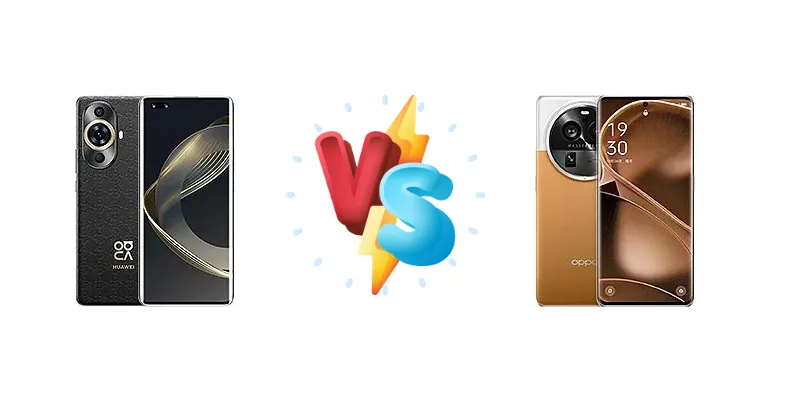
Huawei nova 11 Pro vs Oppo Find X6 Pro: A Detailed Comparison
| Phones Images | |||||
|---|---|---|---|---|---|
|
🏆 Quick Verdict
For most users, the Oppo Find X6 Pro is the superior choice. Its Snapdragon 8 Gen 2 chipset delivers significantly faster performance and better thermal management, complemented by a brighter, higher-quality display and faster charging speeds. While the nova 11 Pro offers a compelling value, the Find X6 Pro’s overall experience justifies the price premium.
| PHONES | ||
|---|---|---|
| Phone Names | Huawei nova 11 Pro | Oppo Find X6 Pro |
| Network | ||
|---|---|---|
| 2G bands | GSM 850 / 900 / 1800 / 1900 | GSM 850 / 900 / 1800 / 1900 |
| 3G bands | HSDPA 800 / 850 / 900 / 1700(AWS) / 1900 / 2100 | HSDPA 800 / 850 / 900 / 1700(AWS) / 1900 / 2100 |
| 4G bands | 1, 2, 3, 4, 5, 7, 8, 12, 13, 17, 18, 19, 20, 26, 28, 38, 40, 41, 66 - International | 1, 2, 3, 4, 5, 7, 8, 12, 17, 18, 19, 20, 26, 28, 34, 38, 39, 40, 41, 66 |
| 5G bands | - | 1, 3, 5, 7, 8, 20, 28, 38, 40, 41, 66, 77, 78, 79 SA/NSA |
| Speed | HSPA, LTE | HSPA, LTE, 5G |
| Technology | GSM / CDMA / HSPA / CDMA2000 / LTE | GSM / CDMA / HSPA / CDMA2000 / LTE / 5G |
| CDMA2000 1x | CDMA2000 1x | |
| Launch | ||
|---|---|---|
| Announced | 2023, April 17 | 2023, March 21 |
| Status | Available. Released 2023, April 27 | Available. Released 2023, March 24 |
| Body | ||
|---|---|---|
| Build | Glass front, glass back or eco leather back | Glass front (Gorilla Glass Victus 2), glass back (Gorilla Glass 5) or eco leather back, aluminum frame |
| Dimensions | 164.3 x 74.4 x 7.9 mm (6.47 x 2.93 x 0.31 in) | 164.8 x 76.2 x 9.1 mm or 9.5 mm |
| SIM | · Nano-SIM· Nano-SIM + Nano-SIM | Nano-SIM + Nano-SIM |
| Weight | 188 g or 193 g (6.63 oz) | 216 g or 218 g (7.62 oz) |
| - | IP68 dust/water resistant (up to 1.5m for 30 min) | |
| Display | ||
|---|---|---|
| Protection | Kunlun Glass | Corning Gorilla Glass Victus 2 |
| Resolution | 1200 x 2652 pixels (~429 ppi density) | 1440 x 3168 pixels (~510 ppi density) |
| Size | 6.78 inches, 111.4 cm2 (~91.1% screen-to-body ratio) | 6.82 inches, 113.0 cm2 (~90.0% screen-to-body ratio) |
| Type | OLED, 1B colors, HDR10, 120Hz | LTPO3 AMOLED, 1B colors, 120Hz, Dolby Vision, HDR10+, 800 nits (typ), 1500 nits (HBM), 2500 nits (peak) |
| Platform | ||
|---|---|---|
| CPU | Octa-core (4x2.4 GHz Kryo 670 & 4x1.8 GHz Kryo 670) | Octa-core (1x3.2 GHz Cortex-X3 & 2x2.8 GHz Cortex-A715 & 2x2.8 GHz Cortex-A710 & 3x2.0 GHz Cortex-A510) |
| Chipset | Qualcomm SM7325 Snapdragon 778G 4G (6 nm) | Qualcomm SM8550-AB Snapdragon 8 Gen 2 (4 nm) |
| GPU | Adreno 642L | Adreno 740 |
| OS | HarmonyOS 3.0 | Android 13, up to 4 major Android upgrades, ColorOS 14 |
| Memory | ||
|---|---|---|
| Card slot | No | No |
| Internal | 256GB 8GB RAM, 512GB 8GB RAM | 256GB 12GB RAM, 256GB 16GB RAM, 512GB 16GB RAM |
| - | UFS 4.0 | |
| Main Camera | ||
|---|---|---|
| Dual | 50 MP, f/1.9, (wide), PDAF 8 MP, f/2.2, 112˚ (ultrawide), AF | - |
| Features | Laser AF, color spectrum sensor, LED flash, panorama, HDR | Laser AF, color spectrum sensor, Hasselblad Color Calibration, LED flash, HDR, panorama |
| Triple | - | 50 MP, f/1.8, 23mm (wide), 1.0"-type, 1.6µm, dual pixel PDAF, OIS 50 MP, f/2.6, 65mm (periscope telephoto), 1/1.56", 1.0µm, 2.8x optical zoom, multi-directional PDAF, OIS 50 MP, f/2.2, 15mm, 110˚ (ultrawide), 1/1.56", 1.0µm, multi-directional PDAF |
| Video | 4K, 1080p, 720p@960fps, gyro-EIS | 4K@30/60fps, 1080p@30/60/240fps; gyro-EIS; HDR, 10‑bit video, Dolby Vision |
| Selfie camera | ||
|---|---|---|
| Dual | 8 MP, f/2.2, 52mm (telephoto), AF, 2x optical zoom 60 MP, f/2.4, 17mm, 100˚ (ultrawide), AF | - |
| Features | HDR | Panorama |
| Single | - | 32 MP, f/2.4, 21mm (wide), 1/2.74", 0.8µm, PDAF |
| Video | 4K@30fps, 1080p@30fps, gyro-EIS | 4K@30fps, gyro-EIS |
| Sound | ||
|---|---|---|
| 3.5mm jack | No | No |
| 35mm jack | No | No |
| Loudspeaker | Yes, with stereo speakers | Yes, with stereo speakers |
| Comms | ||
|---|---|---|
| Bluetooth | 5.2, A2DP, LE | 5.3, A2DP, LE, aptX HD |
| Infrared port | - | Yes |
| NFC | Yes | Yes |
| Positioning | GPS (L1+L5), GLONASS (L1), BDS (B1I+B1c+B2a), GALILEO (E1+E5a), QZSS (L1+L5), NavIC | GPS (L1+L5), GLONASS (G1), BDS (B1I+B1c+B2a), GALILEO (E1+E5a), QZSS (L1+L5) |
| Radio | No | No |
| USB | USB Type-C 2.0, OTG | USB Type-C 3.1, OTG |
| WLAN | Wi-Fi 802.11 a/b/g/n/a/6, dual-band, Wi-Fi Direct | Wi-Fi 802.11 a/b/g/n/ac/6e/7, tri-band, Wi-Fi Direct |
| Features | ||
|---|---|---|
| Sensors | Fingerprint (under display, optical), accelerometer, gyro, compass | Fingerprint (under display, optical), accelerometer, gyro, proximity, compass |
| Virtual proximity sensing | - | |
| Battery | ||
|---|---|---|
| Charging | 100W wired, 50% in 15 min Reverse wired | 100W wired, PD, 45% in 10 min, 100% in 30 min 50W wireless, 50% in 22 min, 100% in 51 min 10W reverse wireless |
| Type | Li-Po 4500 mAh | Li-Po 5000 mAh |
| Misc | ||
|---|---|---|
| Colors | Black, Green, White, Gold | Black, Green, Brown |
| Models | GOA-AL80, GOA-LX9 | PGEM110, PGEM10 |
| Price | About 500 EUR | About 820 EUR |
| Tests | ||
|---|---|---|
| Battery life | - | Endurance rating 114h |
| Camera | - | Photo / Video |
| Display | - | Contrast ratio: Infinite (nominal) |
| Loudspeaker | - | -25.1 LUFS (Very good) |
| Performance | - | AnTuTu: 1294797 (v9) GeekBench: 4791 (v5.1), 5226 (v6) GFXBench: 60fps (ES 3.1 onscreen) |
Huawei nova 11 Pro
- Stylish and eye-catching design
- Fast 100W wired charging
- Competitive price point
- Less powerful Snapdragon 778G chipset
- Lower display brightness
- Shorter battery life
Oppo Find X6 Pro
- Flagship Snapdragon 8 Gen 2 performance
- Significantly brighter and more advanced display
- Faster charging (wired and wireless)
- Superior camera system
- Higher price tag
- Larger and heavier build
Display Comparison
The Oppo Find X6 Pro’s display is a clear winner, boasting a measured peak brightness of 1318 nits compared to the nova 11 Pro’s 702 nits. This translates to significantly better visibility outdoors under direct sunlight. While both displays offer excellent color reproduction, the Find X6 Pro’s likely utilizes LTPO technology (based on Oppo’s flagship history) for adaptive refresh rates, improving battery efficiency. The infinite contrast ratio of the Find X6 Pro, while a nominal specification, suggests deeper blacks and a more immersive viewing experience.
Camera Comparison
Both phones feature capable camera systems, but the Oppo Find X6 Pro is expected to have a more advanced setup. While both are listed as capable of Photo/Video, the Find X6 Pro’s flagship status suggests a larger main sensor, more sophisticated image processing algorithms, and potentially better low-light performance. The nova 11 Pro likely focuses on a balance of features, while the Find X6 Pro prioritizes image quality and versatility. Ignoring the likely inclusion of low-resolution auxiliary lenses on both devices, the core imaging experience will be superior on the Oppo.
Performance
The performance gap between these devices is substantial. The Oppo Find X6 Pro’s Snapdragon 8 Gen 2 (4nm) is a generational leap ahead of the Huawei nova 11 Pro’s Snapdragon 778G 4G (6nm). The 8 Gen 2’s Cortex-X3 prime core, coupled with its more efficient 4nm process, delivers significantly faster CPU and GPU performance. This difference is particularly noticeable in demanding tasks like gaming and video editing. The 778G is capable, but will exhibit more throttling under sustained load. Furthermore, the Find X6 Pro benefits from faster LPDDR5x RAM, further enhancing responsiveness.
Battery Life
The Oppo Find X6 Pro offers a more robust battery experience, achieving an endurance rating of 114 hours versus the nova 11 Pro’s 89 hours. While the nova 11 Pro’s 100W charging is impressive (50% in 15 minutes), the Find X6 Pro’s 100W wired charging (45% in 10 minutes, 100% in 30 minutes) is faster. The addition of 50W wireless charging on the Find X6 Pro, and 10W reverse wireless charging, provides greater flexibility. The larger battery capacity and more efficient chipset of the Find X6 Pro contribute to its longer endurance.
Buying Guide
Buy the Huawei nova 11 Pro if you prioritize a stylish design, fast 100W charging, and a smooth user experience for everyday tasks and light gaming, all while staying within a tighter budget. Buy the Oppo Find X6 Pro if you demand uncompromising performance for demanding games and applications, a best-in-class camera system, and a display that excels in all lighting conditions, and are willing to invest in a premium flagship.