
Huawei nova 11 Pro vs Google Pixel 7 Pro: A Detailed Comparison
| Phones Images | |||||
|---|---|---|---|---|---|
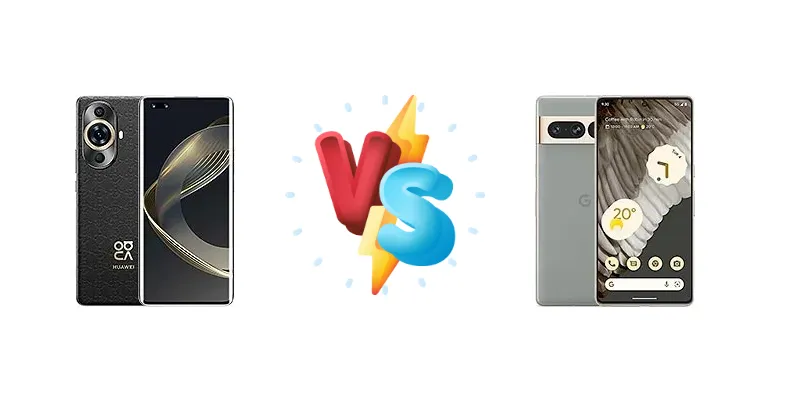
|
🏆 Quick Verdict
For the average user prioritizing camera versatility and software support, the Google Pixel 7 Pro is the stronger choice. However, the Huawei nova 11 Pro’s blazing-fast 100W charging and competitive price point make it a compelling option for those who value speed and efficiency above all else.
| PHONES | ||
|---|---|---|
| Phone Names | Huawei nova 11 Pro | Google Pixel 7 Pro |
| Network | ||
|---|---|---|
| 2G bands | GSM 850 / 900 / 1800 / 1900 | GSM 850 / 900 / 1800 / 1900 |
| 3G bands | HSDPA 800 / 850 / 900 / 1700(AWS) / 1900 / 2100 | HSDPA 800 / 850 / 900 / 1700(AWS) / 1900 / 2100 |
| 4G bands | 1, 2, 3, 4, 5, 7, 8, 12, 13, 17, 18, 19, 20, 26, 28, 38, 40, 41, 66 - International | 1, 2, 3, 4, 5, 7, 8, 12, 13, 14, 17, 18, 19, 20, 25, 26, 28, 29, 30, 38, 39, 40, 41, 42, 46, 48, 66, 71 - GE2AE |
| 5G bands | - | 1, 2, 3, 5, 7, 8, 12, 14, 20, 25, 28, 30, 38, 40, 41, 48, 66, 71, 77, 78, 257, 258, 260, 261 SA/NSA/Sub6/mmWave - GE2AE |
| Speed | HSPA, LTE | HSPA, LTE, 5G |
| Technology | GSM / CDMA / HSPA / CDMA2000 / LTE | GSM / CDMA / HSPA / EVDO / LTE / 5G |
| CDMA2000 1x | 1, 2, 3, 5, 7, 8, 12, 14, 20, 25, 28, 30, 38, 40, 41, 48, 66, 71, 75, 76, 77, 78 SA/NSA/Sub6 - GP4BC | |
| Launch | ||
|---|---|---|
| Announced | 2023, April 17 | 2022, October 06 |
| Status | Available. Released 2023, April 27 | Available. Released 2022, October 13 |
| Body | ||
|---|---|---|
| Build | Glass front, glass back or eco leather back | Glass front (Gorilla Glass Victus), glass back (Gorilla Glass Victus), aluminum frame |
| Dimensions | 164.3 x 74.4 x 7.9 mm (6.47 x 2.93 x 0.31 in) | 162.9 x 76.6 x 8.9 mm (6.41 x 3.02 x 0.35 in) |
| SIM | · Nano-SIM· Nano-SIM + Nano-SIM | Nano-SIM + eSIM |
| Weight | 188 g or 193 g (6.63 oz) | 212 g (7.48 oz) |
| - | IP68 dust/water resistant (up to 1.5m for 30 min) | |
| Display | ||
|---|---|---|
| Protection | Kunlun Glass | Corning Gorilla Glass Victus |
| Resolution | 1200 x 2652 pixels (~429 ppi density) | 1440 x 3120 pixels, 19.5:9 ratio (~512 ppi density) |
| Size | 6.78 inches, 111.4 cm2 (~91.1% screen-to-body ratio) | 6.7 inches, 110.6 cm2 (~88.7% screen-to-body ratio) |
| Type | OLED, 1B colors, HDR10, 120Hz | LTPO AMOLED, 120Hz, HDR10+, 1000 nits (HBM), 1500 nits (peak) |
| - | Always-on display | |
| Platform | ||
|---|---|---|
| CPU | Octa-core (4x2.4 GHz Kryo 670 & 4x1.8 GHz Kryo 670) | Octa-core (2x2.85 GHz Cortex-X1 & 2x2.35 GHz Cortex-A78 & 4x1.80 GHz Cortex-A55) |
| Chipset | Qualcomm SM7325 Snapdragon 778G 4G (6 nm) | Google Tensor G2 (5 nm) |
| GPU | Adreno 642L | Mali-G710 MP7 |
| OS | HarmonyOS 3.0 | Android 13, upgradable to Android 15, up to 5 major Android upgrades |
| Memory | ||
|---|---|---|
| Card slot | No | No |
| Internal | 256GB 8GB RAM, 512GB 8GB RAM | 128GB 8GB RAM, 256GB 8GB RAM, 128GB 12GB RAM, 256GB 12GB RAM, 512GB 12GB RAM |
| - | UFS 3.1 | |
| Main Camera | ||
|---|---|---|
| Dual | 50 MP, f/1.9, (wide), PDAF 8 MP, f/2.2, 112˚ (ultrawide), AF | - |
| Features | Laser AF, color spectrum sensor, LED flash, panorama, HDR | Laser AF, Dual-LED flash, Pixel Shift, Auto-HDR, panorama |
| Single | - | 10.8 MP, f/2.2, 21mm (ultrawide), 1/3.1", 1.22µm |
| Triple | - | 50 MP, f/1.9, 25mm (wide), 1/1.31", 1.2µm, dual pixel PDAF, OIS 48 MP, f/3.5, 120mm (periscope telephoto), 1/2.55", 0.7µm, dual pixel PDAF, OIS, 5x optical zoom 12 MP, f/2.2, 126˚ (ultrawide), 1/2.9", 1.25µm, AF |
| Video | 4K, 1080p, 720p@960fps, gyro-EIS | 4K@30/60fps, 1080p@30/60/120/240fps; gyro-EIS, OIS, 10-bit HDR |
| Selfie camera | ||
|---|---|---|
| Dual | 8 MP, f/2.2, 52mm (telephoto), AF, 2x optical zoom 60 MP, f/2.4, 17mm, 100˚ (ultrawide), AF | - |
| Features | HDR | HDR, panorama |
| Single | - | 10.8 MP, f/2.2, 21mm (ultrawide), 1/3.1", 1.22µm |
| Video | 4K@30fps, 1080p@30fps, gyro-EIS | 4K@30/60fps, 1080p@30/60fps |
| Sound | ||
|---|---|---|
| 3.5mm jack | No | No |
| 35mm jack | No | No |
| Loudspeaker | Yes, with stereo speakers | Yes, with stereo speakers |
| Comms | ||
|---|---|---|
| Bluetooth | 5.2, A2DP, LE | 5.2, A2DP, LE, aptX HD |
| NFC | Yes | Yes |
| Positioning | GPS (L1+L5), GLONASS (L1), BDS (B1I+B1c+B2a), GALILEO (E1+E5a), QZSS (L1+L5), NavIC | GPS (L1+L5), GLONASS (G1), BDS (B1I+B1c+B2a), GALILEO (E1+E5a), QZSS (L1+L5) |
| Radio | No | No |
| USB | USB Type-C 2.0, OTG | USB Type-C 3.2 |
| WLAN | Wi-Fi 802.11 a/b/g/n/a/6, dual-band, Wi-Fi Direct | Wi-Fi 802.11 a/b/g/n/ac/6e, tri-band, Wi-Fi Direct |
| Features | ||
|---|---|---|
| Sensors | Fingerprint (under display, optical), accelerometer, gyro, compass | Fingerprint (under display, optical), accelerometer, gyro, proximity, compass, barometer |
| Virtual proximity sensing | Ultra Wideband (UWB) support | |
| Battery | ||
|---|---|---|
| Charging | 100W wired, 50% in 15 min Reverse wired | 23W wired, PD3.0, 50% in 30 min 23W wireless Reverse wireless |
| Type | Li-Po 4500 mAh | Li-Ion 5000 mAh |
| Misc | ||
|---|---|---|
| Colors | Black, Green, White, Gold | Obsidian, Snow, Hazel |
| Models | GOA-AL80, GOA-LX9 | GP4BC, GE2AE, GFE4J |
| Price | About 500 EUR | € 248.84 / $ 204.00 / £ 259.99 / ₹ 36,999 |
| Tests | ||
|---|---|---|
| Battery life | - | Endurance rating 83h |
| Camera | - | Photo / Video |
| Display | - | Contrast ratio: Infinite (nominal) |
| Loudspeaker | - | -24.8 LUFS (Very good) |
| Performance | - | AnTuTu: 796369 (v9) GeekBench: 3187 (v5.1) GFXBench: 34fps (ES 3.1 onscreen) |
Huawei nova 11 Pro
- Incredibly fast 100W charging
- Stylish and eye-catching design
- Competitive price point
- Limited to 4G connectivity
- Less powerful processor compared to the Pixel 7 Pro
- Software support may be limited
Google Pixel 7 Pro
- Exceptional camera quality with Google’s image processing
- Powerful Google Tensor G2 chip
- Bright and vibrant display
- Slower charging speed (23W)
- Higher price tag
- Larger and heavier design
Display Comparison
The Pixel 7 Pro boasts a significantly brighter display, reaching 1090 nits compared to the nova 11 Pro’s 702 nits. This translates to superior visibility in direct sunlight. While both feature vibrant panels, the Pixel 7 Pro’s infinite (nominal) contrast ratio likely delivers deeper blacks and a more immersive viewing experience. The nova 11 Pro’s display specifications don’t indicate LTPO technology, suggesting a fixed refresh rate, while the Pixel 7 Pro likely utilizes a variable refresh rate for improved efficiency.
Camera Comparison
Both phones offer capable photo and video recording, but the Pixel 7 Pro leverages Google’s renowned computational photography expertise. While sensor sizes aren’t specified, the Pixel 7 Pro’s image processing algorithms excel in dynamic range and low-light performance. The nova 11 Pro’s camera system likely focuses on delivering vibrant, social media-ready images, but may lack the nuanced detail and consistency of the Pixel 7 Pro. The absence of detailed camera specs for the nova 11 Pro makes a direct sensor comparison difficult, but Google’s software advantage is substantial.
Performance
The Google Pixel 7 Pro’s Google Tensor G2, fabricated on a 5nm process, offers a clear architectural advantage over the Huawei nova 11 Pro’s 6nm Snapdragon 778G 4G. The Tensor G2’s tri-cluster configuration, featuring Cortex-X1 cores, prioritizes AI and machine learning tasks, enhancing features like voice recognition and image processing. While the Snapdragon 778G is a capable mid-range chip, the Tensor G2 provides a more responsive and future-proof experience, particularly for demanding applications. The 4G limitation on the nova 11 Pro is a significant drawback for users in areas with 5G coverage.
Battery Life
Despite a slightly lower endurance rating (83h vs 89h), the Pixel 7 Pro’s 23W charging is significantly slower than the nova 11 Pro’s 100W wired charging. The nova 11 Pro can reach 50% charge in just 15 minutes, while the Pixel 7 Pro takes 30 minutes. The Pixel 7 Pro does offer 23W wireless charging and reverse wireless charging, features absent on the nova 11 Pro. However, the sheer speed of the nova 11 Pro’s wired charging is a game-changer for users who prioritize minimizing downtime.
Buying Guide
Buy the Huawei nova 11 Pro if you need exceptionally fast charging – reaching 50% in just 15 minutes – and a visually striking design. It’s ideal for users who frequently top up their phones and don’t rely heavily on Google’s ecosystem. Buy the Google Pixel 7 Pro if you prefer a best-in-class camera experience powered by Google’s Tensor G2 chip, seamless software updates, and a brighter, more vibrant display. It’s the better choice for photography enthusiasts and those deeply integrated into the Google ecosystem.