
Huawei nova 11 Pro vs. iPhone 14 Plus: A Deep Dive into Value and Performance
| Phones Images | |||||
|---|---|---|---|---|---|
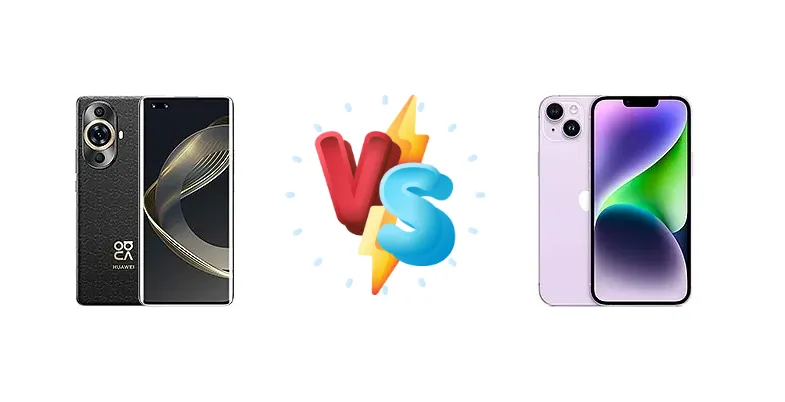
|
🏆 Quick Verdict
For the average user prioritizing long-term software support, ecosystem integration, and consistently strong performance, the iPhone 14 Plus is the better choice. However, the Huawei nova 11 Pro offers a compelling alternative with its blazing-fast 100W charging and respectable performance for a significantly lower price.
| PHONES | ||
|---|---|---|
| Phone Names | Huawei nova 11 Pro | Apple iPhone 14 Plus |
| Network | ||
|---|---|---|
| 2G bands | GSM 850 / 900 / 1800 / 1900 | GSM 850 / 900 / 1800 / 1900 |
| 3G bands | HSDPA 800 / 850 / 900 / 1700(AWS) / 1900 / 2100 | HSDPA 850 / 900 / 1700(AWS) / 1900 / 2100 |
| 4G bands | 1, 2, 3, 4, 5, 7, 8, 12, 13, 17, 18, 19, 20, 26, 28, 38, 40, 41, 66 - International | 1, 2, 3, 4, 5, 7, 8, 12, 13, 17, 18, 19, 20, 25, 26, 28, 30, 32, 34, 38, 39, 40, 41, 42, 46, 48, 66 - A2886, A2888 |
| 5G bands | - | 1, 2, 3, 5, 7, 8, 12, 20, 25, 26, 28, 30, 38, 40, 41, 48, 66, 70, 77, 78, 79 SA/NSA/Sub6 - A2886, A2888 |
| Speed | HSPA, LTE | HSPA, LTE, 5G, EV-DO Rev.A 3.1 Mbps |
| Technology | GSM / CDMA / HSPA / CDMA2000 / LTE | GSM / CDMA / HSPA / EVDO / LTE / 5G |
| CDMA2000 1x | 1, 2, 3, 5, 7, 8, 12, 20, 25, 26, 28, 30, 38, 40, 41, 48, 66, 70, 77, 78, 79 SA/NSA/Sub6 - A2887 | |
| Launch | ||
|---|---|---|
| Announced | 2023, April 17 | 2022, September 07 |
| Status | Available. Released 2023, April 27 | Available. Released 2022, October 07 |
| Body | ||
|---|---|---|
| Build | Glass front, glass back or eco leather back | Glass front, glass back, aluminum frame |
| Dimensions | 164.3 x 74.4 x 7.9 mm (6.47 x 2.93 x 0.31 in) | 160.8 x 78.1 x 7.8 mm (6.33 x 3.07 x 0.31 in) |
| SIM | · Nano-SIM· Nano-SIM + Nano-SIM | · Nano-SIM + eSIM + eSIM (max 2 at a time; International)· eSIM + eSIM (8 or more, max 2 at a time; USA)· Nano-SIM + Nano-SIM (China) |
| Weight | 188 g or 193 g (6.63 oz) | 203 g (7.16 oz) |
| - | IP68 dust/water resistant (up to 6m for 30 min) Apple Pay (Visa, MasterCard, AMEX certified) | |
| Display | ||
|---|---|---|
| Protection | Kunlun Glass | Ceramic Shield glass |
| Resolution | 1200 x 2652 pixels (~429 ppi density) | 1284 x 2778 pixels, 19.5:9 ratio (~458 ppi density) |
| Size | 6.78 inches, 111.4 cm2 (~91.1% screen-to-body ratio) | 6.7 inches, 109.8 cm2 (~87.4% screen-to-body ratio) |
| Type | OLED, 1B colors, HDR10, 120Hz | Super Retina XDR OLED, HDR10, Dolby Vision, 800 nits (HBM), 1200 nits (peak) |
| Platform | ||
|---|---|---|
| CPU | Octa-core (4x2.4 GHz Kryo 670 & 4x1.8 GHz Kryo 670) | Hexa-core (2x3.23 GHz Avalanche + 4x1.82 GHz Blizzard) |
| Chipset | Qualcomm SM7325 Snapdragon 778G 4G (6 nm) | Apple A15 Bionic (5 nm) |
| GPU | Adreno 642L | Apple GPU (5-core graphics) |
| OS | HarmonyOS 3.0 | iOS 16, upgradable to iOS 26.1 |
| Memory | ||
|---|---|---|
| Card slot | No | No |
| Internal | 256GB 8GB RAM, 512GB 8GB RAM | 128GB 6GB RAM, 256GB 6GB RAM, 512GB 6GB RAM |
| - | NVMe | |
| Main Camera | ||
|---|---|---|
| Dual | 50 MP, f/1.9, (wide), PDAF 8 MP, f/2.2, 112˚ (ultrawide), AF | 12 MP, f/1.5, 26mm (wide), 1/1.7", 1.9µm, dual pixel PDAF, sensor-shift OIS 12 MP, f/2.4, 13mm, 120˚ (ultrawide) |
| Features | Laser AF, color spectrum sensor, LED flash, panorama, HDR | Dual-LED dual-tone flash, HDR (photo/panorama) |
| Single | - | 12 MP, f/1.9, 23mm (wide), 1/3.6", PDAF SL 3D, (depth/biometrics sensor) |
| Video | 4K, 1080p, 720p@960fps, gyro-EIS | 4K@24/25/30/60fps, 1080p@25/30/60/120/240fps, HDR, Dolby Vision HDR (up to 60fps), stereo sound rec. |
| Selfie camera | ||
|---|---|---|
| Dual | 8 MP, f/2.2, 52mm (telephoto), AF, 2x optical zoom 60 MP, f/2.4, 17mm, 100˚ (ultrawide), AF | - |
| Features | HDR | HDR |
| Single | - | 12 MP, f/1.9, 23mm (wide), 1/3.6", 1.0µm, PDAF SL 3D, (depth/biometrics sensor) |
| Video | 4K@30fps, 1080p@30fps, gyro-EIS | 4K@24/25/30/60fps, 1080p@25/30/60/120fps, gyro-EIS |
| Sound | ||
|---|---|---|
| 3.5mm jack | No | No |
| 35mm jack | No | No |
| Loudspeaker | Yes, with stereo speakers | Yes, with stereo speakers |
| Comms | ||
|---|---|---|
| Bluetooth | 5.2, A2DP, LE | 5.3, A2DP, LE |
| NFC | Yes | Yes |
| Positioning | GPS (L1+L5), GLONASS (L1), BDS (B1I+B1c+B2a), GALILEO (E1+E5a), QZSS (L1+L5), NavIC | GPS, GLONASS, GALILEO, BDS, QZSS |
| Radio | No | No |
| USB | USB Type-C 2.0, OTG | Lightning, USB 2.0 |
| WLAN | Wi-Fi 802.11 a/b/g/n/a/6, dual-band, Wi-Fi Direct | Wi-Fi 802.11 a/b/g/n/ac/6, dual-band, hotspot |
| Features | ||
|---|---|---|
| Sensors | Fingerprint (under display, optical), accelerometer, gyro, compass | Face ID, accelerometer, gyro, proximity, compass, barometer |
| Virtual proximity sensing | Ultra Wideband (UWB) support Emergency SOS via satellite (SMS sending/receiving) | |
| Battery | ||
|---|---|---|
| Charging | 100W wired, 50% in 15 min Reverse wired | Wired, PD2.0, 50% in 30 min 15W wireless (MagSafe) 15W wireless (Qi2) - requires iOS 17.2 update |
| Type | Li-Po 4500 mAh | Li-Ion 4323 mAh (16.68 Wh) |
| Misc | ||
|---|---|---|
| Colors | Black, Green, White, Gold | Midnight, Purple, Starlight, Blue, Red, Yellow |
| Models | GOA-AL80, GOA-LX9 | A2886, A2632, A2885, A2888, A2887, iphone14,8 |
| Price | About 500 EUR | € 391.58 / $ 329.97 / £ 335.00 |
| SAR | - | 1.14 W/kg (head) 1.15 W/kg (body) |
| SAR EU | - | 0.99 W/kg (head) 0.98 W/kg (body) |
| Tests | ||
|---|---|---|
| Battery life | - | Endurance rating 102h |
| Camera | - | Photo / Video |
| Display | - | Contrast ratio: Infinite (nominal) |
| Loudspeaker | - | -24.7 LUFS (Very good) |
| Performance | - | AnTuTu: 797976 (v9) GeekBench: 4582 (v5.1) GFXBench: 60fps (ES 3.1 onscreen) |
Huawei nova 11 Pro
- Blazing-fast 100W wired charging
- More affordable price point
- Reverse wired charging capability
- Limited to 4G connectivity
- Less powerful Snapdragon 778G chipset
- Shorter battery endurance
Apple iPhone 14 Plus
- Powerful A15 Bionic chip
- Longer battery life and endurance
- Seamless Apple ecosystem integration
- Slower charging speeds (wired and wireless)
- Higher price tag
- No reverse wireless charging
Display Comparison
Both devices feature capable displays, but the iPhone 14 Plus edges out the nova 11 Pro in peak brightness, achieving 797 nits compared to the nova 11 Pro’s 702 nits. This translates to better visibility under direct sunlight. While both are excellent, the iPhone 14 Plus’s infinite (nominal) contrast ratio, typical of OLED panels, provides deeper blacks and a more dynamic image. The nova 11 Pro’s panel specifications aren’t detailed enough to assess color accuracy, but Huawei typically delivers vibrant, if sometimes oversaturated, colors. The larger screen size of the iPhone 14 Plus (6.7” vs. unspecified for the nova 11 Pro) also contributes to a more immersive viewing experience.
Camera Comparison
Both phones offer photo and video capabilities, but details are limited without specific sensor information. The iPhone 14 Plus likely benefits from Apple’s advanced image processing pipeline and computational photography features. While the nova 11 Pro may offer unique camera modes and filters characteristic of Huawei, the A15 Bionic’s image signal processor (ISP) provides a significant advantage in processing speed and image quality. Without knowing sensor sizes or apertures, it’s difficult to make a definitive judgment, but Apple’s consistent camera performance suggests a stronger overall experience. We can assume the iPhone 14 Plus will excel in video recording, offering features like Cinematic mode.
Performance
The performance gap is significant. The Apple A15 Bionic (5nm) in the iPhone 14 Plus is a substantially more powerful chip than the Qualcomm Snapdragon 778G 4G (6nm) found in the nova 11 Pro. The A15’s hexa-core architecture, with its 2x3.23 GHz Avalanche and 4x1.82 GHz Blizzard cores, delivers superior CPU and GPU performance. The Snapdragon 778G, while capable for everyday tasks and moderate gaming, will struggle with demanding applications and sustained workloads. The iPhone 14 Plus benefits from Apple’s tight software optimization, further enhancing its performance advantage. The 4G limitation on the nova 11 Pro is a significant drawback for users in areas with robust 5G infrastructure.
Battery Life
The iPhone 14 Plus boasts a superior endurance rating of 102 hours, compared to the nova 11 Pro’s 89 hours. This suggests the iPhone 14 Plus offers longer battery life under typical usage. However, the nova 11 Pro compensates with its incredibly fast 100W wired charging, achieving 50% charge in just 15 minutes. The iPhone 14 Plus takes 30 minutes to reach 50% with wired charging. The nova 11 Pro also offers reverse wired charging, a feature absent on the iPhone 14 Plus. While the iPhone 14 Plus has 15W wireless charging (MagSafe and Qi2), the nova 11 Pro’s charging speed is a game-changer for users who frequently need to top up their battery quickly.
Buying Guide
Buy the Huawei nova 11 Pro if you need incredibly fast charging, prioritize a vibrant display for media consumption, and are comfortable with the Android ecosystem and potential limitations regarding Google Mobile Services. Buy the Apple iPhone 14 Plus if you prefer a seamless user experience within the Apple ecosystem, demand consistently high performance for demanding tasks, and value long-term software updates and resale value.