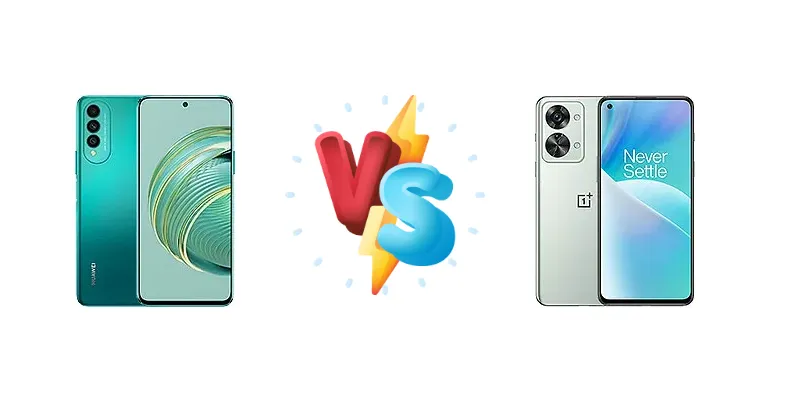
The mid-range smartphone market is fiercely competitive, and the Huawei nova 10z and OnePlus Nord 2T represent compelling options for users seeking a balance of features and affordability. While both aim to deliver a solid experience, they diverge significantly in charging technology and chipset choice, making a direct comparison crucial for informed buyers.
🏆 Quick Verdict
For the average user prioritizing rapid replenishment and consistent performance, the OnePlus Nord 2T emerges as the stronger contender. Its 80W SuperVOOC charging dramatically reduces downtime, and the Dimensity 1300 chipset provides a robust foundation for everyday tasks and gaming, despite both phones sharing a 100-hour endurance rating.
| Network |
|---|
| 2G bands | GSM 850 / 900 / 1800 / 1900 | GSM 850 / 900 / 1800 / 1900 |
| 3G bands | HSDPA 850 / 900 / 2100 | HSDPA 800 / 850 / 900 / 1700(AWS) / 1800 / 1900 / 2100 |
| 4G bands | 1, 3, 5, 8, 34, 38, 39, 40, 41 | 1, 2, 3, 4, 5, 7, 8, 12, 17, 18, 19, 20, 26, 28, 32, 34, 38, 39, 40, 41, 66 |
| 5G bands | - | 1, 3, 7, 8, 20, 28, 38, 41, 78 SA/NSA |
| Speed | HSPA, LTE | HSPA 42.2/5.76 Mbps, LTE Cat18 1200/150 Mbps, 5G |
| Technology | GSM / CDMA / HSPA / LTE | GSM / HSPA / LTE / 5G |
| | CDMA 800 / 1900 | - |
| Launch |
|---|
| Announced | 2022, September 06 | 2022, May 19 |
| Status | Available. Released 2022, September 26 | Available. Released 2022, May 21 |
| Body |
|---|
| Build | - | Glass front (Gorilla Glass 5), plastic frame |
| Dimensions | 160.7 x 73.3 x 8.4 mm (6.33 x 2.89 x 0.33 in) | 159.1 x 73.2 x 8.2 mm (6.26 x 2.88 x 0.32 in) |
| SIM | Nano-SIM + Nano-SIM | Nano-SIM + Nano-SIM |
| Weight | 179 g (6.31 oz) | 190 g (6.70 oz) |
| | Splash resistant | - |
| Display |
|---|
| Protection | - | Corning Gorilla Glass 5 |
| Resolution | 1080 x 2400 pixels, 20:9 ratio (~399 ppi density) | 1080 x 2400 pixels, 20:9 ratio (~409 ppi density) |
| Size | 6.6 inches, 105.2 cm2 (~89.3% screen-to-body ratio) | 6.43 inches, 99.8 cm2 (~85.7% screen-to-body ratio) |
| Type | IPS LCD | AMOLED, 90Hz, HDR10+ |
| Platform |
|---|
| CPU | - | Octa-core (1x3.0 GHz Cortex-A78 & 3x2.6 GHz Cortex-A78 & 4x2.0 GHz Cortex-A55) |
| Chipset | - | Mediatek Dimensity 1300 (6 nm) |
| GPU | - | Mali-G77 MC9 |
| OS | HarmonyOS 2.0 | Android 12, upgradable to Android 14, OxygenOS 14 |
| Memory |
|---|
| Card slot | No | No |
| Internal | 128GB 8GB RAM, 256GB 8GB RAM | 128GB 8GB RAM, 256GB 12GB RAM |
| | - | UFS 3.1 |
| Main Camera |
|---|
| Features | LED flash, Panorama, HDR | Dual-LED flash, HDR, panorama |
| Single | 16 MP, f/2.0, (wide) | 32 MP, f/2.4, (wide), 1/2.8", 0.8µm |
| Triple | 64 MP, f/1.9, 27mm (wide), PDAF
8 MP, f/2.4, (ultrawide)
2 MP (macro), PDAF | 50 MP, f/1.9, 24mm (wide), 1/1.56", 1.0µm, PDAF, OIS
8 MP, f/2.2, 120˚ (ultrawide)
Auxiliary lens |
| Video | 1080p@30fps | 4K@30fps, 1080p@30/60/120/480fps, gyro-EIS |
| Selfie camera |
|---|
| Features | - | Auto HDR |
| Single | 16 MP, f/2.0, (wide) | 32 MP, f/2.4, (wide), 1/2.8", 0.8µm |
| Video | 1080p@30fps | 1080p@30fps, gyro-EIS |
| Sound |
|---|
| 3.5mm jack | Yes | No |
| 35mm jack | Yes | No |
| Loudspeaker | Yes | Yes, with stereo speakers |
| Comms |
|---|
| Bluetooth | 5.1, A2DP, LE | 5.2, A2DP, LE, aptX HD |
| NFC | No | Yes |
| Positioning | GPS, GLONASS, GALILEO, BDS, QZSS | GPS, GLONASS, GALILEO, BDS, NavIC |
| Radio | No | No |
| USB | USB Type-C 2.0, OTG | USB Type-C 2.0, OTG |
| WLAN | Wi-Fi 802.11 a/b/g/n/ac, dual-band, Wi-Fi Direct | Wi-Fi 802.11 a/b/g/n/ac/6, dual-band, Wi-Fi Direct |
| Features |
|---|
| Sensors | Fingerprint (side-mounted), accelerometer, compass | Fingerprint (under display, optical), accelerometer, gyro, proximity, compass |
| | Virtual proximity sensing | - |
| Battery |
|---|
| Charging | 40W wired | 80W wired, PD |
| Type | Li-Po 4000 mAh | Li-Po 4500 mAh |
| Misc |
|---|
| Colors | Black, Silver, Green | Gray Shadow, Jade Fog |
| Models | CHA-AL80 | CPH2399, CPH2401 |
| Price | About 260 EUR | € 144.39 / $ 169.99 / ₹ 31,490 |
| Tests |
|---|
| Battery life | - |
Endurance rating 100h
|
| Camera | - |
Photo / Video |
| Display | - |
Contrast ratio: Infinite (nominal) |
| Loudspeaker | - |
-25.6 LUFS (Very good)
|
| Performance | - |
AnTuTu: 490545 (v8) | 604467 (v9)
GeekBench: 2790 (v5.1)
GFXBench: 40fps (ES 3.1 onscreen) |
Huawei nova 10z
- Potentially lower price point
- 40W wired charging offers decent charging speeds
- Huawei's EMUI software (preference-based)
- Limited information on key specs (display, camera, chipset)
- Slower charging compared to Nord 2T
OnePlus Nord 2T
- 80W SuperVOOC charging with PD for rapid replenishment
- Powerful Mediatek Dimensity 1300 (6nm) chipset
- Brighter display (636 nits)
- Potentially higher price
- OxygenOS software changes (preference-based)
Display Comparison
The OnePlus Nord 2T boasts a measured peak brightness of 636 nits, a significant advantage over the unspecified brightness of the nova 10z. While both displays have an 'infinite' (nominal) contrast ratio, the Nord 2T’s higher brightness translates to better visibility in direct sunlight. The lack of detailed display specifications for the nova 10z makes a precise comparison difficult, but the Nord 2T clearly holds an edge in visual clarity.
Camera Comparison
Both devices offer photo and video capabilities, but detailed camera specifications are lacking for the nova 10z. The Nord 2T’s camera system likely benefits from MediaTek’s Imagiq 790 ISP, which provides advanced image processing capabilities. Without knowing the sensor size or aperture of the nova 10z’s camera, it’s difficult to assess its image quality relative to the Nord 2T. The absence of details on OIS (Optical Image Stabilization) for either device further complicates the comparison.
Performance
The OnePlus Nord 2T is powered by the Mediatek Dimensity 1300 (6nm), featuring an octa-core CPU configuration with a prime Cortex-A78 core clocked at 3.0 GHz. This contrasts with the unspecified chipset of the nova 10z. The Dimensity 1300’s 6nm process node offers improved power efficiency compared to older nodes, potentially leading to better sustained performance and thermal management during demanding tasks. The Nord 2T’s CPU architecture, with its combination of Cortex-A78 and A55 cores, is optimized for both performance and efficiency, making it well-suited for gaming and multitasking.
Battery Life
Both the Huawei nova 10z and OnePlus Nord 2T achieve an endurance rating of 100 hours, suggesting comparable battery life under similar usage conditions. However, the Nord 2T’s 80W SuperVOOC charging with PD support provides a substantial advantage in terms of charging speed. 40W charging on the nova 10z will take considerably longer to fully replenish the battery, making the Nord 2T the clear winner for users who prioritize minimizing downtime.
Buying Guide
Buy the Huawei nova 10z if you prioritize a potentially lower price point and are less concerned with the absolute fastest charging speeds. Buy the OnePlus Nord 2T if you value significantly faster 80W charging, a more powerful and efficient chipset in the Dimensity 1300, and a generally smoother user experience, even if it comes at a slightly higher cost.
Frequently Asked Questions
❓ How long does it realistically take to fully charge the OnePlus Nord 2T with the 80W SuperVOOC charger?
The OnePlus Nord 2T’s 80W SuperVOOC charging can typically take the battery from 0% to 100% in around 30-35 minutes, making it exceptionally convenient for users who need a quick power boost. This is a significant advantage over the slower 40W charging on the Huawei nova 10z.
❓ Does the Dimensity 1300 in the Nord 2T get hot during extended gaming sessions?
The Dimensity 1300’s 6nm process node and OnePlus’s thermal management system generally keep temperatures under control during gaming. While some heat is inevitable, the Nord 2T is unlikely to experience significant throttling, allowing for sustained performance over longer gaming sessions. However, prolonged, intensive use will naturally lead to some warming.
❓ What kind of charger does the Huawei nova 10z include in the box, and is it compatible with PD charging?
The Huawei nova 10z supports 40W wired charging, but details regarding the included charger and PD compatibility are limited. It's likely to include a Huawei-specific 40W charger, and PD support may be limited or absent. This contrasts with the Nord 2T's full PD support.