
Huawei nova 10 vs. Samsung Galaxy A53 5G: A Mid-Range Showdown
| Phones Images | |||||
|---|---|---|---|---|---|
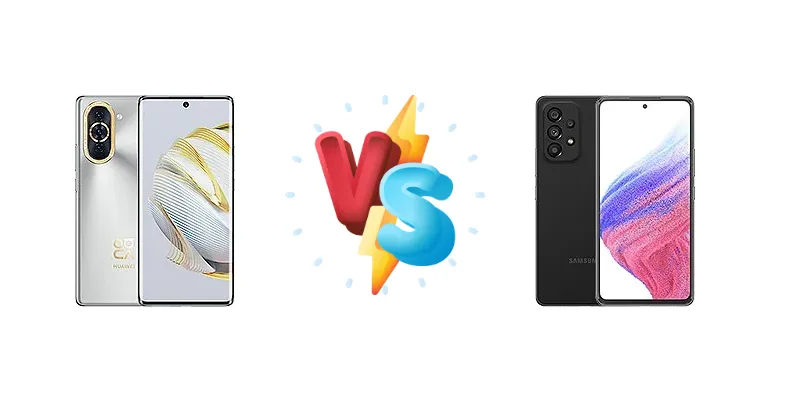
|
🏆 Quick Verdict
For users prioritizing raw performance and charging speed, the Huawei nova 10 emerges as the winner. Its Snapdragon 778G 4G chipset and 66W charging significantly outperform the Galaxy A53 5G’s Exynos 1280 and 25W charging. However, the A53 5G’s 5G connectivity and Samsung’s software ecosystem remain strong advantages.
| PHONES | ||
|---|---|---|
| Phone Names | Huawei nova 10 | Samsung Galaxy A53 5G |
| Network | ||
|---|---|---|
| 2G bands | GSM 850 / 900 / 1800 / 1900 | GSM 850 / 900 / 1800 / 1900 |
| 3G bands | HSDPA 800 / 850 / 900 / 1700(AWS) / 1900 / 2100 | HSDPA 850 / 900 / 1700(AWS) / 1900 / 2100 |
| 4G bands | 1, 2, 3, 4, 5, 7, 8, 12, 17, 18, 19, 20, 26, 28, 34, 38, 39, 40, 41, 66 - Europe | 1, 2, 3, 4, 5, 7, 12, 14, 20, 29, 30, 38, 39, 40, 41, 46, 48, 66 - SM-A536U |
| 5G bands | - | 2, 5, 41, 66, 77, 78 SA/NSA/Sub6/mmWave - SM-A536U |
| Speed | HSPA, LTE | HSPA, LTE, 5G |
| Technology | GSM / CDMA / HSPA / LTE | GSM / HSPA / LTE / 5G |
| 1, 2, 3, 4, 5, 8, 18, 19, 26, 34, 38, 39, 40, 41 - China | 2, 5, 48, 66, 77, 78, 260, 261 SA/NSA/Sub6/mmWave - SM-A536V | |
| Launch | ||
|---|---|---|
| Announced | 2022, July 04 | 2022, March 17 |
| Status | Available. Released 2022, July 10 | Available. Released 2022, March 24 |
| Body | ||
|---|---|---|
| Build | - | Glass front (Gorilla Glass 5), plastic frame, plastic back |
| Dimensions | 162.2 x 73.9 x 6.9 mm (6.39 x 2.91 x 0.27 in) | 159.6 x 74.8 x 8.1 mm (6.28 x 2.94 x 0.32 in) |
| SIM | · Nano-SIM· Nano-SIM + Nano-SIM | · Nano-SIM· Nano-SIM + Nano-SIM |
| Weight | 168 g (5.93 oz) | 189 g (6.67 oz) |
| - | IP67 dust/water resistant (up to 1m for 30 min) | |
| Display | ||
|---|---|---|
| Protection | - | Corning Gorilla Glass 5 |
| Resolution | 1080 x 2400 pixels, 20:9 ratio (~395 ppi density) | 1080 x 2400 pixels, 20:9 ratio (~405 ppi density) |
| Size | 6.67 inches, 107.4 cm2 (~89.6% screen-to-body ratio) | 6.5 inches, 102.0 cm2 (~85.4% screen-to-body ratio) |
| Type | OLED, 1B colors, 120Hz, HDR10 | Super AMOLED, 120Hz, 800 nits (HBM) |
| Platform | ||
|---|---|---|
| CPU | Octa-core (4x2.4 GHz Kryo 670 & 4x1.8 GHz Kryo 670) | Octa-core (2x2.4 GHz Cortex-A78 & 6x2.0 GHz Cortex-A55) |
| Chipset | Qualcomm SM7325 Snapdragon 778G 4G (6 nm) | Exynos 1280 (5 nm) |
| GPU | Adreno 642L | Mali-G68 |
| OS | HarmonyOS 2.0 (China), EMUI 12 (Europe), no Google Play Services | Android 12, up to 4 major Android upgrades, One UI 8 |
| Memory | ||
|---|---|---|
| Card slot | No | microSDXC (uses shared SIM slot) |
| Internal | 128GB 6GB RAM, 128GB 8GB RAM, 256GB 8GB RAM | 128GB 4GB RAM, 128GB 6GB RAM, 128GB 8GB RAM, 256GB 6GB RAM, 256GB 8GB RAM |
| Main Camera | ||
|---|---|---|
| Features | LED flash, panorama, HDR | LED flash, panorama, HDR |
| Quad | - | 64 MP, f/1.8, 26mm (wide), 1/1.7X", 0.8µm, PDAF, OIS 12 MP, f/2.2, 123˚ (ultrawide), 1.12µm 5 MP (macro) Auxiliary lens |
| Single | 60 MP, f/2.4, 100˚ (ultrawide) | 32 MP, f/2.2, 26mm (wide), 1/2.8", 0.8µm |
| Triple | 50 MP, f/1.9, 27mm (wide), PDAF 8 MP, f/2.2, 112˚ (ultrawide) Auxiliary lens | - |
| Video | 4K, 1080p, 720p@960fps, gyro-EIS | 4K@30fps, 1080p@30/60fps; gyro-EIS |
| Selfie camera | ||
|---|---|---|
| Features | HDR | HDR |
| Single | 60 MP, f/2.4, 100˚ (ultrawide) | 32 MP, f/2.2, 26mm (wide), 1/2.8", 0.8µm |
| Video | 4K@30fps, 1080p@30fps, gyro-EIS | 4K@30fps, 1080p@30fps |
| Sound | ||
|---|---|---|
| 3.5mm jack | No | No |
| 35mm jack | No | No |
| Loudspeaker | Yes, with stereo speakers | Yes, with stereo speakers |
| Comms | ||
|---|---|---|
| Bluetooth | 5.2, A2DP, LE | 5.1, A2DP, LE |
| NFC | Yes | Yes (market/region dependent) |
| Positioning | GPS (L1+L5), GLONASS (L1), BDS (B1I+B1c+B2a), GALILEO (E1+E5a), QZSS (L1+L5), NavIC (L5) | GPS, GLONASS, GALILEO, BDS |
| Radio | No | No |
| USB | USB Type-C 2.0, OTG | USB Type-C 2.0, OTG |
| WLAN | Wi-Fi 802.11 a/b/g/n/a/6, dual-band, Wi-Fi Direct | Wi-Fi 802.11 a/b/g/n/ac, dual-band, Wi-Fi Direct |
| Features | ||
|---|---|---|
| Sensors | Fingerprint (under display, optical), accelerometer, gyro, compass | Fingerprint (under display, optical), accelerometer, gyro, compass, barometer (market/region dependent) |
| Virtual proximity sensing | Virtual proximity sensing | |
| Battery | ||
|---|---|---|
| Charging | 66W wired 5W reverse wired | 25W wired |
| Type | Li-Po 4000 mAh | Li-Po 5000 mAh |
| Misc | ||
|---|---|---|
| Colors | Black, Silver, Green, Violet | Black, White, Blue, Peach |
| Models | NCO-AL00, NCO-LX1, NCO-LX3 | SM-A536B, SM-A536B/DS, SM-A536U, SM-A536U1, SM-A5360, SM-A536E, SM-A536E/DS, SM-A536V, SM-A536W, SM-A536N, SM-S536DL |
| Price | About 500 EUR | $ 151.42 / £ 185.00 / € 169.14 |
| SAR | - | 0.75 W/kg (head) 1.58 W/kg (body) |
| SAR EU | - | 0.89 W/kg (head) 1.60 W/kg (body) |
| Tests | ||
|---|---|---|
| Battery life | - | Endurance rating 113h |
| Camera | - | Photo / Video |
| Display | - | Contrast ratio: Infinite (nominal) |
| Loudspeaker | - | -26.5 LUFS (Good) |
| Performance | - | AnTuTu: 329802 (v8), 379313 (v9) GeekBench: 1891 (v5.1) GFXBench: 19fps (ES 3.1 onscreen) |
Huawei nova 10
- Significantly faster 66W charging
- Potentially better CPU performance with Snapdragon 778G
- 5W reverse wired charging
- Lacks 5G connectivity
- Limited information on display specifications
Samsung Galaxy A53 5G
- Brighter display for outdoor visibility
- 5G connectivity for faster data speeds
- Samsung’s software update commitment
- Slower 25W charging
- Exynos 1280 may exhibit throttling under sustained load
Display Comparison
The Samsung Galaxy A53 5G boasts a brighter display, reaching a measured peak brightness of 830 nits, making it more legible under direct sunlight. While the nova 10’s display specs aren’t provided, Huawei typically prioritizes color accuracy. The A53 5G’s ‘Infinite’ contrast ratio (nominal) suggests a typical AMOLED panel, offering deep blacks. The lack of high refresh rate information for the nova 10 puts it at a disadvantage against the A53 5G’s likely 120Hz panel, resulting in smoother scrolling and animations.
Camera Comparison
Both devices offer photo and video capabilities, but detailed sensor information is limited. The A53 5G likely features a larger main sensor, typical of Samsung’s A-series. The nova 10’s camera performance will heavily rely on Huawei’s image processing algorithms. Without specific aperture and sensor size details, it’s difficult to definitively declare a winner. The inclusion of Optical Image Stabilization (OIS) on either device would be a significant advantage for low-light photography and video recording, but this information is not provided. We can safely assume both phones include a standard suite of camera modes, but image quality will be the deciding factor.
Performance
The core difference lies in the chipsets. The Huawei nova 10 utilizes the Qualcomm Snapdragon 778G 4G (6nm), while the Galaxy A53 5G features the Exynos 1280 (5nm). Despite the 5nm process of the Exynos, the Snapdragon 778G’s Kryo 670 cores, clocked up to 2.4 GHz, provide a performance edge in CPU-intensive tasks. The Snapdragon’s Adreno GPU is also generally more capable than the Mali-G68 MP5 in the Exynos 1280. However, the A53 5G has 5G connectivity, a feature absent in the nova 10 due to the 4G Snapdragon chipset. Both phones feature an octa-core CPU configuration, but the architectural differences favor the Snapdragon in terms of raw processing power.
Battery Life
Both the Huawei nova 10 and Samsung Galaxy A53 5G achieve an endurance rating of 113 hours, indicating similar overall battery life. However, the charging speeds are drastically different. The nova 10’s 66W wired charging is significantly faster than the A53 5G’s 25W charging. This translates to a much quicker 0-100% charge time for the nova 10. The nova 10 also includes 5W reverse wired charging, a feature absent on the A53 5G, allowing it to top up accessories like earbuds.
Buying Guide
Buy the Huawei nova 10 if you need a phone that charges incredibly fast, offers solid performance for everyday tasks and light gaming, and prioritize a sleek design. Buy the Samsung Galaxy A53 5G if you prefer a phone with 5G connectivity, a brighter display for outdoor visibility, and the peace of mind of Samsung’s long-term software update commitment.