
Huawei nova 10 vs. Oppo Reno8 Pro: A Detailed Comparison of Mid-Range Powerhouses
| Phones Images | |||||
|---|---|---|---|---|---|
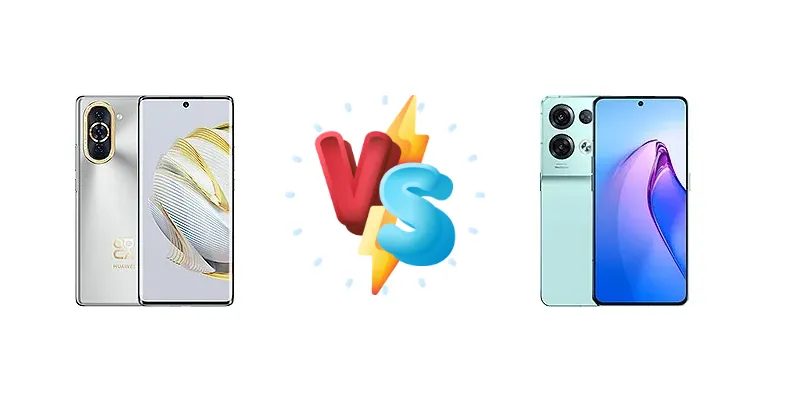
|
🏆 Quick Verdict
For users prioritizing sustained performance and faster charging, the Oppo Reno8 Pro is the clear winner. Its Dimensity 8100 Max chipset delivers a noticeable performance uplift, and the 80W charging significantly reduces downtime. However, the Huawei nova 10 remains a strong contender for those seeking a more balanced, efficient experience.
| PHONES | ||
|---|---|---|
| Phone Names | Huawei nova 10 | Oppo Reno8 Pro |
| Network | ||
|---|---|---|
| 2G bands | GSM 850 / 900 / 1800 / 1900 | GSM 850 / 900 / 1800 / 1900 |
| 3G bands | HSDPA 800 / 850 / 900 / 1700(AWS) / 1900 / 2100 | HSDPA 800 / 850 / 900 / 1700(AWS) / 1900 / 2100 |
| 4G bands | 1, 2, 3, 4, 5, 7, 8, 12, 17, 18, 19, 20, 26, 28, 34, 38, 39, 40, 41, 66 - Europe | 1, 2, 3, 4, 5, 7, 8, 12, 17, 18, 19, 20, 26, 28, 32, 38, 39, 40, 41 |
| 5G bands | - | 1, 3, 5, 7, 8, 20, 28, 38, 40, 41, 77, 78 SA/NSA |
| Speed | HSPA, LTE | HSPA, LTE, 5G |
| Technology | GSM / CDMA / HSPA / LTE | GSM / HSPA / LTE / 5G |
| 1, 2, 3, 4, 5, 8, 18, 19, 26, 34, 38, 39, 40, 41 - China | - | |
| Launch | ||
|---|---|---|
| Announced | 2022, July 04 | 2022, July 18 |
| Status | Available. Released 2022, July 10 | Available. Released 2022, July 19 |
| Body | ||
|---|---|---|
| Build | - | Glass front (Gorilla Glass 5), aluminum frame, glass back |
| Dimensions | 162.2 x 73.9 x 6.9 mm (6.39 x 2.91 x 0.27 in) | 161.2 x 74.2 x 7.3 mm (6.35 x 2.92 x 0.29 in) |
| SIM | · Nano-SIM· Nano-SIM + Nano-SIM | Nano-SIM + Nano-SIM |
| Weight | 168 g (5.93 oz) | 183 g (6.46 oz) |
| Display | ||
|---|---|---|
| Protection | - | Corning Gorilla Glass 5 |
| Resolution | 1080 x 2400 pixels, 20:9 ratio (~395 ppi density) | 1080 x 2412 pixels, 20:9 ratio (~394 ppi density) |
| Size | 6.67 inches, 107.4 cm2 (~89.6% screen-to-body ratio) | 6.7 inches, 108.0 cm2 (~90.3% screen-to-body ratio) |
| Type | OLED, 1B colors, 120Hz, HDR10 | AMOLED, 1B colors, 120Hz, HDR10+, 500 nits (typ), 800 nits (HBM), 950 nits (peak) |
| Platform | ||
|---|---|---|
| CPU | Octa-core (4x2.4 GHz Kryo 670 & 4x1.8 GHz Kryo 670) | Octa-core (4x2.85 GHz Cortex-A78 & 4x2.0 GHz Cortex-A55) |
| Chipset | Qualcomm SM7325 Snapdragon 778G 4G (6 nm) | Mediatek Dimensity 8100 Max (5 nm) |
| GPU | Adreno 642L | Mali-G610 MC6 |
| OS | HarmonyOS 2.0 (China), EMUI 12 (Europe), no Google Play Services | Android 12, upgradable to Android 14, ColorOS 14 |
| Memory | ||
|---|---|---|
| Card slot | No | No |
| Internal | 128GB 6GB RAM, 128GB 8GB RAM, 256GB 8GB RAM | 256GB 8GB RAM, 256GB 12GB RAM |
| - | UFS 3.1 | |
| Main Camera | ||
|---|---|---|
| Features | LED flash, panorama, HDR | Color spectrum sensor, LED flash, HDR, panorama |
| Single | 60 MP, f/2.4, 100˚ (ultrawide) | 32 MP, f/2.4, 22mm (wide), 1/2.74", 0.8µm, AF |
| Triple | 50 MP, f/1.9, 27mm (wide), PDAF 8 MP, f/2.2, 112˚ (ultrawide) Auxiliary lens | 50 MP, f/1.8, 23mm (wide), 1/1.56", 1.0µm, multi-directional PDAF 8 MP, f/2.2, 16mm, 112˚ (ultrawide), 1/4.0", 1.12µm 2 MP (macro) |
| Video | 4K, 1080p, 720p@960fps, gyro-EIS | 4K@30fps, 1080p@30/60/120/240fps, 720p@960fps, gyro-EIS |
| Selfie camera | ||
|---|---|---|
| Features | HDR | Panorama, HDR |
| Single | 60 MP, f/2.4, 100˚ (ultrawide) | 32 MP, f/2.4, 22mm (wide), 1/2.74", 0.8µm, AF |
| Video | 4K@30fps, 1080p@30fps, gyro-EIS | 1080p@30fps, gyro-EIS |
| Sound | ||
|---|---|---|
| 3.5mm jack | No | No |
| 35mm jack | No | No |
| Loudspeaker | Yes, with stereo speakers | Yes, with stereo speakers |
| Comms | ||
|---|---|---|
| Bluetooth | 5.2, A2DP, LE | 5.3, A2DP, LE, aptX HD |
| NFC | Yes | Yes |
| Positioning | GPS (L1+L5), GLONASS (L1), BDS (B1I+B1c+B2a), GALILEO (E1+E5a), QZSS (L1+L5), NavIC (L5) | GPS (L1+L5), GLONASS (L1), BDS (B1I+B2a), GALILEO (E1+E5a), QZSS (L1+L5) |
| Radio | No | No |
| USB | USB Type-C 2.0, OTG | USB Type-C 2.0, OTG |
| WLAN | Wi-Fi 802.11 a/b/g/n/a/6, dual-band, Wi-Fi Direct | Wi-Fi 802.11 a/b/g/n/ac/6, dual-band, Wi-Fi Direct |
| Features | ||
|---|---|---|
| Sensors | Fingerprint (under display, optical), accelerometer, gyro, compass | Fingerprint (under display, optical), accelerometer, gyro, proximity, compass |
| Virtual proximity sensing | - | |
| Battery | ||
|---|---|---|
| Charging | 66W wired 5W reverse wired | 80W wired, 45% in 10 min, 100% in 31 min Reverse wired |
| Type | Li-Po 4000 mAh | Li-Po 4500 mAh |
| Misc | ||
|---|---|---|
| Colors | Black, Silver, Green, Violet | Glazed Green, Glazed Black, House of the Dragon |
| Models | NCO-AL00, NCO-LX1, NCO-LX3 | CPH2357 |
| Price | About 500 EUR | ₹ 28,490 |
| Tests | ||
|---|---|---|
| Battery life | - | Endurance rating 100h |
| Camera | - | Photo / Video |
| Display | - | Contrast ratio: Infinite (nominal) |
| Loudspeaker | - | -25.5 LUFS (Very good) |
| Performance | - | AnTuTu: 718351 (v9) GeekBench: 3395 (v5.1) GFXBench: 44fps (ES 3.1 onscreen) |
Huawei nova 10
- Efficient Snapdragon 778G chipset for good battery life
- 66W fast charging is still relatively quick
- Potentially more affordable price point
- Limited to 4G connectivity
- Less powerful CPU and GPU compared to the Reno8 Pro
- Missing detailed display specifications
Oppo Reno8 Pro
- Powerful MediaTek Dimensity 8100 Max for excellent performance
- 80W SuperVOOC charging for incredibly fast charging speeds
- Brighter display for better outdoor visibility
- Potentially higher price tag
- Dimensity 8100 Max may generate more heat under sustained load
- Camera details are lacking for a full assessment
Display Comparison
The Oppo Reno8 Pro edges out the Huawei nova 10 in display capabilities, boasting a measured peak brightness of 818 nits. While both phones likely utilize OLED panels (though not explicitly stated), the Reno8 Pro’s higher brightness translates to better visibility in direct sunlight. The Reno8 Pro’s ‘Infinite’ contrast ratio, while a nominal specification, suggests excellent black levels typical of OLED technology. The nova 10’s display specifications are not provided, making a direct comparison of color accuracy and refresh rate impossible, but it’s reasonable to assume a standard 60Hz or 90Hz panel given the chipset and price point.
Camera Comparison
Both devices are listed as having Photo/Video capabilities, but detailed camera specifications are lacking. Without sensor size, aperture, or OIS details, a definitive camera comparison is difficult. However, the Reno8 Pro’s higher processing power afforded by the Dimensity 8100 Max likely allows for more sophisticated image processing algorithms, potentially resulting in better low-light performance and dynamic range. The absence of information regarding the inclusion of telephoto lenses on either device suggests a focus on primary and ultrawide cameras. Any 2MP macro lenses present would likely offer limited utility.
Performance
The core difference between these two phones lies in their chipsets. The Oppo Reno8 Pro’s MediaTek Dimensity 8100 Max, built on a 5nm process, offers a significant performance advantage over the Huawei nova 10’s Qualcomm Snapdragon 778G 4G (6nm). The Dimensity 8100 Max features a more powerful CPU configuration – four Cortex-A78 cores clocked at 2.85 GHz versus the Snapdragon’s four Kryo 670 cores at 2.4 GHz. This translates to faster app loading times, smoother multitasking, and higher frame rates in graphically intensive games. The Snapdragon 778G’s 4G limitation is also a significant drawback for users in areas with robust 5G infrastructure.
Battery Life
Both phones achieve an endurance rating of 100 hours, suggesting comparable battery life under similar usage conditions. However, the Oppo Reno8 Pro’s 80W wired charging is a game-changer. It can reach 45% charge in just 10 minutes and fully charge in 31 minutes, significantly reducing downtime. The Huawei nova 10’s 66W charging is respectable, but slower. The Reno8 Pro also offers reverse wired charging, a convenient feature for topping up accessories, while the nova 10 provides 5W reverse wired charging.
Buying Guide
Buy the Huawei nova 10 if you need a reliable daily driver with good battery life and a focus on efficient performance for everyday tasks and light gaming. It’s ideal for users who don’t demand the absolute highest frame rates in demanding games. Buy the Oppo Reno8 Pro if you prefer a phone capable of handling demanding games and applications with ease, and if minimizing charging time is a priority. This phone is geared towards power users and mobile gamers.