
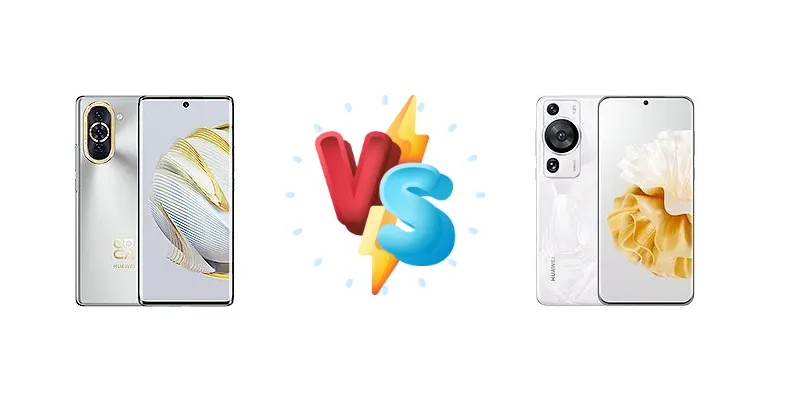
Huawei Nova 10 vs Huawei P60 Pro: The Ultimate Showdown
| Phones Images | |||||
|---|---|---|---|---|---|
|
🏆 Quick Verdict
The Huawei P60 Pro is the clear winner, boasting a significantly more powerful chipset, superior camera system, and faster charging. While the Nova 10 offers a more budget-friendly option with a stylish design, the P60 Pro's premium features justify its higher price for most users.
| PHONES | ||
|---|---|---|
| Phone Names | Huawei nova 10 | Huawei P60 Pro |
| Network | ||
|---|---|---|
| 2G bands | GSM 850 / 900 / 1800 / 1900 | GSM 850 / 900 / 1800 / 1900 |
| 3G bands | HSDPA 800 / 850 / 900 / 1700(AWS) / 1900 / 2100 | HSDPA 800 / 850 / 900 / 1700(AWS) / 1900 / 2100 |
| 4G bands | 1, 2, 3, 4, 5, 7, 8, 12, 17, 18, 19, 20, 26, 28, 34, 38, 39, 40, 41, 66 - Europe | 1, 2, 3, 4, 5, 7, 8, 12, 13, 17, 18, 19, 20, 26, 28, 32, 34, 38, 39, 40, 41, 66 - International |
| Speed | HSPA, LTE | HSPA, LTE |
| Technology | GSM / CDMA / HSPA / LTE | GSM / CDMA / HSPA / CDMA2000 / LTE |
| 1, 2, 3, 4, 5, 8, 18, 19, 26, 34, 38, 39, 40, 41 - China | 1, 2, 3, 4, 5, 7, 8, 12, 17, 18, 19, 20, 26, 28, 34, 38, 39, 40, 41 - China | |
| Launch | ||
|---|---|---|
| Announced | 2022, July 04 | 2023, March 23 |
| Status | Available. Released 2022, July 10 | Available. Released 2023, March 31 |
| Body | ||
|---|---|---|
| Dimensions | 162.2 x 73.9 x 6.9 mm (6.39 x 2.91 x 0.27 in) | 161 x 74.5 x 8.3 mm (6.34 x 2.93 x 0.33 in) |
| SIM | · Nano-SIM· Nano-SIM + Nano-SIM | · Nano-SIM· Nano-SIM + Nano-SIM |
| Weight | 168 g (5.93 oz) | 200 g (7.05 oz) |
| - | IP68 dust/water resistant (up to 1.5m for 30 min) | |
| Display | ||
|---|---|---|
| Protection | - | Kunlun Glass |
| Resolution | 1080 x 2400 pixels, 20:9 ratio (~395 ppi density) | 1220 x 2700 pixels (~444 ppi density) |
| Size | 6.67 inches, 107.4 cm2 (~89.6% screen-to-body ratio) | 6.67 inches, 107.7 cm2 (~89.8% screen-to-body ratio) |
| Type | OLED, 1B colors, 120Hz, HDR10 | LTPO OLED, 1B colors, 120Hz |
| Platform | ||
|---|---|---|
| CPU | Octa-core (4x2.4 GHz Kryo 670 & 4x1.8 GHz Kryo 670) | Octa-core (1x3.19 GHz Cortex-X2 & 3x2.75 GHz Cortex-A710 & 4x2.0 GHz Cortex-A510) |
| Chipset | Qualcomm SM7325 Snapdragon 778G 4G (6 nm) | Qualcomm SM8475 Snapdragon 8+ Gen 1 4G (4 nm) |
| GPU | Adreno 642L | Adreno 730 |
| OS | HarmonyOS 2.0 (China), EMUI 12 (Europe), no Google Play Services | HarmonyOS 3.1 (China), EMUI 13.1 (Europe), no Google Play Services |
| Memory | ||
|---|---|---|
| Card slot | No | Nano Memory (uses shared SIM slot) |
| Internal | 128GB 6GB RAM, 128GB 8GB RAM, 256GB 8GB RAM | 256GB 8GB RAM, 256GB 12GB RAM, 512GB 12GB RAM |
| - | UFS | |
| Main Camera | ||
|---|---|---|
| Features | LED flash, panorama, HDR | Laser AF, color spectrum sensor, LED flash, HDR, panorama |
| Single | 60 MP, f/2.4, 100˚ (ultrawide) | - |
| Triple | 50 MP, f/1.9, 27mm (wide), PDAF 8 MP, f/2.2, 112˚ (ultrawide) Auxiliary lens | 48 MP, f/1.4-f/4.0, 25mm (wide), PDAF, OIS 48 MP, f/2.1, 90mm (telephoto), PDAF, sensor-shift OIS, 3.5x optical zoom 13 MP, f/2.2, 13mm (ultrawide), AF |
| Video | 4K, 1080p, 720p@960fps, gyro-EIS | 4K@30/60fps, 1080p@30/60fps, 1080p@960fps; gyro-EIS, HDR Vivid |
| Selfie camera | ||
|---|---|---|
| Features | HDR | Panorama, HDR |
| Single | 60 MP, f/2.4, 100˚ (ultrawide) | 13 MP, f/2.4, (ultrawide) |
| Video | 4K@30fps, 1080p@30fps, gyro-EIS | 4K@30/60fps, 1080p@30fps, HDR Vivid |
| Sound | ||
|---|---|---|
| 3.5mm jack | No | No |
| 35mm jack | No | No |
| Loudspeaker | Yes, with stereo speakers | Yes, with stereo speakers |
| Comms | ||
|---|---|---|
| Bluetooth | 5.2, A2DP, LE | 5.2, A2DP, LE |
| Infrared port | - | Yes |
| NFC | Yes | Yes |
| Positioning | GPS (L1+L5), GLONASS (L1), BDS (B1I+B1c+B2a), GALILEO (E1+E5a), QZSS (L1+L5), NavIC (L5) | GPS (L1+L5), GLONASS (B1I+B1c+B2a), BDS (B1I+B1c+B2a), GALILEO (E1+E5a), QZSS (L1+L5), NavIC |
| Radio | No | No |
| USB | USB Type-C 2.0, OTG | USB Type-C 3.1, OTG |
| WLAN | Wi-Fi 802.11 a/b/g/n/a/6, dual-band, Wi-Fi Direct | Wi-Fi 802.11 a/b/g/n/ac/6, dual-band, Wi-Fi Direct |
| Features | ||
|---|---|---|
| Sensors | Fingerprint (under display, optical), accelerometer, gyro, compass | Fingerprint (under display, optical), accelerometer, gyro, proximity, compass |
| Virtual proximity sensing | BDS Satellite Message | |
| Battery | ||
|---|---|---|
| Charging | 66W wired 5W reverse wired | 88W wired 50W wireless Reverse wireless |
| Type | Li-Po 4000 mAh | Li-Po 4815 mAh |
| Misc | ||
|---|---|---|
| Colors | Black, Silver, Green, Violet | Black, Green, Violet, Rococo Pearl |
| Models | NCO-AL00, NCO-LX1, NCO-LX3 | MNA-AL00, MNA-LX9 |
| Price | About 500 EUR | € 738.50 |
| Tests | ||
|---|---|---|
| Battery life | - | Endurance rating 96h |
| Camera | - | Photo / Video |
| Display | - | Contrast ratio: Infinite (nominal) |
| Loudspeaker | - | -27.3 LUFS (Good) |
| Performance | - | AnTuTu: 1030473 (v9) GeekBench: 4422 (v6) GFXBench: 65fps (ES 3.1 onscreen) |
Huawei nova 10
- Stylish Design
- Fast 66W Charging
- More Affordable
- Reverse Wired Charging
- Less Powerful Chipset
- Lower Camera Quality
- Limited 4G Connectivity
Huawei P60 Pro
- Flagship Performance (Snapdragon 8+ Gen 1)
- Exceptional Camera System
- Bright and Vibrant Display
- Fast 88W Wired & 50W Wireless Charging
- Premium Build Quality
- Higher Price
- 4G Connectivity Only
Display Comparison
The Huawei P60 Pro takes the display crown with its measured 1135 nits peak brightness, offering exceptional visibility even in direct sunlight. Its 'Infinite' contrast ratio (nominal) suggests deep blacks and vibrant colors. The Nova 10's display is good, but lacks the sheer brilliance and contrast of the P60 Pro. Both likely use OLED panels, but the P60 Pro's implementation is clearly superior.
Camera Comparison
The P60 Pro's camera system is a major selling point. While specific details are missing, Huawei's P-series is renowned for its exceptional image quality and innovative features. The Nova 10's camera is decent, but doesn't compete with the flagship-level capabilities of the P60 Pro. Expect better low-light performance, more detail, and more advanced features on the P60 Pro.
Performance
The Snapdragon 8+ Gen 1 in the P60 Pro is a powerhouse, significantly outperforming the Snapdragon 778G 4G in the Nova 10. Expect smoother multitasking, faster app loading times, and better gaming performance on the P60 Pro. The Nova 10 is still capable for everyday tasks, but struggles with demanding applications.
Battery Life
Both phones boast an impressive endurance rating of 96 hours, suggesting excellent battery life. However, the P60 Pro's 88W wired charging and 50W wireless charging offer significantly faster charging speeds compared to the Nova 10's 66W wired and 5W reverse wired charging.
Buying Guide
The Huawei Nova 10 is ideal for users prioritizing aesthetics, fast charging, and a more affordable price point. It's a great choice for social media enthusiasts and those who want a stylish phone for everyday use. The Huawei P60 Pro is for photography lovers, power users, and those who demand top-tier performance and a premium experience. It's a flagship device for those who want the best Huawei has to offer.