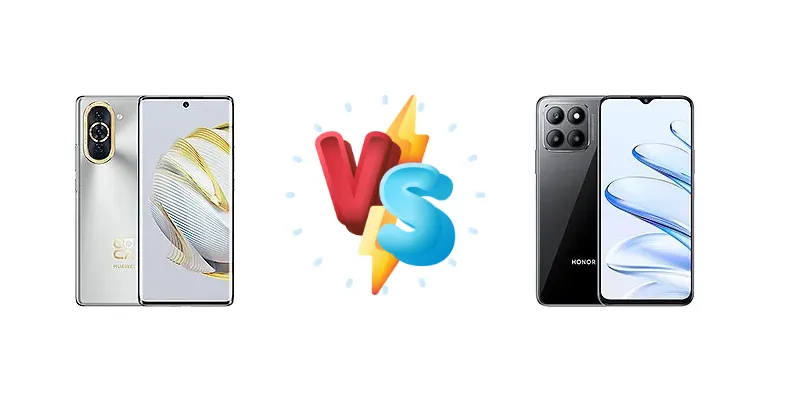
Both the Huawei nova 10 and the Honor 70 Lite aim for the competitive mid-range smartphone market, but they take distinctly different approaches. The nova 10 prioritizes processing power and charging speed, while the 70 Lite focuses on affordability and 5G connectivity. This comparison dissects their key specifications to determine which device delivers the best value for your money.
🏆 Quick Verdict
For users prioritizing performance and rapid charging, the Huawei nova 10 is the clear winner. Its Snapdragon 778G 4G chipset offers a substantial performance advantage over the Honor 70 Lite’s Snapdragon 480+ 5G, and the 66W charging is significantly faster than the 22.5W offered by Honor. However, the 70 Lite provides 5G connectivity at a lower price point.
| Network |
|---|
| 2G bands | GSM 850 / 900 / 1800 / 1900 | GSM 850 / 900 / 1800 / 1900 |
| 3G bands | HSDPA 800 / 850 / 900 / 1700(AWS) / 1900 / 2100 | HSDPA 850 / 900 / 1900 / 2100 |
| 4G bands | 1, 2, 3, 4, 5, 7, 8, 12, 17, 18, 19, 20, 26, 28, 34, 38, 39, 40, 41, 66 - Europe | LTE |
| 5G bands | - | SA/NSA |
| Speed | HSPA, LTE | HSPA, LTE, 5G |
| Technology | GSM / CDMA / HSPA / LTE | GSM / HSPA / LTE / 5G |
| | 1, 2, 3, 4, 5, 8, 18, 19, 26, 34, 38, 39, 40, 41 - China | - |
| Launch |
|---|
| Announced | 2022, July 04 | 2023, March 20 |
| Status | Available. Released 2022, July 10 | Available. Released 2023, March 31 |
| Body |
|---|
| Dimensions | 162.2 x 73.9 x 6.9 mm (6.39 x 2.91 x 0.27 in) | 163.7 x 75.1 x 8.7 mm (6.44 x 2.96 x 0.34 in) |
| SIM | · Nano-SIM· Nano-SIM + Nano-SIM | Nano-SIM + Nano-SIM |
| Weight | 168 g (5.93 oz) | 194 g (6.84 oz) |
| Display |
|---|
| Resolution | 1080 x 2400 pixels, 20:9 ratio (~395 ppi density) | 720 x 1600 pixels, 20:9 ratio (~270 ppi density) |
| Size | 6.67 inches, 107.4 cm2 (~89.6% screen-to-body ratio) | 6.5 inches, 102.0 cm2 (~83.0% screen-to-body ratio) |
| Type | OLED, 1B colors, 120Hz, HDR10 | TFT LCD, 90Hz |
| Platform |
|---|
| CPU | Octa-core (4x2.4 GHz Kryo 670 & 4x1.8 GHz Kryo 670) | Octa-core (2x2.2 GHz Kryo 460 & 6x1.9 GHz Kryo 460) |
| Chipset | Qualcomm SM7325 Snapdragon 778G 4G (6 nm) | Qualcomm SM4350-AC Snapdragon 480+ 5G (8 nm) |
| GPU | Adreno 642L | Adreno 619 |
| OS | HarmonyOS 2.0 (China), EMUI 12 (Europe), no Google Play Services | Android 12, upgradable to Android 14, Magic UI 8 |
| Memory |
|---|
| Card slot | No | Unspecified |
| Internal | 128GB 6GB RAM, 128GB 8GB RAM, 256GB 8GB RAM | 128GB 4GB RAM |
| Main Camera |
|---|
| Features | LED flash, panorama, HDR | LED flash, HDR, panorama |
| Single | 60 MP, f/2.4, 100˚ (ultrawide) | 8 MP, f/2.0, (wide) |
| Triple | 50 MP, f/1.9, 27mm (wide), PDAF
8 MP, f/2.2, 112˚ (ultrawide)
Auxiliary lens | 50 MP, f/1.8, (wide), PDAF
2 MP (macro)
Auxiliary lens |
| Video | 4K, 1080p, 720p@960fps, gyro-EIS | 1080p@30fps |
| Selfie camera |
|---|
| Features | HDR | - |
| Single | 60 MP, f/2.4, 100˚ (ultrawide) | 8 MP, f/2.0, (wide) |
| Video | 4K@30fps, 1080p@30fps, gyro-EIS | 1080p@30fps |
| Sound |
|---|
| 3.5mm jack | No | Yes |
| 35mm jack | No | Yes |
| Loudspeaker | Yes, with stereo speakers | Yes |
| Comms |
|---|
| Bluetooth | 5.2, A2DP, LE | 5.1, A2DP, LE |
| NFC | Yes | Yes |
| Positioning | GPS (L1+L5), GLONASS (L1), BDS (B1I+B1c+B2a), GALILEO (E1+E5a), QZSS (L1+L5), NavIC (L5) | GPS, GLONASS, GALILEO, BDS |
| Radio | No | Unspecified |
| USB | USB Type-C 2.0, OTG | USB Type-C 2.0, OTG |
| WLAN | Wi-Fi 802.11 a/b/g/n/a/6, dual-band, Wi-Fi Direct | Wi-Fi 802.11 a/b/g/n/ac, dual-band, Wi-Fi Direct |
| Features |
|---|
| Sensors | Fingerprint (under display, optical), accelerometer, gyro, compass | Fingerprint (side-mounted), accelerometer, proximity |
| | Virtual proximity sensing | 24-bit/192kHz audio |
| Battery |
|---|
| Charging | 66W wired
5W reverse wired | 22.5W wired |
| Type | Li-Po 4000 mAh | Li-Po 5000 mAh |
| Misc |
|---|
| Colors | Black, Silver, Green, Violet | Ocean Blue, Titanium Silver, Midnight Black |
| Models | NCO-AL00, NCO-LX1, NCO-LX3 | RBN-NX1 |
| Price | About 500 EUR | About 120 EUR |
Huawei nova 10
- Significantly faster charging (66W)
- More powerful Snapdragon 778G processor
- Superior image processing capabilities
- Lacks 5G connectivity
- Potentially higher price point
Honor 70 Lite
- 5G connectivity
- More affordable price
- Potentially better battery efficiency due to 8nm process
- Slower Snapdragon 480+ processor
- Significantly slower charging (22.5W)
- Less capable image processing
Display Comparison
While both phones likely feature LCD panels (data not provided), the core difference lies in their processing power, impacting UI responsiveness. The display quality is likely similar, but the nova 10’s faster processor will translate to smoother animations and quicker app loading times. Bezels and color accuracy are not specified, but are likely comparable given the price brackets.
Camera Comparison
Without detailed camera specifications, a direct comparison is difficult. However, the chipset plays a crucial role in image processing. The Snapdragon 778G’s more powerful ISP (Image Signal Processor) in the nova 10 will likely result in better image quality, especially in low-light conditions. The Honor 70 Lite will likely rely more on software processing to compensate for its less capable chipset. The presence of OIS (Optical Image Stabilization) is unknown for both, but would be a significant advantage for the phone that has it.
Performance
The Huawei nova 10’s Qualcomm Snapdragon 778G 4G (6nm) is a significant step up from the Honor 70 Lite’s Snapdragon 480+ 5G (8nm). The 778G’s Kryo 670 cores, clocked up to 2.4 GHz, deliver substantially more processing power than the 480+’s Kryo 460 cores (2.2 GHz). The 6nm process node of the 778G also contributes to better power efficiency. While the 70 Lite has 5G, the 778G’s superior CPU and GPU performance will be more noticeable in everyday tasks and gaming. The 8nm process of the 480+ is more efficient, but the architectural differences favor the 778G.
Battery Life
The charging speeds are a major differentiator. The Huawei nova 10’s 66W wired charging is dramatically faster than the Honor 70 Lite’s 22.5W charging. This means the nova 10 can go from 0-100% in significantly less time. While battery capacity isn’t specified, the faster charging of the nova 10 mitigates the impact of a potentially smaller battery. The 70 Lite will require considerably longer to fully charge, impacting user convenience.
Buying Guide
Buy the Huawei nova 10 if you need a phone capable of handling demanding applications, enjoy mobile gaming, and value extremely fast charging. This phone is ideal for users who frequently use resource-intensive apps or want to minimize downtime. Buy the Honor 70 Lite if you prioritize 5G connectivity on a tight budget and primarily use your phone for basic tasks like browsing, social media, and light communication. It’s a solid choice for users who don’t require top-tier performance.
Frequently Asked Questions
❓ Will the Snapdragon 480+ in the Honor 70 Lite struggle with graphically demanding games like PUBG Mobile?
Yes, the Snapdragon 480+ is an entry-level 5G chipset. While it can run PUBG Mobile, you’ll likely need to lower the graphics settings to achieve a playable frame rate. The Huawei nova 10’s Snapdragon 778G will provide a much smoother gaming experience at higher settings.
❓ How long does it realistically take to fully charge the Huawei nova 10 with the 66W charger?
With 66W charging, the Huawei nova 10 can typically charge from 0% to 100% in around 40-45 minutes, depending on battery capacity and usage during charging. This is a significant advantage over the Honor 70 Lite’s much slower 22.5W charging.
❓ Does the lack of 5G on the Huawei nova 10 matter for most users?
For many users, the lack of 5G on the nova 10 isn’t a dealbreaker. 5G coverage is still limited in many areas, and 4G LTE remains perfectly adequate for most everyday tasks. The performance benefits of the 778G outweigh the 5G advantage for many.