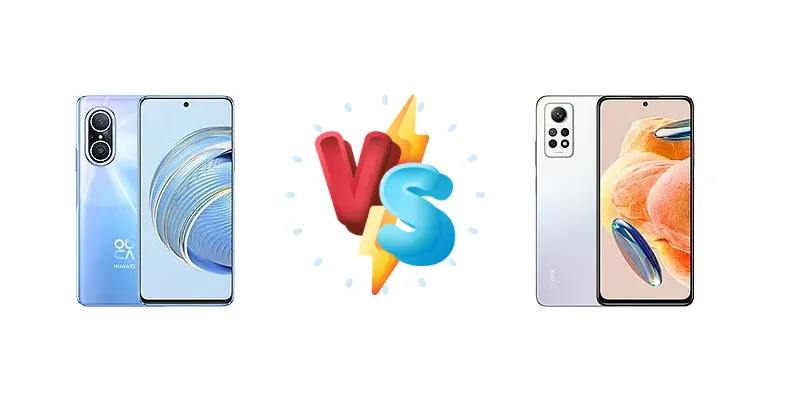
Both the Huawei nova 10 Youth and the Xiaomi Redmi Note 12 Pro 4G target the competitive mid-range 4G smartphone market. While both offer fast charging and appealing designs, they diverge significantly in their core processing power. This comparison dissects those differences, helping you determine which device best suits your needs.
🏆 Quick Verdict
For the average user prioritizing consistent performance and future-proofing, the Xiaomi Redmi Note 12 Pro 4G is the better choice. Its Snapdragon 732G, built on an 8nm process, delivers a noticeable performance advantage over the nova 10 Youth’s Snapdragon 680G, despite both supporting 67W charging.
| Network |
|---|
| 2G bands | GSM 850 / 900 / 1800 / 1900 | GSM 850 / 900 / 1800 / 1900 |
| 3G bands | HSDPA 850 / 900 / 1700(AWS) / 1900 / 2100 | HSDPA 850 / 900 / 1700(AWS) / 1900 / 2100 |
| 4G bands | 1, 2, 3, 4, 5, 8, 18, 19, 26, 34, 38, 39, 40, 41 | 1, 2, 3, 4, 5, 7, 8, 20, 28, 38, 40, 41, 66 |
| Speed | HSPA, LTE | HSPA, LTE |
| Technology | GSM / CDMA / HSPA / CDMA2000 / LTE | GSM / HSPA / LTE |
| | CDMA2000 1x | - |
| Launch |
|---|
| Announced | 2023, March 04 | 2023, March 03 |
| Status | Available. Released 2023, March 04 | Available. Released 2023, April 11 |
| Body |
|---|
| Dimensions | 164.6 x 75.6 x 7.9 mm (6.48 x 2.98 x 0.31 in) | 164.2 x 76.1 x 8.1 mm (6.46 x 3.00 x 0.32 in) |
| SIM | Nano-SIM + Nano-SIM | Nano-SIM + Nano-SIM |
| Weight | 191 g (6.74 oz) | 201.8 g (7.13 oz) |
| | Splash and dust resistant | - |
| Display |
|---|
| Resolution | 1080 x 2388 pixels (~387 ppi density) | 1080 x 2400 pixels, 20:9 ratio (~395 ppi density) |
| Size | 6.78 inches, 111.4 cm2 (~89.5% screen-to-body ratio) | 6.67 inches, 107.4 cm2 (~86.0% screen-to-body ratio) |
| Type | IPS LCD, 90Hz | AMOLED, 120Hz, Dolby Vision, 700 nits (HBM), 1100 nits (peak) |
| Platform |
|---|
| CPU | Octa-core (4x2.4 GHz Cortex-A73 & 4x1.9 GHz Cortex-A53) | Octa-core (2x2.2 GHz Kryo 470 Gold & 6x1.8 GHz Kryo 470 Silver) |
| Chipset | Qualcomm Snapdragon 680G 4G (6 nm) | Qualcomm SM7150 Snapdragon 732G (8 nm) |
| GPU | Adreno 610 | Adreno 618 |
| OS | HarmonyOS 2.0 | Android 11, MIUI 13 |
| Memory |
|---|
| Card slot | No | microSDXC (uses shared SIM slot) |
| Internal | 128GB 8GB RAM, 256GB 8GB RAM | 128GB 6GB RAM, 128GB 8GB RAM, 256GB 8GB RAM |
| | - | UFS 2.2 |
| Main Camera |
|---|
| Features | LED flash, HDR, panorama | LED flash, HDR, panorama |
| Quad | 108 MP, (wide), PDAF
8 MP, (ultrawide)
2 MP (macro)
Auxiliary lens | 108 MP, f/1.9, (wide), 1/1.52", 0.7µm, PDAF
8 MP, 120˚, (ultrawide)
2 MP (macro)
Auxiliary lens |
| Single | 16 MP, f/2.2, (wide) | - |
| Triple | 108 MP, (wide), PDAF
8 MP, (ultrawide)
2 MP, (macro)
2 MP, (depth) | - |
| Video | 1080p@30fps | 4K@30fps, 1080p@30/60fps |
| Selfie camera |
|---|
| Single | 16 MP, f/2.2, (wide) | 16 MP, f/2.4, (wide) |
| Video | 1080p@30fps | 1080p@30fps |
| Sound |
|---|
| 3.5mm jack | No | Yes |
| 35mm jack | No | Yes |
| Loudspeaker | Yes | Yes, with stereo speakers |
| Comms |
|---|
| Bluetooth | 5.0, A2DP, LE | 5.0, A2DP, LE |
| Infrared port | - | Yes |
| NFC | No | Yes (market/region dependent) |
| Positioning | GPS, GLONASS, GALILEO, BDS, QZSS | GPS, GLONASS, GALILEO, BDS |
| Radio | No | Unspecified |
| USB | USB Type-C 2.0, OTG | USB Type-C 2.0, OTG |
| WLAN | Wi-Fi 802.11 a/b/g/n/ac, dual-band | Wi-Fi 802.11 a/b/g/n/ac, dual-band |
| Features |
|---|
| Sensors | Fingerprint (side-mounted), accelerometer, proximity, compass | Fingerprint (side-mounted), accelerometer, gyro, compass |
| Battery |
|---|
| Charging | 66W wired, 60% in 15 min, 100% in 35 min
5W reverse wired | 67W wired |
| Type | Li-Po 4000 mAh | Li-Po 5000 mAh |
| Misc |
|---|
| Colors | Black, Blue | Star Blue, Graphite Gray, Polar White, Ice blue |
| Models | JLN-AL00 | 2209116AG, 2209116AG |
| Price | About 230 EUR | About 150 EUR |
Huawei nova 10 Youth
- Sleek and modern design (assumed based on Huawei's aesthetic)
- Fast 67W charging
- Potentially lighter weight due to less complex chipset
- Less powerful Snapdragon 680G chipset
- Likely struggles with demanding games and apps
- Potentially slower image processing
Xiaomi Redmi Note 12 Pro 4G
- More powerful Snapdragon 732G chipset
- Better performance for gaming and multitasking
- More efficient 8nm process for improved battery life
- May be slightly heavier due to more complex chipset
- Design may be less visually striking (subjective)
- Potential for slightly higher price
Display Comparison
Neither device boasts a standout display. While specific panel details (like peak brightness or color gamut coverage) are absent, the focus here is on processing power. Both likely utilize IPS LCD panels common in this price bracket. The absence of high refresh rates on either device suggests a focus on battery life over visual fluidity.
Camera Comparison
Without detailed camera specs beyond the main sensors, a direct comparison is difficult. However, the chipset plays a role in image processing speed and quality. The Redmi Note 12 Pro 4G’s more powerful Snapdragon 732G will likely handle image processing tasks more efficiently, resulting in faster capture times and potentially better low-light performance. The absence of Optical Image Stabilization (OIS) on either device suggests a reliance on software stabilization, where the 732G’s ISP could provide an edge.
Performance
The core difference lies in the chipsets. The Xiaomi Redmi Note 12 Pro 4G’s Snapdragon 732G (8nm) is architecturally superior to the Huawei nova 10 Youth’s Snapdragon 680G (6nm). The 732G features Kryo 470 Gold cores clocked at 2.2 GHz, offering a performance boost over the 680G’s Cortex-A73 cores at 2.4 GHz. The 8nm process of the 732G also contributes to better thermal efficiency, potentially reducing throttling during sustained workloads. This translates to smoother gaming and faster app loading times on the Redmi Note 12 Pro 4G. The 680G is adequate for everyday tasks, but will struggle with more demanding applications.
Battery Life
Both phones feature 67W wired charging, promising rapid replenishment. Huawei claims 60% charge in 15 minutes and 100% in 35 minutes, while Xiaomi claims similar speeds. While battery capacity isn't specified, the Snapdragon 732G’s 8nm process is more power-efficient than the 6nm Snapdragon 680G. This means the Redmi Note 12 Pro 4G could potentially offer slightly longer battery life despite similar capacity, and the more efficient chip will reduce heat generation during charging.
Buying Guide
Buy the Huawei nova 10 Youth if you prioritize a sleek design and are primarily a casual user focused on social media, light browsing, and basic photography. Buy the Xiaomi Redmi Note 12 Pro 4G if you value smoother multitasking, better gaming performance, and a more capable chipset for demanding applications, even within the 4G ecosystem.
Frequently Asked Questions
❓ Will the Snapdragon 680G in the nova 10 Youth struggle with graphically intensive games like PUBG Mobile?
Yes, the Snapdragon 680G is a budget-oriented chipset. While PUBG Mobile may be playable at lower settings, expect frame drops and stuttering, especially during intense firefights. The Redmi Note 12 Pro 4G’s Snapdragon 732G will provide a significantly smoother gaming experience.
❓ How much of a real-world difference will the 8nm vs 6nm process make in terms of battery life?
The 8nm process of the Snapdragon 732G is more efficient, meaning it consumes less power for the same tasks. While the difference won't be dramatic, you can expect a few extra hours of usage on the Redmi Note 12 Pro 4G, particularly during prolonged gaming or video streaming.
❓ Does the faster charging speed of 67W on both phones actually translate to a noticeable difference in daily use?
Absolutely. 67W charging is incredibly fast, allowing you to top up your phone quickly during short breaks. Both phones claim a full charge in around 35 minutes, which is a significant convenience compared to slower charging standards.
❓ Is the lack of 5G connectivity a major drawback for either of these phones?
For users in areas with limited 5G coverage, or those who don't heavily rely on mobile data, the lack of 5G isn't a significant issue. Both phones offer robust 4G LTE connectivity, which is still sufficient for most everyday tasks. However, if 5G is a priority, you'll need to consider other options.