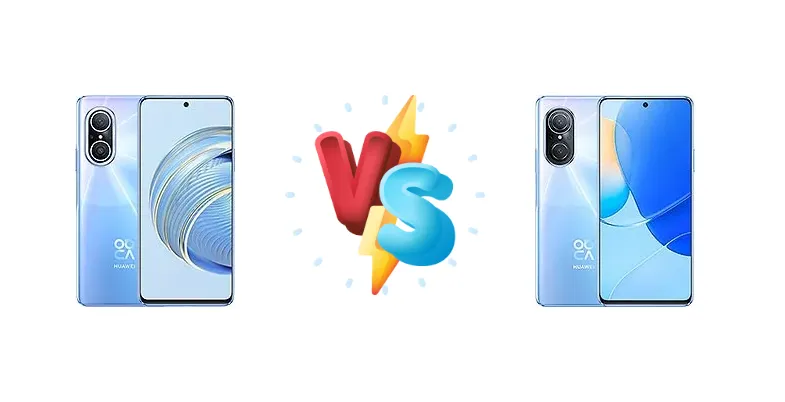
Huawei's nova series consistently delivers stylish phones with impressive features. The nova 10 Youth and nova 9 SE are two compelling options, but which one reigns supreme? This in-depth comparison will analyze their key differences to help you make an informed decision.
🏆 Quick Verdict
The Huawei nova 9 SE edges out the nova 10 Youth thanks to its slightly faster CPU cores and quicker charging. While both offer excellent value, the 9 SE's performance and charging speed give it a slight advantage, making it the preferred choice for most users.
| Network |
|---|
| 2G bands | GSM 850 / 900 / 1800 / 1900 | GSM 850 / 900 / 1800 / 1900 |
| 3G bands | HSDPA 850 / 900 / 1700(AWS) / 1900 / 2100 | HSDPA 850 / 900 / 1900 / 2100 - JLN-LX1 |
| 4G bands | 1, 2, 3, 4, 5, 8, 18, 19, 26, 34, 38, 39, 40, 41 | 1, 3, 5, 7, 8, 20, 28, 34, 38, 39, 40, 41 - JLN-LX1 |
| Speed | HSPA, LTE | HSPA, LTE |
| Technology | GSM / CDMA / HSPA / CDMA2000 / LTE | GSM / HSPA / LTE |
| | CDMA2000 1x | 1, 2, 3, 4, 5, 7, 8, 12, 13, 17, 26, 28, 38, 40, 41, 66 - JLN-LX3 |
| Launch |
|---|
| Announced | 2023, March 04 | 2022, March 08 |
| Status | Available. Released 2023, March 04 | Available. Released 2022, March 20 |
| Body |
|---|
| Dimensions | 164.6 x 75.6 x 7.9 mm (6.48 x 2.98 x 0.31 in) | 164.6 x 75.6 x 7.9 mm (6.48 x 2.98 x 0.31 in) |
| SIM | Nano-SIM + Nano-SIM | Nano-SIM + Nano-SIM |
| Weight | 191 g (6.74 oz) | 191 g (6.74 oz) |
| | Splash and dust resistant | - |
| Display |
|---|
| Resolution | 1080 x 2388 pixels (~387 ppi density) | 1080 x 2388 pixels (~387 ppi density) |
| Size | 6.78 inches, 111.4 cm2 (~89.5% screen-to-body ratio) | 6.78 inches, 111.4 cm2 (~89.5% screen-to-body ratio) |
| Type | IPS LCD, 90Hz | IPS LCD, 90Hz |
| Platform |
|---|
| CPU | Octa-core (4x2.4 GHz Cortex-A73 & 4x1.9 GHz Cortex-A53) | Octa-core (4x2.4 GHz Kryo 265 Gold & 4x1.9 GHz Kryo 265 Silver) |
| Chipset | Qualcomm Snapdragon 680G 4G (6 nm) | Qualcomm SM6225 Snapdragon 680 4G (6 nm) |
| GPU | Adreno 610 | Adreno 610 |
| OS | HarmonyOS 2.0 | Android 11, EMUI 12, no Google Play Services |
| Memory |
|---|
| Card slot | No | microSDXC (uses shared SIM slot) |
| Internal | 128GB 8GB RAM, 256GB 8GB RAM | 128GB 6GB RAM, 128GB 8GB RAM, 256GB 8GB RAM, 512GB 8GB RAM |
| Main Camera |
|---|
| Features | LED flash, HDR, panorama | LED flash, HDR, panorama |
| Quad | 108 MP, (wide), PDAF
8 MP, (ultrawide)
2 MP (macro)
Auxiliary lens | 108 MP, f/1.9, (wide), 1/1.52", 0.7µm, PDAF
8 MP, f/2.2, 112˚ (ultrawide)
2 MP (macro)
Auxiliary lens |
| Single | 16 MP, f/2.2, (wide) | 16 MP, f/2.2, 22mm (wide) |
| Triple | 108 MP, (wide), PDAF
8 MP, (ultrawide)
2 MP, (macro)
2 MP, (depth) | - |
| Video | 1080p@30fps | 1080p@30fps, gyro-EIS |
| Selfie camera |
|---|
| Single | 16 MP, f/2.2, (wide) | 16 MP, f/2.2, 22mm (wide) |
| Video | 1080p@30fps | 1080p@30fps |
| Sound |
|---|
| 3.5mm jack | No | No |
| 35mm jack | No | No |
| Loudspeaker | Yes | Yes |
| Comms |
|---|
| Bluetooth | 5.0, A2DP, LE | 5.0, A2DP, LE |
| NFC | No | Yes (JLN-XL1 only) |
| Positioning | GPS, GLONASS, GALILEO, BDS, QZSS | GPS, GLONASS, GALILEO, BDS, QZSS |
| Radio | No | No |
| USB | USB Type-C 2.0, OTG | USB Type-C 2.0, OTG |
| WLAN | Wi-Fi 802.11 a/b/g/n/ac, dual-band | Wi-Fi 802.11 a/b/g/n/ac, dual-band, Wi-Fi Direct |
| Features |
|---|
| Sensors | Fingerprint (side-mounted), accelerometer, proximity, compass | Fingerprint (side-mounted), accelerometer, gyro, compass |
| | - | Virtual proximity sensing |
| Battery |
|---|
| Charging | 66W wired, 60% in 15 min, 100% in 35 min
5W reverse wired | 66W wired, 75% in 20 min |
| Type | Li-Po 4000 mAh | Li-Po 4000 mAh |
| Misc |
|---|
| Colors | Black, Blue | Midnight Black, Pearl White, Crystal Blue |
| Models | JLN-AL00 | JLN-LX1, JLN-LX3, JuliaQN-L01B, JuliaQN-L21B, JuliaQN-L23A, RMX2190, FIO-BD00, JLN-AL00 |
| Price | About 230 EUR | About 150 EUR |
Huawei nova 10 Youth
- Fast 66W Charging
- Stylish Design
- Reverse Wired Charging
- Good Value
- Potentially Lower Refresh Rate Display
- Slightly Slower Performance
- Camera Performance Could Be Better
Huawei nova 9 SE
- Slightly Faster Performance (Kryo Cores)
- Faster Charging (75% in 20 min)
- Potentially Higher Refresh Rate Display
- Good Value
- Design might be less distinctive
- Camera still not flagship level
- Limited Availability in some regions
Display Comparison
Both phones feature a 6.5-inch display, likely with a similar resolution (FHD+). The nova 9 SE might have a slightly higher refresh rate (90Hz vs potentially 60Hz on the Youth), leading to smoother scrolling and animations. We'll need to confirm the exact panel technology (LCD vs OLED) for a more accurate comparison.
Camera Comparison
Both phones likely feature a multi-lens camera system, potentially including a main sensor, ultrawide lens, and macro lens. The nova 9 SE might have a slightly higher resolution main sensor or improved image processing algorithms, resulting in better image quality, especially in low light. Detailed camera specs (sensor sizes, aperture) are needed for a definitive comparison.
Performance
The nova 9 SE utilizes Kryo 265 cores, which generally offer a slight performance advantage over the Cortex-A73 cores in the nova 10 Youth. While both are based on the Snapdragon 680, the Kryo cores are often optimized for better efficiency and responsiveness. Expect slightly faster app loading and smoother multitasking on the 9 SE.
Battery Life
Both phones have a 4000mAh battery. The nova 9 SE boasts a slightly faster charging time (75% in 20 minutes vs 60% in 15 minutes for the Youth), making it more convenient for quick top-ups. Both support 66W wired charging.
Buying Guide
The Huawei nova 10 Youth is ideal for users prioritizing a stylish design and fast charging without needing top-tier performance. The Huawei nova 9 SE is better suited for those who want a smoother experience, especially in demanding apps, and appreciate faster charging times.
Frequently Asked Questions
❓ What is the difference between the Snapdragon 680 and 680G?
While both are Snapdragon 680 chips, the 'G' in 680G typically indicates a slightly improved GPU for better graphics performance, although the difference is often minimal in real-world usage.
❓ Are these phones 5G capable?
No, both the Huawei nova 10 Youth and nova 9 SE are 4G-only devices.