
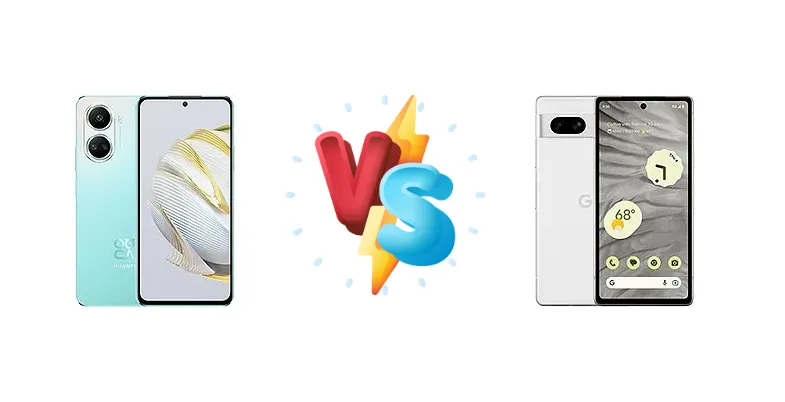
Google Pixel 7a vs. Huawei Nova 10 SE: A Detailed Comparison
| Phones Images | |||||
|---|---|---|---|---|---|
|
🏆 Quick Verdict
For most users, the Google Pixel 7a is the superior choice. Its Tensor G2 chipset delivers significantly better performance and future-proofing, coupled with Google’s exceptional camera software. While the nova 10 SE boasts impressive 66W charging, it can’t match the Pixel 7a’s overall capabilities.
| PHONES | ||
|---|---|---|
| Phone Names | Huawei nova 10 SE | Google Pixel 7a |
| Network | ||
|---|---|---|
| 2G bands | GSM 850 / 900 / 1800 / 1900 | GSM 850 / 900 / 1800 / 1900 |
| 3G bands | HSDPA 850 / 900 / 1900 / 2100 - BNE-LX1 | HSDPA 800 / 850 / 900 / 1700(AWS) / 1900 / 2100 |
| 4G bands | 1, 3, 5, 7, 8, 20, 28, 34, 38, 39, 40, 41 - BNE-LX1 | 1, 2, 3, 4, 5, 7, 8, 12, 13, 14, 17, 20, 25, 26, 28, 29, 30, 38, 40, 41, 48, 66, 71 - GWKK3, G0DZQ |
| 5G bands | - | 1, 2, 3, 5, 7, 8, 12, 14, 20, 25, 28, 30, 38, 41, 48, 66, 71, 77, 78 SA/NSA/Sub6 - GWKK3 |
| Speed | HSPA, LTE | HSPA, LTE, 5G |
| Technology | GSM / HSPA / LTE | GSM / HSPA / LTE / 5G |
| 1, 2, 3, 4, 5, 7, 8, 12, 13, 17, 26, 28, 38, 40, 41, 66 - BNE-LX3 | 1, 2, 3, 5, 7, 8, 12, 20, 25, 28, 38, 40, 41, 66, 75, 76, 77, 78, 79 SA/NSA/Sub6 - GHL1X, G82U8 | |
| Launch | ||
|---|---|---|
| Announced | 2022, October 05 | 2023, May 10 |
| Status | Available. Released 2022, October 25 | Available. Released 2023, May 10 |
| Body | ||
|---|---|---|
| Build | - | Glass front (Gorilla Glass 3), aluminum frame, plastic back |
| Dimensions | 162.4 x 75.5 x 7.4 mm (6.39 x 2.97 x 0.29 in) | 152 x 72.9 x 9 mm (5.98 x 2.87 x 0.35 in) |
| SIM | · Nano-SIM· Nano-SIM + Nano-SIM | Nano-SIM + eSIM |
| Weight | 184 g (6.49 oz) | 193.5 g (6.84 oz) |
| - | IP67 dust/water resistant (up to 1m for 30 min) | |
| Display | ||
|---|---|---|
| Protection | - | Corning Gorilla Glass 3 |
| Resolution | 1080 x 2400 pixels, 20:9 ratio (~395 ppi density) | 1080 x 2400 pixels, 20:9 ratio (~429 ppi density) |
| Size | 6.67 inches, 107.4 cm2 (~87.6% screen-to-body ratio) | 6.1 inches, 90.7 cm2 (~81.8% screen-to-body ratio) |
| Type | OLED, 1B colors, 90Hz | OLED, HDR, 90Hz |
| Always-On Display | Always-on display | |
| Platform | ||
|---|---|---|
| CPU | Octa-core (4x2.4 GHz Cortex-A73 & 4x1.9 GHz Cortex-A53) | Octa-core (2x2.85 GHz Cortex-X1 & 2x2.35 GHz Cortex-A78 & 4x1.80 GHz Cortex-A55) |
| Chipset | Qualcomm Snapdragon 680G 4G (6 nm) | Google Tensor G2 (5 nm) |
| GPU | Adreno 610 | Mali-G710 MP7 |
| OS | EMUI 12, no Google Play Services | Android 13, upgradable to Android 15, up to 5 major Android upgrades |
| Memory | ||
|---|---|---|
| Card slot | No | No |
| Internal | 128GB 6GB RAM, 128GB 8GB RAM, 256GB 8GB RAM | 128GB 8GB RAM |
| - | UFS 3.1 | |
| Main Camera | ||
|---|---|---|
| Dual | - | 64 MP, f/1.9, 26mm (wide), 1/1.73", 0.8µm, dual pixel PDAF, OIS 13 MP, f/2.2, 120˚ (ultrawide), 1.12µm |
| Features | Dual-LED dual-tone flash, panorama, HDR | Dual-LED flash, Pixel Shift, Auto-HDR, panorama |
| Single | 16 MP, f/2.2, (wide) | - |
| Triple | 108 MP, f/1.9, 27mm (wide), PDAF 8 MP, f/2.2, 112˚ (ultrawide) 2 MP (macro) | - |
| Video | 1080p@30fps | 4K@30/60fps, 1080p@30/60/120/240fps, OIS |
| Selfie camera | ||
|---|---|---|
| Features | - | HDR, panorama |
| Single | 16 MP, f/2.2, (wide) | 13 MP, f/2.2, 20mm (ultrawide), 1.12µm |
| Video | 1080p@30fps | 4K@30fps, 1080p@30fps |
| Sound | ||
|---|---|---|
| 3.5mm jack | No | No |
| 35mm jack | No | No |
| Loudspeaker | Yes | Yes, with stereo speakers |
| Comms | ||
|---|---|---|
| Bluetooth | 5.0, A2DP, LE | 5.3, A2DP, LE |
| NFC | Yes (BNE-LX1 only) | Yes |
| Positioning | GPS, GLONASS, GALILEO, BDS, QZSS | GPS, GLONASS, GALILEO, BDS, QZSS, NavIC |
| Radio | No | No |
| USB | USB Type-C 2.0, OTG | USB Type-C 3.2 |
| WLAN | Wi-Fi 802.11 a/b/g/n/ac, dual-band | Wi-Fi 802.11 a/b/g/n/ac/6e, tri-band |
| Features | ||
|---|---|---|
| Sensors | Fingerprint (side-mounted), accelerometer, gyro, compass, proximity (ultrasound) | Fingerprint (under display, optical), accelerometer, gyro, proximity, compass, barometer |
| Battery | ||
|---|---|---|
| Charging | 66W wired 5W reverse wired | 18W wired, PD3.0 7.5W wireless |
| Type | Li-Po 4500 mAh | Li-Po 4385 mAh |
| Misc | ||
|---|---|---|
| Colors | Starry Silver, Mint Green, Starry Black | Charcoal, Snow, Sea, Coral |
| Models | BNE-LX1, BNE-LX3, BNE-AL00 | GWKK3, GHL1X, G0DZQ, G82U8 |
| Price | About 170 EUR | € 179.90 / $ 150.00 / £ 170.00 / ₹ 25,980 |
Huawei nova 10 SE
- Significantly faster processor with the Google Tensor G2
- Superior camera performance and image processing
- Guaranteed software updates and security patches
- Slower charging speed (18W)
- Potentially lower battery endurance compared to nova 10 SE
Google Pixel 7a
- Extremely fast 66W wired charging
- Simple and streamlined user experience
- Potentially longer battery life due to efficient chipset
- Less powerful processor, limiting performance in demanding tasks
- Inferior camera capabilities compared to the Pixel 7a
Display Comparison
The Pixel 7a’s display shines with a measured peak brightness of 1070 nits, offering excellent visibility even in direct sunlight – a crucial advantage over the nova 10 SE, whose display brightness is not specified. While both likely utilize OLED panels, the Pixel 7a’s higher brightness and Google’s color calibration expertise provide a more vibrant and accurate viewing experience. The absence of LTPO technology on either device means refresh rates are likely fixed, impacting smoothness compared to higher-end phones.
Camera Comparison
Google’s Pixel phones are renowned for their computational photography, and the 7a is no exception. While specific sensor details aren’t provided, the Pixel 7a leverages Google’s Tensor G2 chip for advanced image processing, including features like Magic Eraser and Photo Unblur. The nova 10 SE’s camera system is less detailed in the provided specs, suggesting a more conventional approach. The Pixel 7a’s superior processing power will likely result in better dynamic range, noise reduction, and overall image quality, particularly in challenging lighting conditions. Ignoring the likely low-resolution macro lens on the nova 10 SE, the Pixel 7a’s video capabilities are also expected to be superior due to the Tensor G2’s dedicated image signal processor.
Performance
The performance gap between these devices is substantial. The Google Pixel 7a’s Tensor G2, built on a 5nm process, features a tri-cluster configuration with high-performance Cortex-X1 cores, delivering significantly more processing power than the Huawei nova 10 SE’s Snapdragon 680G. The 680G, fabricated on a 6nm node, is geared towards efficiency rather than raw speed; its Cortex-A73 cores are older architecture and will struggle with demanding tasks. This translates to smoother multitasking, faster app loading, and a more responsive gaming experience on the Pixel 7a. The Pixel 7a also benefits from potentially faster RAM (likely LPDDR5x) compared to the nova 10 SE.
Battery Life
The Huawei nova 10 SE’s standout feature is its 66W wired charging, allowing for a significantly faster 0-100% charge compared to the Pixel 7a’s 18W charging. While the Pixel 7a boasts a reported 76-hour endurance rating, this is a complex metric. The nova 10 SE’s faster charging mitigates concerns about battery life, allowing for quick top-ups throughout the day. The Pixel 7a also supports 7.5W wireless charging, a feature absent on the nova 10 SE, offering added convenience.
Buying Guide
Buy the Huawei nova 10 SE if you prioritize extremely fast charging and a simple, uncluttered software experience, and are less concerned with demanding applications or top-tier camera performance. Buy the Google Pixel 7a if you value a powerful processor, exceptional camera capabilities powered by AI, and guaranteed software updates directly from Google, even if it means slower charging speeds.