
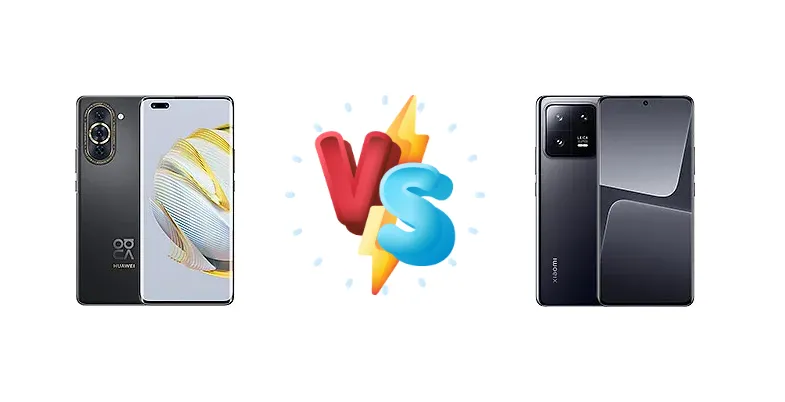
Xiaomi 13 Pro vs Huawei nova 10 Pro: A Deep Dive into Performance and Charging
| Phones Images | |||||
|---|---|---|---|---|---|
|
🏆 Quick Verdict
For most users, the Xiaomi 13 Pro is the superior choice. Its Snapdragon 8 Gen 2 chipset provides significantly faster performance and better long-term software support. However, the Huawei nova 10 Pro’s 100W charging is a compelling feature for those prioritizing speed above all else.
| PHONES | ||
|---|---|---|
| Phone Names | Huawei nova 10 Pro | Xiaomi 13 Pro |
| Network | ||
|---|---|---|
| 2G bands | GSM 850 / 900 / 1800 / 1900 | GSM 850 / 900 / 1800 / 1900 |
| 3G bands | HSDPA 800 / 850 / 900 / 1700(AWS) / 1900 / 2100 | HSDPA 800 / 850 / 900 / 1700(AWS) / 1900 / 2100 |
| 4G bands | 1, 2, 3, 4, 5, 8, 18, 19, 26, 34, 38, 39, 40, 41 | 1, 2, 3, 4, 5, 7, 8, 12, 13, 17, 18, 19, 20, 25, 26, 28, 32, 38, 39, 40, 41, 42, 48, 66 - International |
| 5G bands | - | 1, 3, 5, 7, 8, 20, 28, 38, 40, 41, 66, 71, 75, 77, 78 SA/NSA - International |
| Speed | HSPA, LTE | HSPA, LTE, 5G |
| Technology | GSM / CDMA / HSPA / LTE | GSM / CDMA / HSPA / CDMA2000 / LTE / 5G |
| CDMA 800 | 1, 3, 5, 8, 28, 38, 40, 41, 77, 78, 79 SA/NSA - China | |
| Launch | ||
|---|---|---|
| Announced | 2022, July 04 | 2022, December 11 |
| Status | Available. Released 2022, July 10 | Available. Released 2022, December 14 |
| Body | ||
|---|---|---|
| Build | - | Glass front (Gorilla Glass Victus), ceramic back or silicone polymer back, aluminum frame |
| Dimensions | 164.2 x 74.5 x 7.9 mm (6.46 x 2.93 x 0.31 in) | 162.9 x 74.6 x 8.4 mm or 8.7 mm |
| SIM | Nano-SIM + Nano-SIM | · Nano-SIM + eSIM· Nano-SIM + Nano-SIM |
| Weight | 191 g (6.74 oz) | 210 g or 229 g (7.41 oz) |
| - | IP68 dust/water resistant (up to 1.5m for 30 min) | |
| Display | ||
|---|---|---|
| Protection | - | Corning Gorilla Glass Victus |
| Resolution | 1200 x 2652 pixels (~429 ppi density) | 1440 x 3200 pixels, 20:9 ratio (~522 ppi density) |
| Size | 6.78 inches, 111.4 cm2 (~91.1% screen-to-body ratio) | 6.73 inches, 108.9 cm2 (~89.6% screen-to-body ratio) |
| Type | OLED, 1B colors, HDR10, 120Hz | LTPO AMOLED, 1B colors, 120Hz, Dolby Vision, HDR10+, 1200 nits (HBM), 1900 nits (peak) |
| Platform | ||
|---|---|---|
| CPU | Octa-core (4x2.4 GHz Kryo 670 & 4x1.8 GHz Kryo 670) | Octa-core (1x3.2 GHz Cortex-X3 & 2x2.8 GHz Cortex-A715 & 2x2.8 GHz Cortex-A710 & 3x2.0 GHz Cortex-A510) |
| Chipset | Qualcomm SM7325 Snapdragon 778G 4G (6 nm) | Qualcomm SM8550-AB Snapdragon 8 Gen 2 (4 nm) |
| GPU | Adreno 642L | Adreno 740 |
| OS | HarmonyOS 2.0 | Android 13, upgradable to Android 14, HyperOS |
| Memory | ||
|---|---|---|
| Card slot | No | No |
| Internal | 128GB 8GB RAM, 256GB 8GB RAM | 128GB 8GB RAM, 256GB 8GB RAM, 256GB 12GB RAM, 512GB 12GB RAM |
| - | UFS 3.1 - 128GB UFS 4.0 - 256/512GB | |
| Main Camera | ||
|---|---|---|
| Dual | 8 MP, f/2.2, 52mm (portrait), AF 60 MP, f/2.4, 17mm, 100˚ (ultrawide), AF | - |
| Features | LED flash, panorama, HDR | Laser AF, color spectrum sensor, Leica lens, Dual-LED dual-tone flash, HDR, panorama |
| Triple | 50 MP, f/1.8, 27mm (wide), PDAF 8 MP, f/2.2, 112˚ (ultrawide), AF Auxiliary lens | 50.3 MP, f/1.9, 23mm (wide), 1.0"-type, 1.6µm, dual pixel PDAF, OIS 50 MP, f/2.0, 75mm (telephoto), PDAF (10cm - ∞), 3.2x optical zoom 50 MP, f/2.2, 14mm, 115˚ (ultrawide), AF |
| Video | 4K, 1080p, 720p@960fps, gyro-EIS | 8K@24fps (HDR), 4K@24/30/60fps (HDR10+, 10-bit Dolby Vision HDR, 10-bit LOG), 1080p@30/120/240/960fps, 1080p@1920fps, gyro-EIS |
| Selfie camera | ||
|---|---|---|
| Dual | 8 MP, f/2.2, 52mm (telephoto), AF, 2x optical zoom 60 MP, f/2.4, 17mm, 100˚ (ultrawide), AF | - |
| Features | HDR | HDR, panorama |
| Single | - | 32 MP, f/2.0, 22mm (wide), 1/3.14", 0.7µm |
| Video | 4K@30fps, 1080p@30fps, gyro-EIS | 1080p@30fps |
| Sound | ||
|---|---|---|
| 3.5mm jack | No | No |
| 35mm jack | No | No |
| Loudspeaker | Yes, with stereo speakers | Yes, with stereo speakers |
| - | 24-bit/192kHz audio | |
| Comms | ||
|---|---|---|
| Bluetooth | 5.2, A2DP, LE | 5.3, A2DP, aptX HD, aptX Adaptive |
| Infrared port | - | Yes |
| NFC | Yes | Yes |
| Positioning | GPS (L1+L5), GLONASS (L1), BDS (B1I+B1c+B2a), GALILEO (E1+E5a), QZSS (L1+L5), NavIC (L5) | GPS (L1+L5), GLONASS (G1), BDS (B1I+B1c+B2a), GALILEO (E1+E5a), QZSS (L1+L5), NavIC (L5) |
| Radio | No | No |
| USB | USB Type-C 2.0, OTG | USB Type-C 2.0, OTG |
| WLAN | Wi-Fi 802.11 a/b/g/n/a/6, dual-band, Wi-Fi Direct | Wi-Fi 802.11 a/b/g/n/ac/6e, dual-band, Wi-Fi Direct |
| Features | ||
|---|---|---|
| Sensors | Fingerprint (under display, optical), accelerometer, gyro, compass | Fingerprint (under display, optical), accelerometer, proximity, gyro, compass, barometer |
| Virtual proximity sensing | - | |
| Battery | ||
|---|---|---|
| Charging | 100W wired, 20-80% in 10 min Reverse wired | 120W wired, PD3.0, QC4, 100% in 19 min 50W wireless, 100% in 36 min 10W reverse wireless |
| Type | Li-Po 4500 mAh | Li-Po 4820 mAh |
| Misc | ||
|---|---|---|
| Colors | Black, Silver, Green, Violet | Ceramic White, Ceramic Black, Ceramic Flora Green, Mountain Blue |
| Models | GLA-AL00, GLA-LX1 | 2210132G, 2210132C |
| Price | About 730 EUR | About 750 EUR |
| Tests | ||
|---|---|---|
| Battery life | Endurance rating 89h | Endurance rating 115h |
| Camera | Photo / Video | Photo / Video |
| Display | Contrast ratio: Infinite (nominal) | Contrast ratio: Infinite (nominal) |
| Loudspeaker | -27.7 LUFS (Good) | -25.6 LUFS (Very good) |
| Performance | AnTuTu: 528847 (v9) GeekBench: 2794 (v5.1) GFXBench: 23fps (ES 3.1 onscreen) | AnTuTu: 1281666 (v9) GeekBench: 5087 (v5.1), 5323 (v6) GFXBench: 64fps (ES 3.1 onscreen) |
Huawei nova 10 Pro
- Incredibly fast 100W wired charging
- Sleek and stylish design
- Competitive price point
- 4G connectivity limitation
- Less powerful Snapdragon 778G chipset
- Potentially limited software updates
Xiaomi 13 Pro
- Flagship Snapdragon 8 Gen 2 performance
- 5G connectivity
- Brighter and potentially more efficient display
- Faster and more versatile charging options (wired & wireless)
- Higher price tag
- May lack the unique aesthetic appeal of the nova 10 Pro
- Larger size and weight
Display Comparison
The Xiaomi 13 Pro boasts a significantly brighter display, reaching 1253 nits compared to the Huawei nova 10 Pro’s 784 nits. This translates to superior visibility in direct sunlight. Both displays share an 'Infinite' (nominal) contrast ratio, suggesting excellent black levels. While neither specification details refresh rate, the Xiaomi 13 Pro, being a flagship, is likely to feature an adaptive refresh rate (LTPO) for improved power efficiency, a feature not confirmed for the nova 10 Pro.
Camera Comparison
Both phones feature capable camera systems, but detailed sensor information is lacking. However, the Xiaomi 13 Pro, as a flagship, is expected to have a larger main sensor and more advanced image processing capabilities. The absence of specific details on the nova 10 Pro’s camera system suggests it may not compete directly with the Xiaomi 13 Pro in image quality, particularly in low-light conditions. The focus should be on the primary sensor and OIS, as 2MP macro lenses are rarely impactful.
Performance
The performance gap is substantial. The Xiaomi 13 Pro’s Snapdragon 8 Gen 2 (4nm) is a generational leap ahead of the Huawei nova 10 Pro’s Snapdragon 778G 4G (6nm). The 8 Gen 2’s octa-core configuration – with a Cortex-X3 prime core – delivers significantly faster processing speeds and improved graphics performance. The 4nm process node also contributes to better thermal efficiency, reducing the likelihood of throttling during sustained workloads. The nova 10 Pro’s 4G connectivity is a major limitation for users in areas with 5G coverage.
Battery Life
The Xiaomi 13 Pro offers a more comprehensive charging solution. While the Huawei nova 10 Pro’s 100W wired charging is incredibly fast (20-80% in 10 minutes), the Xiaomi 13 Pro matches it with 120W wired charging (100% in 19 minutes) and adds 50W wireless charging (100% in 36 minutes) and 10W reverse wireless charging. Endurance ratings suggest the Xiaomi 13 Pro has a longer battery life (115h) compared to the nova 10 Pro (89h), likely due to a combination of battery capacity and the more efficient Snapdragon 8 Gen 2 chipset.
Buying Guide
Buy the Huawei nova 10 Pro if you prioritize incredibly fast charging and a sleek aesthetic, and are comfortable with the limitations of the 4G Snapdragon 778G and potential software ecosystem constraints. Buy the Xiaomi 13 Pro if you demand top-tier performance for gaming and demanding applications, require 5G connectivity, and value a more robust software experience with guaranteed updates.