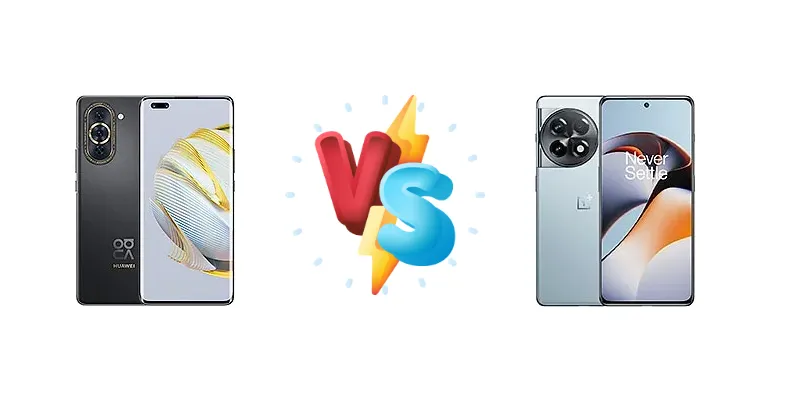
The Huawei nova 10 Pro and OnePlus 11R represent compelling options in the increasingly competitive mid-range smartphone market. The nova 10 Pro focuses on a sleek design and fast charging, while the OnePlus 11R prioritizes raw processing power with its flagship-tier chipset. This comparison dissects their key differences to help you determine which device best suits your needs.
🏆 Quick Verdict
For most users, the OnePlus 11R emerges as the stronger choice. Its Snapdragon 8+ Gen 1 chipset delivers significantly superior performance, making it ideal for demanding tasks and gaming. While the nova 10 Pro boasts impressive 100W charging, the 11R matches it and compensates with a more powerful processor.
| Network |
|---|
| 2G bands | GSM 850 / 900 / 1800 / 1900 | GSM 850 / 900 / 1800 / 1900 |
| 3G bands | HSDPA 800 / 850 / 900 / 1700(AWS) / 1900 / 2100 | HSDPA 850 / 900 / 1700(AWS) / 2100 |
| 4G bands | 1, 2, 3, 4, 5, 8, 18, 19, 26, 34, 38, 39, 40, 41 | 1, 3, 4, 5, 8, 28, 34, 38, 39, 40, 41 |
| 5G bands | - | 1, 3, 5, 8, 28, 40, 41, 77, 78 SA/NSA |
| Speed | HSPA, LTE | HSPA, LTE (3CA), 5G |
| Technology | GSM / CDMA / HSPA / LTE | GSM / CDMA / HSPA / LTE / 5G |
| | CDMA 800 | CDMA 800 |
| Launch |
|---|
| Announced | 2022, July 04 | 2023, February 07 |
| Status | Available. Released 2022, July 10 | Available. Released 2023, February 21 |
| Body |
|---|
| Build | - | Glass front, glass back (Gorilla Glass 5), plastic frame |
| Dimensions | 164.2 x 74.5 x 7.9 mm (6.46 x 2.93 x 0.31 in) | 163.4 x 74.3 x 8.7 mm (6.43 x 2.93 x 0.34 in) |
| SIM | Nano-SIM + Nano-SIM | Nano-SIM + Nano-SIM |
| Weight | 191 g (6.74 oz) | 204 g (7.20 oz) |
| Display |
|---|
| Resolution | 1200 x 2652 pixels (~429 ppi density) | 1240 x 2772 pixels, 20:9 ratio (~451 ppi density) |
| Size | 6.78 inches, 111.4 cm2 (~91.1% screen-to-body ratio) | 6.74 inches, 109.2 cm2 (~90.0% screen-to-body ratio) |
| Type | OLED, 1B colors, HDR10, 120Hz | Fluid AMOLED, 1B colors, 120Hz, HDR10+, 1450 nits (peak) |
| Platform |
|---|
| CPU | Octa-core (4x2.4 GHz Kryo 670 & 4x1.8 GHz Kryo 670) | Octa-core (1x3.0 GHz Cortex-X2 & 3x2.5 GHz Cortex-A710 & 4x1.80 GHz Cortex-A510) |
| Chipset | Qualcomm SM7325 Snapdragon 778G 4G (6 nm) | Qualcomm SM8475 Snapdragon 8+ Gen 1 (4 nm) |
| GPU | Adreno 642L | Adreno 730 |
| OS | HarmonyOS 2.0 | Android 13, upgradable to Android 15, OxygenOS 15 |
| Memory |
|---|
| Card slot | No | No |
| Internal | 128GB 8GB RAM, 256GB 8GB RAM | 128GB 8GB RAM, 256GB 16GB RAM, 512GB 18GB RAM |
| | - | UFS 3.1 |
| Main Camera |
|---|
| Dual | 8 MP, f/2.2, 52mm (portrait), AF
60 MP, f/2.4, 17mm, 100˚ (ultrawide), AF | - |
| Features | LED flash, panorama, HDR | Color spectrum sensor, LED flash, HDR, panorama |
| Single | - | 16 MP, f/2.4, 24mm (wide), 1/3.09", 1.0µm |
| Triple | 50 MP, f/1.8, 27mm (wide), PDAF
8 MP, f/2.2, 112˚ (ultrawide), AF
Auxiliary lens | 50 MP, f/1.8, 24mm (wide), 1/1.56", 1.0µm, multi-directional PDAF, OIS
8 MP, f/2.2, 120˚ (ultrawide), 1/4.0", 1.12µm
2 MP (macro) |
| Video | 4K, 1080p, 720p@960fps, gyro-EIS | 4K@30/60fps, 1080p@30/60/240fps, gyro-EIS |
| Selfie camera |
|---|
| Dual | 8 MP, f/2.2, 52mm (telephoto), AF, 2x optical zoom
60 MP, f/2.4, 17mm, 100˚ (ultrawide), AF | - |
| Features | HDR | HDR |
| Single | - | 16 MP, f/2.4, 24mm (wide), 1/3.09", 1.0µm |
| Video | 4K@30fps, 1080p@30fps, gyro-EIS | 1080p@30fps |
| Sound |
|---|
| 3.5mm jack | No | No |
| 35mm jack | No | No |
| Loudspeaker | Yes, with stereo speakers | Yes, with stereo speakers |
| | - | 24-bit/192kHz audio |
| Comms |
|---|
| Bluetooth | 5.2, A2DP, LE | 5.3, A2DP, LE, aptX HD |
| Infrared port | - | Yes |
| NFC | Yes | Yes |
| Positioning | GPS (L1+L5), GLONASS (L1), BDS (B1I+B1c+B2a), GALILEO (E1+E5a), QZSS (L1+L5), NavIC (L5) | GPS (L1+L5), GLONASS (G1), BDS (B1I+B1c+B2a), GALILEO (E1+E5a), QZSS (L1+L5) |
| Radio | No | No |
| USB | USB Type-C 2.0, OTG | USB Type-C 2.0 |
| WLAN | Wi-Fi 802.11 a/b/g/n/a/6, dual-band, Wi-Fi Direct | Wi-Fi 802.11 a/b/g/n/ac/6, dual-band |
| Features |
|---|
| Sensors | Fingerprint (under display, optical), accelerometer, gyro, compass | Fingerprint (under display, optical), accelerometer, gyro, proximity, compass |
| | Virtual proximity sensing | - |
| Battery |
|---|
| Charging | 100W wired, 20-80% in 10 min
Reverse wired | 100W wired |
| Type | Li-Po 4500 mAh | Li-Po 5000 mAh |
| Misc |
|---|
| Colors | Black, Silver, Green, Violet | Galactic Silver, Sonic Black, Solar Red |
| Models | GLA-AL00, GLA-LX1 | CPH2487 |
| Price | About 730 EUR | About 600 EUR |
| SAR | - | 1.16 W/kg (head) 0.61 W/kg (body) |
| Tests |
|---|
| Battery life |
Endurance rating 89h
| - |
| Camera |
Photo / Video | - |
| Display |
Contrast ratio: Infinite (nominal) | - |
| Loudspeaker |
-27.7 LUFS (Good)
| - |
| Performance |
AnTuTu: 528847 (v9)
GeekBench: 2794 (v5.1)
GFXBench: 23fps (ES 3.1 onscreen) | - |
Huawei nova 10 Pro
- Extremely fast 100W charging
- Sleek and stylish design
- Reverse wired charging capability
- Snapdragon 778G is less powerful than flagship chips
- Limited to 4G connectivity
- Camera specifications are unknown
OnePlus 11R
- Powerful Snapdragon 8+ Gen 1 processor
- 100W fast charging
- More efficient chipset for longer gaming sessions
- Battery capacity not specified
- Camera details are limited
- OxygenOS may not appeal to all users
Display Comparison
Both phones feature displays capable of infinite contrast ratios, typical of OLED panels. However, the Huawei nova 10 Pro’s measured peak brightness of 784 nits is a key specification. While adequate for most scenarios, it may struggle in direct sunlight compared to displays found on higher-end devices. The OnePlus 11R’s display specifications are not provided, but given its positioning, it likely offers similar brightness levels. The absence of LTPO technology in either device suggests a standard 60Hz or 120Hz refresh rate, impacting smoothness during scrolling and animations.
Camera Comparison
Both devices are listed as having photo and video capabilities, but detailed camera specifications are lacking for the nova 10 Pro. The absence of information regarding sensor size, aperture, or optical image stabilization (OIS) makes a direct comparison difficult. Given the nova 10 Pro’s market positioning, it likely features a versatile camera system focused on social media-friendly image processing. The OnePlus 11R’s camera specifications are also unavailable, but OnePlus typically prioritizes image quality in its R-series devices. Without more data, it’s difficult to assess which phone offers a superior photographic experience.
Performance
The performance gap is the most significant differentiator. The OnePlus 11R’s Snapdragon 8+ Gen 1 (4nm) is a substantial upgrade over the Huawei nova 10 Pro’s Snapdragon 778G 4G (6nm). The 8+ Gen 1 features a Cortex-X2 prime core clocked at 3.0 GHz, alongside Cortex-A710 and A510 cores, offering a considerable boost in CPU and GPU performance. The 778G, while capable, is designed for efficiency rather than outright speed. The 4nm process node of the 8+ Gen 1 also contributes to better thermal efficiency, reducing the likelihood of throttling during sustained workloads. The nova 10 Pro’s 4G connectivity is a limitation for users requiring 5G speeds.
Battery Life
The Huawei nova 10 Pro boasts an endurance rating of 89 hours, indicating solid battery life. Its 100W wired charging is a standout feature, capable of charging from 20-80% in just 10 minutes. The OnePlus 11R also supports 100W charging, matching the nova 10 Pro’s speed. While the 11R’s battery capacity isn’t specified, the more efficient Snapdragon 8+ Gen 1 chipset could potentially offset any capacity difference, delivering comparable real-world battery performance. The nova 10 Pro’s reverse wired charging adds a convenient feature for topping up accessories.
Buying Guide
Buy the Huawei nova 10 Pro if you prioritize a stylish design, exceptionally fast charging, and a user interface that doesn't rely on Google Mobile Services. Buy the OnePlus 11R if you value raw performance for gaming and demanding applications, a cleaner Android experience, and a more future-proof chipset. The 11R is the better option for power users and mobile gamers.
Frequently Asked Questions
❓ Does the Snapdragon 778G in the nova 10 Pro struggle with graphically intensive games like Genshin Impact?
Yes, the Snapdragon 778G is a mid-range chipset and will likely require reduced graphics settings and potentially experience frame drops in demanding games like Genshin Impact. The OnePlus 11R’s Snapdragon 8+ Gen 1 is far better equipped to handle such titles at higher settings.
❓ Is the lack of 5G connectivity on the Huawei nova 10 Pro a significant drawback in 2024?
For users in areas with widespread 5G coverage, the lack of 5G on the nova 10 Pro is a considerable limitation. It will restrict download and upload speeds, impacting streaming, online gaming, and large file transfers. The OnePlus 11R supports 5G, offering a more future-proof experience.
❓ How does the 100W charging on both phones compare in real-world usage?
Both phones claim to charge from 20-80% in approximately 10 minutes with 100W charging. However, the actual charging speed can vary based on factors like battery temperature and the charger used. Both provide incredibly fast top-ups, minimizing downtime.