
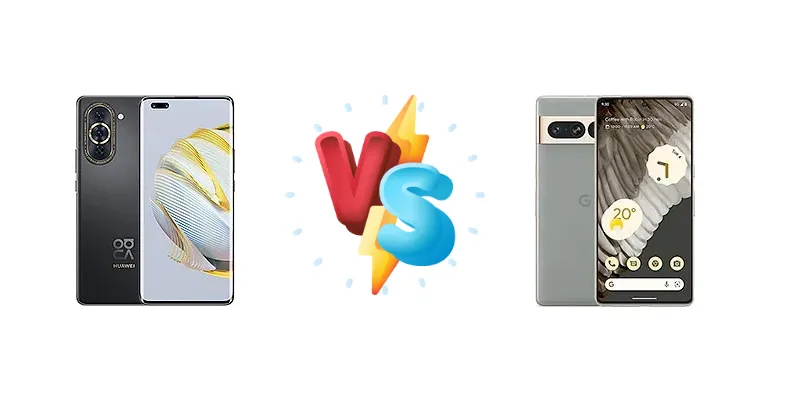
Huawei nova 10 Pro vs. Google Pixel 7 Pro: A Deep Dive into Speed, AI, and Value
| Phones Images | |||||
|---|---|---|---|---|---|
|
🏆 Quick Verdict
For the average user prioritizing camera versatility and long-term software support, the Google Pixel 7 Pro is the stronger choice. However, the Huawei nova 10 Pro’s incredibly fast 100W charging and competitive price make it a compelling option for those who value convenience and rapid power-ups.
| PHONES | ||
|---|---|---|
| Phone Names | Huawei nova 10 Pro | Google Pixel 7 Pro |
| Network | ||
|---|---|---|
| 2G bands | GSM 850 / 900 / 1800 / 1900 | GSM 850 / 900 / 1800 / 1900 |
| 3G bands | HSDPA 800 / 850 / 900 / 1700(AWS) / 1900 / 2100 | HSDPA 800 / 850 / 900 / 1700(AWS) / 1900 / 2100 |
| 4G bands | 1, 2, 3, 4, 5, 8, 18, 19, 26, 34, 38, 39, 40, 41 | 1, 2, 3, 4, 5, 7, 8, 12, 13, 14, 17, 18, 19, 20, 25, 26, 28, 29, 30, 38, 39, 40, 41, 42, 46, 48, 66, 71 - GE2AE |
| 5G bands | - | 1, 2, 3, 5, 7, 8, 12, 14, 20, 25, 28, 30, 38, 40, 41, 48, 66, 71, 77, 78, 257, 258, 260, 261 SA/NSA/Sub6/mmWave - GE2AE |
| Speed | HSPA, LTE | HSPA, LTE, 5G |
| Technology | GSM / CDMA / HSPA / LTE | GSM / CDMA / HSPA / EVDO / LTE / 5G |
| CDMA 800 | 1, 2, 3, 5, 7, 8, 12, 14, 20, 25, 28, 30, 38, 40, 41, 48, 66, 71, 75, 76, 77, 78 SA/NSA/Sub6 - GP4BC | |
| Launch | ||
|---|---|---|
| Announced | 2022, July 04 | 2022, October 06 |
| Status | Available. Released 2022, July 10 | Available. Released 2022, October 13 |
| Body | ||
|---|---|---|
| Build | - | Glass front (Gorilla Glass Victus), glass back (Gorilla Glass Victus), aluminum frame |
| Dimensions | 164.2 x 74.5 x 7.9 mm (6.46 x 2.93 x 0.31 in) | 162.9 x 76.6 x 8.9 mm (6.41 x 3.02 x 0.35 in) |
| SIM | Nano-SIM + Nano-SIM | Nano-SIM + eSIM |
| Weight | 191 g (6.74 oz) | 212 g (7.48 oz) |
| - | IP68 dust/water resistant (up to 1.5m for 30 min) | |
| Display | ||
|---|---|---|
| Protection | - | Corning Gorilla Glass Victus |
| Resolution | 1200 x 2652 pixels (~429 ppi density) | 1440 x 3120 pixels, 19.5:9 ratio (~512 ppi density) |
| Size | 6.78 inches, 111.4 cm2 (~91.1% screen-to-body ratio) | 6.7 inches, 110.6 cm2 (~88.7% screen-to-body ratio) |
| Type | OLED, 1B colors, HDR10, 120Hz | LTPO AMOLED, 120Hz, HDR10+, 1000 nits (HBM), 1500 nits (peak) |
| - | Always-on display | |
| Platform | ||
|---|---|---|
| CPU | Octa-core (4x2.4 GHz Kryo 670 & 4x1.8 GHz Kryo 670) | Octa-core (2x2.85 GHz Cortex-X1 & 2x2.35 GHz Cortex-A78 & 4x1.80 GHz Cortex-A55) |
| Chipset | Qualcomm SM7325 Snapdragon 778G 4G (6 nm) | Google Tensor G2 (5 nm) |
| GPU | Adreno 642L | Mali-G710 MP7 |
| OS | HarmonyOS 2.0 | Android 13, upgradable to Android 15, up to 5 major Android upgrades |
| Memory | ||
|---|---|---|
| Card slot | No | No |
| Internal | 128GB 8GB RAM, 256GB 8GB RAM | 128GB 8GB RAM, 256GB 8GB RAM, 128GB 12GB RAM, 256GB 12GB RAM, 512GB 12GB RAM |
| - | UFS 3.1 | |
| Main Camera | ||
|---|---|---|
| Dual | 8 MP, f/2.2, 52mm (portrait), AF 60 MP, f/2.4, 17mm, 100˚ (ultrawide), AF | - |
| Features | LED flash, panorama, HDR | Laser AF, Dual-LED flash, Pixel Shift, Auto-HDR, panorama |
| Single | - | 10.8 MP, f/2.2, 21mm (ultrawide), 1/3.1", 1.22µm |
| Triple | 50 MP, f/1.8, 27mm (wide), PDAF 8 MP, f/2.2, 112˚ (ultrawide), AF Auxiliary lens | 50 MP, f/1.9, 25mm (wide), 1/1.31", 1.2µm, dual pixel PDAF, OIS 48 MP, f/3.5, 120mm (periscope telephoto), 1/2.55", 0.7µm, dual pixel PDAF, OIS, 5x optical zoom 12 MP, f/2.2, 126˚ (ultrawide), 1/2.9", 1.25µm, AF |
| Video | 4K, 1080p, 720p@960fps, gyro-EIS | 4K@30/60fps, 1080p@30/60/120/240fps; gyro-EIS, OIS, 10-bit HDR |
| Selfie camera | ||
|---|---|---|
| Dual | 8 MP, f/2.2, 52mm (telephoto), AF, 2x optical zoom 60 MP, f/2.4, 17mm, 100˚ (ultrawide), AF | - |
| Features | HDR | HDR, panorama |
| Single | - | 10.8 MP, f/2.2, 21mm (ultrawide), 1/3.1", 1.22µm |
| Video | 4K@30fps, 1080p@30fps, gyro-EIS | 4K@30/60fps, 1080p@30/60fps |
| Sound | ||
|---|---|---|
| 3.5mm jack | No | No |
| 35mm jack | No | No |
| Loudspeaker | Yes, with stereo speakers | Yes, with stereo speakers |
| Comms | ||
|---|---|---|
| Bluetooth | 5.2, A2DP, LE | 5.2, A2DP, LE, aptX HD |
| NFC | Yes | Yes |
| Positioning | GPS (L1+L5), GLONASS (L1), BDS (B1I+B1c+B2a), GALILEO (E1+E5a), QZSS (L1+L5), NavIC (L5) | GPS (L1+L5), GLONASS (G1), BDS (B1I+B1c+B2a), GALILEO (E1+E5a), QZSS (L1+L5) |
| Radio | No | No |
| USB | USB Type-C 2.0, OTG | USB Type-C 3.2 |
| WLAN | Wi-Fi 802.11 a/b/g/n/a/6, dual-band, Wi-Fi Direct | Wi-Fi 802.11 a/b/g/n/ac/6e, tri-band, Wi-Fi Direct |
| Features | ||
|---|---|---|
| Sensors | Fingerprint (under display, optical), accelerometer, gyro, compass | Fingerprint (under display, optical), accelerometer, gyro, proximity, compass, barometer |
| Virtual proximity sensing | Ultra Wideband (UWB) support | |
| Battery | ||
|---|---|---|
| Charging | 100W wired, 20-80% in 10 min Reverse wired | 23W wired, PD3.0, 50% in 30 min 23W wireless Reverse wireless |
| Type | Li-Po 4500 mAh | Li-Ion 5000 mAh |
| Misc | ||
|---|---|---|
| Colors | Black, Silver, Green, Violet | Obsidian, Snow, Hazel |
| Models | GLA-AL00, GLA-LX1 | GP4BC, GE2AE, GFE4J |
| Price | About 730 EUR | € 248.84 / $ 204.00 / £ 259.99 / ₹ 36,999 |
| Tests | ||
|---|---|---|
| Battery life | Endurance rating 89h | Endurance rating 83h |
| Camera | Photo / Video | Photo / Video |
| Display | Contrast ratio: Infinite (nominal) | Contrast ratio: Infinite (nominal) |
| Loudspeaker | -27.7 LUFS (Good) | -24.8 LUFS (Very good) |
| Performance | AnTuTu: 528847 (v9) GeekBench: 2794 (v5.1) GFXBench: 23fps (ES 3.1 onscreen) | AnTuTu: 796369 (v9) GeekBench: 3187 (v5.1) GFXBench: 34fps (ES 3.1 onscreen) |
Huawei nova 10 Pro
- Incredibly fast 100W charging
- Sleek and stylish design
- Competitive price point
- Limited to 4G connectivity
- Less powerful processor than Pixel 7 Pro
Google Pixel 7 Pro
- Superior camera performance with AI enhancements
- Brighter and more vibrant display
- Guaranteed software updates and Google integration
- Slower charging speeds (23W)
- Higher price tag
Display Comparison
The Pixel 7 Pro boasts a significantly brighter display, reaching 1090 nits compared to the nova 10 Pro’s 784 nits. This translates to better visibility outdoors under direct sunlight. Both displays share an 'Infinite' (nominal) contrast ratio, suggesting deep blacks, but the Pixel 7 Pro’s higher peak brightness provides a more vibrant and readable experience in all conditions. While both are excellent, the Pixel 7 Pro’s panel is demonstrably superior for outdoor use and overall visual punch.
Camera Comparison
Both phones offer photo and video capabilities, but the Pixel 7 Pro’s computational photography prowess sets it apart. While sensor sizes aren’t specified, Google’s image processing algorithms, powered by the Tensor G2, excel at dynamic range, noise reduction, and detail preservation. The Pixel 7 Pro’s Super Res Zoom is a standout feature, providing impressive zoom capabilities without significant image degradation. The nova 10 Pro likely relies more on hardware for image quality, which is good, but lacks the software refinement of the Pixel.
Performance
The Google Pixel 7 Pro’s Google Tensor G2, fabricated on a 5nm process, offers a more sophisticated architecture than the Huawei nova 10 Pro’s 6nm Qualcomm Snapdragon 778G 4G. The Tensor G2’s octa-core CPU, featuring Cortex-X1 and Cortex-A78 cores, is designed for AI and machine learning tasks, resulting in faster image processing and smarter features. While the Snapdragon 778G is a capable mid-range chip, the Tensor G2 provides a noticeable performance advantage, particularly in tasks leveraging Google’s AI capabilities. The 4G limitation on the nova 10 Pro is a significant drawback for users in areas with 5G coverage.
Battery Life
The Huawei nova 10 Pro achieves an endurance rating of 89 hours, slightly exceeding the Pixel 7 Pro’s 83 hours. However, this is heavily influenced by the nova 10 Pro’s groundbreaking 100W wired charging. Achieving a 20-80% charge in just 10 minutes is a game-changer for users who frequently need to top up their battery. The Pixel 7 Pro’s 23W wired charging and 23W wireless charging are considerably slower, taking 30 minutes to reach 50% with wired charging. While the Pixel 7 Pro offers wireless charging and reverse wireless charging, the nova 10 Pro’s charging speed is a clear advantage.
Buying Guide
Buy the Huawei nova 10 Pro if you need a phone that can go from near-empty to 80% charge in under 15 minutes and appreciate a sleek, eye-catching design. Buy the Google Pixel 7 Pro if you prefer a best-in-class camera experience, seamless integration with Google services, and guaranteed software updates for years to come.