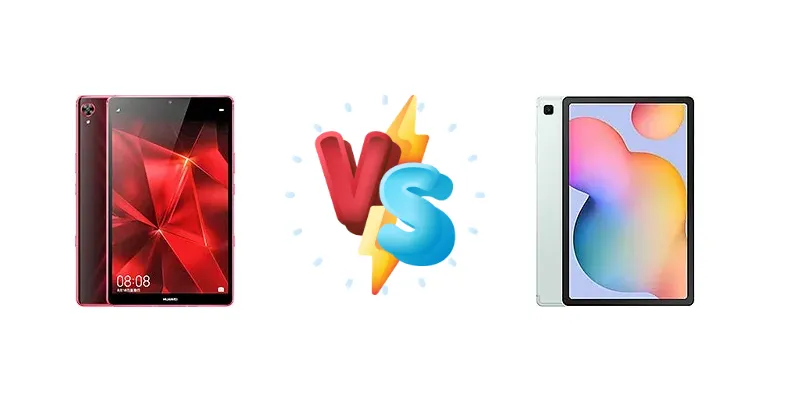
The tablet market continues to offer compelling options at various price points. We're pitting the Huawei MediaPad M6 Turbo 8.4, a device leveraging Huawei's Kirin 980 chipset, against the updated Samsung Galaxy Tab S6 Lite (2024) powered by the Exynos 1280. This comparison focuses on how architectural differences and manufacturing processes impact real-world performance and user experience, particularly for those seeking a balance between portability and productivity.
🏆 Quick Verdict
For the average user prioritizing efficiency and long-term software support, the Samsung Galaxy Tab S6 Lite (2024) emerges as the better choice. While the Kirin 980 in the MediaPad M6 Turbo 8.4 offers competitive raw performance, the Exynos 1280’s 5nm process and Samsung’s software ecosystem provide a smoother, more sustainable experience.
| Network |
|---|
| 2G bands | GSM 850 / 900 / 1800 / 1900 | GSM 850 / 900 / 1800 / 1900 |
| 3G bands | HSDPA 800 / 850 / 900 / 1700(AWS) / 1900 / 2100 | HSDPA 850 / 900 / 1700(AWS) / 1900 / 2100 |
| 4G bands | 1, 3, 4, 5, 8, 19, 34, 38, 39, 40, 41 | 1, 2, 3, 4, 5, 7, 8, 12, 17, 20, 25, 26, 28, 38, 40, 41, 66 |
| Speed | HSPA 42.2/5.76 Mbps, LTE (3CA) Cat12 600/75 Mbps - cellular model only | HSPA, LTE - cellular model only |
| Technology | GSM / CDMA / HSPA / LTE | GSM / HSPA / LTE |
| | CDMA 800 & TD-SCDMA | - |
| Launch |
|---|
| Announced | 2019, September. Released 2019, September | 2024, March 26 |
| Status | Discontinued | Available. Released 2024, March 28 |
| Body |
|---|
| Build | - | Glass front, aluminum back, aluminum frame |
| Dimensions | 206.4 x 125.2 x 8.2 mm (8.13 x 4.93 x 0.32 in) | 244.5 x 154.3 x 7 mm (9.63 x 6.07 x 0.28 in) |
| SIM | Nano-SIM (cellular model only) | Nano-SIM (cellular model only) |
| Weight | 340 g (11.99 oz) | 465/467 g (1.03 lb) |
| Display |
|---|
| Resolution | 2560 x 1600 pixels, 16:10 ratio (~359 ppi density) | 1200 x 2000 pixels, 5:3 ratio (~224 ppi density) |
| Size | 8.4 inches, 204.6 cm2 (~79.2% screen-to-body ratio) | 10.4 inches, 307.9 cm2 (~81.6% screen-to-body ratio) |
| Type | IPS LCD | TFT LCD |
| Platform |
|---|
| CPU | Octa-core (2x2.6 GHz Cortex-A76 & 2x1.92 GHz Cortex-A76 & 4x1.8 GHz Cortex-A55) | Octa-core (2x2.4 GHz Cortex-A78 & 6x2.0 GHz Cortex-A55) |
| Chipset | Kirin 980 (7 nm) | Exynos 1280 (5 nm) |
| GPU | Mali-G76 MP10 | Mali-G68 |
| OS | Android 9.0 (Pie), EMUI 9.1 | Android 14, upgradable to Android 15, One UI 7 |
| Memory |
|---|
| Card slot | microSDXC (dedicated slot) | microSDXC (dedicated slot) |
| Internal | 128GB 6GB RAM | 64GB 4GB RAM, 128GB 4GB RAM |
| | UFS 2.1 | - |
| Main Camera |
|---|
| Features | LED flash, HDR, panorama | HDR, panorama |
| Single | 13 MP, f/1.8, PDAF | 8 MP, (wide), 1/4.0", 1.12µm, AF |
| Video | 1080p@30fps | 1080p@30fps |
| Selfie camera |
|---|
| Single | 8 MP, f/2.0 | 5 MP, (wide), 1/5.0", 1.12µm |
| Video | 1080p@30fps | 1080p@30fps |
| Sound |
|---|
| 3.5mm jack | No | - |
| 35mm jack | No | Yes |
| Loudspeaker | Yes, with stereo speakers | Yes, with stereo speakers |
| | Tuned by Harman Kardon
| - |
| Comms |
|---|
| Bluetooth | 5.0, A2DP, LE | 5.3, A2DP, LE |
| NFC | No | No |
| Positioning | GPS, GLONASS, BDS - cellular model only | GPS, GLONASS, BDS, GALILEO, QZSS - cellular model only |
| Radio | No | No |
| USB | USB Type-C 2.0, OTG | USB Type-C 2.0 |
| WLAN | Wi-Fi 802.11 a/b/g/n/ac, dual-band, Wi-Fi Direct | Wi-Fi 802.11 a/b/g/n/ac, dual-band, Wi-Fi Direct |
| Features |
|---|
| Sensors | Accelerometer, gyro, proximity, compass | Accelerometer, proximity, gyro (wi-fi model only) |
| Battery |
|---|
| Charging | - | 15W wired |
| Type | Li-Po 6100 mAh, non-removable | Li-Po 7040 mAh |
| Misc |
|---|
| Colors | Phantom Red, Phantom Blue | Gray, Mint, Rose Gold |
| Models | VRD-AL10, VRD-W10, VRD-W09, VRD-AL09 | SM-P620, SM-P625 |
| Price | About 350 EUR | $ 215.00 |
| SAR | - | 0.95 W/kg (body) |
Huawei MediaPad M6 Turbo 8.4
- Potentially higher peak CPU performance in short bursts.
- May be available at a lower price point due to its age.
- Huawei's build quality is generally good.
- Older 7nm process leads to lower power efficiency.
- Limited software support and lack of Google Mobile Services.
- Uncertainty regarding long-term updates.
Samsung Galaxy Tab S6 Lite (2024)
- More efficient 5nm Exynos 1280 chipset.
- Full Android experience with access to Google Play Store.
- Samsung’s software updates and ecosystem support.
- 15W charging is relatively slow.
- Performance is not class-leading, but sufficient for most tasks.
- IPS LCD display lacks the vibrancy of OLED panels.
Display Comparison
Neither device boasts a cutting-edge display. The MediaPad M6 Turbo 8.4’s display specifications are not provided, but given its age, it likely utilizes an IPS LCD panel. The Tab S6 Lite (2024) also uses an IPS LCD. The key difference lies in the underlying processing power impacting display rendering. While both are 8.4 inches, the Exynos 1280’s GPU will likely provide a smoother experience with graphically intensive content. The lack of high refresh rates on either device suggests they are geared towards content consumption rather than fast-paced gaming.
Camera Comparison
Camera performance is unlikely to be a deciding factor for most tablet buyers. The MediaPad M6 Turbo 8.4’s camera specs are not available. The Tab S6 Lite (2024) features an 8MP main camera, which is adequate for basic snapshots and video calls. Neither device is expected to excel in low-light conditions or offer advanced photographic features. The focus should be on video conferencing and casual photography, not professional-grade image capture.
Performance
The core of this comparison rests on the chipsets. The Huawei MediaPad M6 Turbo 8.4’s Kirin 980 (7nm) features a complex CPU configuration with a mix of Cortex-A76 and A55 cores. While powerful for its time, it’s built on an older 7nm process. The Samsung Galaxy Tab S6 Lite (2024) utilizes the Exynos 1280 (5nm). This smaller node translates to improved power efficiency and thermal management. The Exynos 1280’s Cortex-A78 cores, while fewer in number (2 vs 4 A76 in the Kirin 980), are architecturally superior, offering better instructions per clock (IPC). This means the Tab S6 Lite will likely handle sustained workloads more effectively, avoiding the throttling that could plague the MediaPad M6 Turbo under prolonged stress. The Tab S6 Lite’s LPDDR4X RAM is standard for its class, while the MediaPad M6 Turbo’s RAM speed is unspecified, but likely similar.
Battery Life
Battery life will be influenced by both capacity and efficiency. The MediaPad M6 Turbo 8.4’s battery capacity is not specified. The Tab S6 Lite (2024) packs a 7,040mAh battery and supports 15W wired charging. The Exynos 1280’s 5nm process contributes to better power efficiency, meaning the Tab S6 Lite will likely offer longer battery life on a single charge. While 15W charging isn’t particularly fast, it’s sufficient for overnight charging and topping up throughout the day. The Kirin 980’s 7nm process will consume more power, potentially requiring more frequent charging.
Buying Guide
Buy the Huawei MediaPad M6 Turbo 8.4 if you prioritize raw processing power for demanding tasks and are comfortable with the limitations of the Huawei ecosystem. This tablet suits users who heavily rely on local processing and don't require Google Mobile Services. Buy the Samsung Galaxy Tab S6 Lite (2024) if you value a streamlined Android experience, efficient performance for everyday tasks, and the benefits of Samsung’s software updates and broader app compatibility.
Frequently Asked Questions
❓ Does the Exynos 1280 in the Tab S6 Lite (2024) overheat during extended gaming sessions?
The Exynos 1280’s 5nm manufacturing process and efficient thermal design minimize overheating. While it may get warm during prolonged gaming, it’s unlikely to experience significant throttling, providing a more consistent gaming experience compared to the older Kirin 980.
❓ Is the lack of Google Mobile Services on the Huawei MediaPad M6 Turbo 8.4 a significant limitation?
Yes, the absence of Google Mobile Services (GMS) is a major drawback for many users. It means you won’t have direct access to the Google Play Store, Gmail, YouTube, or other core Google apps. Huawei’s AppGallery offers alternatives, but app availability and compatibility can be limited.
❓ How does the software update policy differ between the two tablets?
Samsung provides a more consistent and longer-term software update policy for the Galaxy Tab S6 Lite (2024). Huawei’s update schedule for the MediaPad M6 Turbo 8.4 is less predictable, and it’s likely to receive fewer major Android updates.
❓ Is the 15W charging on the Tab S6 Lite (2024) slow compared to other tablets?
15W charging is slower than the fast charging technologies found on some higher-end tablets. However, it’s sufficient for overnight charging and topping up the 7,040mAh battery throughout the day. The Tab S6 Lite’s efficient chipset also means it doesn’t require extremely fast charging to maintain a reasonable battery life.