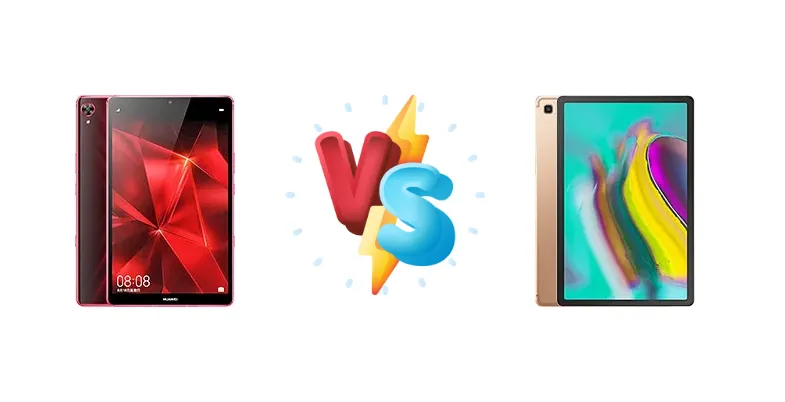
The 8-inch to 8.4-inch tablet space is a sweet spot for portability and usability. The Huawei MediaPad M6 Turbo 8.4, powered by the Kirin 980, aims for near-flagship performance at a competitive price. Meanwhile, the Samsung Galaxy Tab S5e, with its Snapdragon 670, prioritizes a sleek design and efficient power consumption. This comparison dissects their strengths and weaknesses to determine which tablet best suits your needs.
🏆 Quick Verdict
For users prioritizing raw performance and multitasking, the Huawei MediaPad M6 Turbo 8.4 is the clear winner. Its Kirin 980 chipset delivers significantly more processing power than the Snapdragon 670 in the Tab S5e. However, the Tab S5e offers a more refined software experience and faster charging, making it a strong contender for media consumption and everyday tasks.
| Network |
|---|
| 2G bands | GSM 850 / 900 / 1800 / 1900 | GSM 850 / 900 / 1800 / 1900 |
| 3G bands | HSDPA 800 / 850 / 900 / 1700(AWS) / 1900 / 2100 | HSDPA 850 / 900 / 1700(AWS) / 1900 / 2100 |
| 4G bands | 1, 3, 4, 5, 8, 19, 34, 38, 39, 40, 41 | 1, 2, 3, 4, 5, 7, 8, 12, 13, 17, 20, 28, 38, 40, 41, 66 |
| Speed | HSPA 42.2/5.76 Mbps, LTE (3CA) Cat12 600/75 Mbps - cellular model only | HSPA, LTE - cellular model only |
| Technology | GSM / CDMA / HSPA / LTE | GSM / HSPA / LTE |
| | CDMA 800 & TD-SCDMA | - |
| Launch |
|---|
| Announced | 2019, September. Released 2019, September | 2019, February. Released 2019, April |
| Status | Discontinued | Discontinued |
| Body |
|---|
| Build | - | Glass front, aluminum back, aluminum frame |
| Dimensions | 206.4 x 125.2 x 8.2 mm (8.13 x 4.93 x 0.32 in) | 245 x 160 x 5.5 mm (9.65 x 6.30 x 0.22 in) |
| SIM | Nano-SIM (cellular model only) | Nano-SIM (cellular model only) |
| Weight | 340 g (11.99 oz) | 400 g (14.11 oz) |
| Display |
|---|
| Resolution | 2560 x 1600 pixels, 16:10 ratio (~359 ppi density) | 1600 x 2560 pixels, 16:10 ratio (~288 ppi density) |
| Size | 8.4 inches, 204.6 cm2 (~79.2% screen-to-body ratio) | 10.5 inches, 319.7 cm2 (~81.6% screen-to-body ratio) |
| Type | IPS LCD | Super AMOLED |
| Platform |
|---|
| CPU | Octa-core (2x2.6 GHz Cortex-A76 & 2x1.92 GHz Cortex-A76 & 4x1.8 GHz Cortex-A55) | Octa-core (2x2.0 GHz 360 Gold & 6x1.7 GHz Kryo 360 Silver) |
| Chipset | Kirin 980 (7 nm) | Qualcomm SDM670 Snapdragon 670 (10 nm) |
| GPU | Mali-G76 MP10 | Adreno 615 |
| OS | Android 9.0 (Pie), EMUI 9.1 | Android 9.0 (Pie), upgradable to Android 11, One UI 3.1 |
| Memory |
|---|
| Card slot | microSDXC (dedicated slot) | microSDXC (dedicated slot) |
| Internal | 128GB 6GB RAM | 64GB 4GB RAM, 128GB 6GB RAM |
| | UFS 2.1 | eMMC 5.1 |
| Main Camera |
|---|
| Features | LED flash, HDR, panorama | HDR, panorama |
| Single | 13 MP, f/1.8, PDAF | 13 MP, f/2.0, 26mm, 1/3.4", 1.0µm, AF |
| Video | 1080p@30fps | 4K@30fps |
| Selfie camera |
|---|
| Single | 8 MP, f/2.0 | 8 MP, f/2.0, 26mm, 1/4.0", 1.12µm |
| Video | 1080p@30fps | 1080p@30fps |
| Sound |
|---|
| 3.5mm jack | No | No |
| 35mm jack | No | No |
| Loudspeaker | Yes, with stereo speakers | Yes, with stereo speakers (4 speakers) |
| | Tuned by Harman Kardon
| Tuned by AKG/HARMAN |
| Comms |
|---|
| Bluetooth | 5.0, A2DP, LE | 5.0, A2DP, LE |
| NFC | No | No |
| Positioning | GPS, GLONASS, BDS - cellular model only | GPS, GLONASS, BDS, GALILEO - cellular model only |
| Radio | No | No |
| USB | USB Type-C 2.0, OTG | USB Type-C 3.1, magnetic connector |
| WLAN | Wi-Fi 802.11 a/b/g/n/ac, dual-band, Wi-Fi Direct | Wi-Fi 802.11 a/b/g/n/ac, dual-band, Wi-Fi Direct |
| Features |
|---|
| Sensors | Accelerometer, gyro, proximity, compass | Fingerprint (side-mounted), accelerometer, gyro, proximity, compass |
| | - | ANT+ |
| Battery |
|---|
| Charging | - | 18W wired |
| Type | Li-Po 6100 mAh, non-removable | Li-Po 7040 mAh, non-removable |
| Misc |
|---|
| Colors | Phantom Red, Phantom Blue | Black, Gold, Silver |
| Models | VRD-AL10, VRD-W10, VRD-W09, VRD-AL09 | SM-T725, SM-T720 |
| Price | About 350 EUR | About 410 EUR |
| SAR EU | - | 1.03 W/kg (head) |
| Tests |
|---|
| Performance | - |
AnTuTu: 152610 (v7)
GeekBench: 5684 (v4.4)
GFXBench: 6.4fps (ES 3.1 onscreen) |
Huawei MediaPad M6 Turbo 8.4
- Significantly more powerful Kirin 980 chipset
- More compact and portable 8.4-inch form factor
- Potentially higher pixel density display
- Battery capacity and charging speed likely inferior to Tab S5e
- Software experience may lack the polish of Samsung’s One UI
- Camera performance likely not a priority
Samsung Galaxy Tab S5e
- Excellent battery life with a 7040mAh battery
- Faster 18W wired charging
- Sleek and lightweight design
- Less powerful Snapdragon 670 chipset
- Larger form factor may be less portable
- TFT LCD display may not offer the same color accuracy as IPS
Display Comparison
Neither device boasts cutting-edge display technology. While specific display specs (resolution, panel type) are missing for the M6 Turbo, Huawei typically employs IPS LCDs in this segment. The Tab S5e features a 10.5-inch TFT LCD. The M6 Turbo’s smaller 8.4-inch form factor will offer a higher pixel density for comparable resolutions. The Tab S5e’s larger screen is better for split-screen multitasking, but the M6 Turbo’s size enhances portability. Both likely lack high refresh rates, focusing on power efficiency.
Camera Comparison
Camera performance is unlikely to be a primary focus for either tablet. Specific camera specs for the M6 Turbo are unavailable, but Huawei often includes a decent main sensor in its tablets. The Tab S5e features a 13MP main camera and a 5MP front camera. Given the focus on portability and media consumption, both tablets likely prioritize functional cameras for video calls and casual snapshots over high-end photography capabilities. Image processing will likely differ, with Huawei potentially leaning towards more saturated colors and Samsung aiming for a more natural look.
Performance
The Kirin 980 (7nm) in the MediaPad M6 Turbo 8.4 represents a significant leap in processing power compared to the Snapdragon 670 (10nm) in the Tab S5e. The Kirin 980’s octa-core configuration, featuring two high-performance Cortex-A76 cores, provides superior single-core and multi-core performance. The Snapdragon 670’s Kryo cores are more focused on efficiency. This translates to faster app loading times, smoother multitasking, and a more responsive user experience on the M6 Turbo. The 7nm process node of the Kirin 980 also contributes to better thermal efficiency, potentially reducing throttling during sustained workloads. While the Tab S5e is adequate for everyday tasks, the M6 Turbo is better equipped for demanding applications and gaming.
Battery Life
Battery capacity details for the M6 Turbo are missing, but tablets in this class typically range from 5000mAh to 6000mAh. The Tab S5e packs a 7040mAh battery, providing excellent battery life for typical usage scenarios. However, the M6 Turbo’s more powerful Kirin 980 will consume more power. The Tab S5e compensates with 18W wired charging, offering faster replenishment than what the M6 Turbo likely supports. While the M6 Turbo might offer comparable runtime with optimized software, the Tab S5e’s larger battery and faster charging provide a more convenient experience.
Buying Guide
Buy the Huawei MediaPad M6 Turbo 8.4 if you need a tablet capable of handling demanding applications, moderate gaming, and extensive multitasking. Its powerful Kirin 980 chipset provides a noticeable performance advantage. Buy the Samsung Galaxy Tab S5e if you prefer a lightweight, sleek design with a focus on media consumption, long battery life, and a streamlined user experience. It’s ideal for users who prioritize portability and simplicity over raw power.
Frequently Asked Questions
❓ Is the Kirin 980 in the MediaPad M6 Turbo 8.4 capable of handling demanding games like PUBG or Call of Duty?
Yes, the Kirin 980 is a capable chipset that can handle most mobile games, including PUBG and Call of Duty, at medium to high settings. While it won't match the performance of flagship Snapdragon chips, it provides a significantly smoother gaming experience than the Snapdragon 670 in the Tab S5e. Expect playable frame rates, but be mindful of potential thermal throttling during extended gaming sessions.
❓ Does the Samsung Galaxy Tab S5e support Samsung DeX for a desktop-like experience?
No, the Samsung Galaxy Tab S5e does not support Samsung DeX. While it offers a streamlined Android experience, it lacks the desktop mode functionality found on some of Samsung’s higher-end tablets and phones. This means you won’t be able to connect it to a monitor and use it as a full-fledged desktop computer.
❓ What kind of storage options are available on each tablet, and can the storage be expanded?
Specific storage configurations vary by region. However, both tablets typically offer options ranging from 64GB to 128GB. The Samsung Galaxy Tab S5e features a microSD card slot for storage expansion up to 512GB. The Huawei MediaPad M6 Turbo 8.4 may or may not include a microSD card slot, depending on the model and region. Check the specifications carefully before purchasing if expandable storage is a priority.