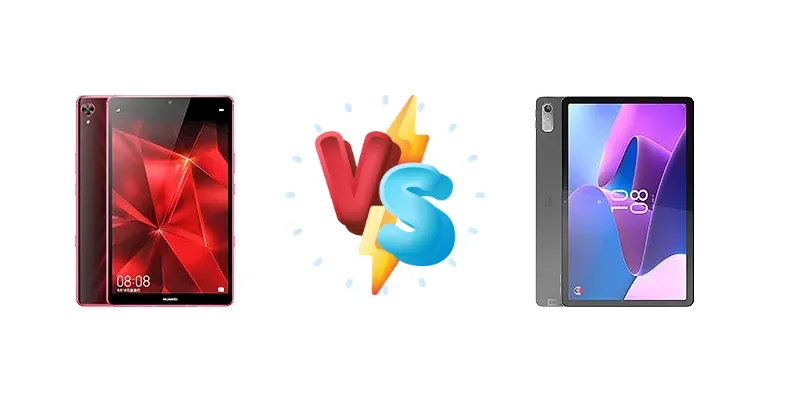
The tablet market offers a diverse range of options, but narrowing down the best choice can be challenging. We pit the Huawei MediaPad M6 Turbo 8.4, a device leveraging Huawei’s Kirin 980 chipset, against the Lenovo Tab P11 Pro Gen 2, powered by the MediaTek Kompanio 1300T. This comparison focuses on how architectural differences and feature sets translate into real-world performance and usability.
🏆 Quick Verdict
For the average user prioritizing fast charging and a more modern chipset architecture, the Lenovo Tab P11 Pro Gen 2 is the better choice. While the MediaPad M6 Turbo 8.4 remains a capable device, the Kompanio 1300T’s 6nm process and Cortex-A78 cores offer a performance edge and improved efficiency.
| Network |
|---|
| 2G bands | GSM 850 / 900 / 1800 / 1900 | GSM 850 / 900 / 1800 / 1900 |
| 3G bands | HSDPA 800 / 850 / 900 / 1700(AWS) / 1900 / 2100 | HSDPA 850 / 900 / 1900 / 2100 |
| 4G bands | 1, 3, 4, 5, 8, 19, 34, 38, 39, 40, 41 | LTE |
| Speed | HSPA 42.2/5.76 Mbps, LTE (3CA) Cat12 600/75 Mbps - cellular model only | HSPA, LTE - cellular model only |
| Technology | GSM / CDMA / HSPA / LTE | GSM / HSPA / LTE |
| | CDMA 800 & TD-SCDMA | - |
| Launch |
|---|
| Announced | 2019, September. Released 2019, September | 2022, September 01 |
| Status | Discontinued | Available. Released 2022, September 01 |
| Body |
|---|
| Build | - | Glass front, plastic back, plastic frame |
| Dimensions | 206.4 x 125.2 x 8.2 mm (8.13 x 4.93 x 0.32 in) | 263.7 x 166.7 x 6.8 mm (10.38 x 6.56 x 0.27 in) |
| SIM | Nano-SIM (cellular model only) | Nano-SIM (cellular model only) |
| Weight | 340 g (11.99 oz) | 480 g (1.06 lb) |
| | - | Stylus support (magnetic) |
| Display |
|---|
| Resolution | 2560 x 1600 pixels, 16:10 ratio (~359 ppi density) | 1536 x 2560 pixels, 5:3 ratio (~267 ppi density) |
| Size | 8.4 inches, 204.6 cm2 (~79.2% screen-to-body ratio) | 11.2 inches, 357.0 cm2 (~81.2% screen-to-body ratio) |
| Type | IPS LCD | OLED, HDR10+, Dolby Vision, 120Hz, 420 nits (typ), 600 nits (peak) |
| Platform |
|---|
| CPU | Octa-core (2x2.6 GHz Cortex-A76 & 2x1.92 GHz Cortex-A76 & 4x1.8 GHz Cortex-A55) | Octa-core (4x2.6 GHz Cortex-A78 & 4x2.0 GHz Cortex-A55) |
| Chipset | Kirin 980 (7 nm) | Mediatek MT8797 Kompanio 1300T (6 nm) |
| GPU | Mali-G76 MP10 | Mali-G77 MC9 |
| OS | Android 9.0 (Pie), EMUI 9.1 | Android 12, upgradable to Android 13 |
| Memory |
|---|
| Card slot | microSDXC (dedicated slot) | microSDXC (dedicated slot) |
| Internal | 128GB 6GB RAM | 128GB 4GB RAM, 128GB 6GB RAM, 256GB 8GB RAM |
| | UFS 2.1 | UFS 3.1 |
| Main Camera |
|---|
| Features | LED flash, HDR, panorama | LED flash |
| Single | 13 MP, f/1.8, PDAF | 13 MP, f/2.4, (wide), AF |
| Video | 1080p@30fps | 1080p@30fps |
| Selfie camera |
|---|
| Single | 8 MP, f/2.0 | 8 MP |
| Video | 1080p@30fps | 1080p@30fps |
| Sound |
|---|
| 3.5mm jack | No | No |
| 35mm jack | No | No |
| Loudspeaker | Yes, with stereo speakers | Yes, with stereo speakers (4 speakers) |
| | Tuned by Harman Kardon
| Tuned by JBL |
| Comms |
|---|
| Bluetooth | 5.0, A2DP, LE | 5.1, A2DP, LE |
| NFC | No | No |
| Positioning | GPS, GLONASS, BDS - cellular model only | GPS, GLONASS - cellular model only |
| Radio | No | No |
| USB | USB Type-C 2.0, OTG | USB Type-C 3.0, OTG, magnetic connector, video output |
| WLAN | Wi-Fi 802.11 a/b/g/n/ac, dual-band, Wi-Fi Direct | Wi-Fi 802.11 a/b/g/n/ac/6, dual-band, Wi-Fi Direct |
| Features |
|---|
| Sensors | Accelerometer, gyro, proximity, compass | Accelerometer, gyro, proximity, compass |
| Battery |
|---|
| Charging | - | 20W wired, QC3 |
| Type | Li-Po 6100 mAh, non-removable | Li-Po 8200 mAh |
| Misc |
|---|
| Colors | Phantom Red, Phantom Blue | Storm Grey, Oat |
| Models | VRD-AL10, VRD-W10, VRD-W09, VRD-AL09 | ZAB50194GB, ZAB50043SE |
| Price | About 350 EUR | About 500 EUR |
| Tests |
|---|
| Performance | - |
AnTuTu: 616573 (v9)
GeekBench: 2827 (v5.1) |
Huawei MediaPad M6 Turbo 8.4
- Compact 8.4-inch form factor
- Capable Kirin 980 chipset for everyday tasks
- Potentially lower price point due to age
- Older chipset architecture
- Likely slower charging speeds
- Potentially limited software support
Lenovo Tab P11 Pro Gen 2
- More efficient Kompanio 1300T chipset
- Faster 20W charging with QC3
- Likely longer software support lifecycle
- May be slightly more expensive
- Larger size compared to the M6 Turbo
- Performance gains may not be noticeable for basic tasks
Display Comparison
Both tablets feature 8.4-inch displays, but detailed specifications like resolution, panel type (IPS vs OLED), and refresh rate are missing. However, the MediaPad M6 Turbo’s age suggests it likely lacks features like high refresh rates or HDR support commonly found in newer tablets. The Lenovo Tab P11 Pro Gen 2, being a newer generation, is more likely to offer a brighter panel and potentially wider color gamut. Bezels are also likely slimmer on the Lenovo, contributing to a more immersive viewing experience.
Camera Comparison
Detailed camera specifications are unavailable for both devices. Given the tablet market, camera performance is rarely a primary focus. However, it’s reasonable to assume both tablets feature modest camera setups suitable for casual snapshots and video calls. Without specific sensor details, it’s difficult to make a definitive comparison, but newer tablets generally benefit from improved image processing algorithms.
Performance
The core difference lies in the chipsets. The Huawei MediaPad M6 Turbo 8.4 utilizes the Kirin 980 (7nm), featuring a tri-cluster CPU configuration with Cortex-A76 cores. The Lenovo Tab P11 Pro Gen 2 employs the MediaTek Kompanio 1300T (6nm) with Cortex-A78 cores. The A78 cores in the Kompanio 1300T represent a generational improvement over the A76 cores in the Kirin 980, offering better single-core performance and efficiency. The 6nm process node of the Kompanio 1300T further enhances efficiency and potentially reduces thermal throttling during sustained workloads. While both have octa-core CPUs, the architectural advantages lean towards the Lenovo.
Battery Life
Battery capacity is not specified for either device. However, the Lenovo Tab P11 Pro Gen 2’s 20W wired charging with QC3 support is a significant advantage. The MediaPad M6 Turbo 8.4’s charging speed is unknown, but older devices typically have slower charging capabilities. Faster charging translates to less downtime and greater convenience, especially for users who rely on their tablets throughout the day. The Kompanio 1300T’s improved efficiency may also contribute to longer battery life in real-world usage.
Buying Guide
Buy the Huawei MediaPad M6 Turbo 8.4 if you prioritize a compact 8.4-inch form factor and are already invested in the Huawei ecosystem. Its Kirin 980 still delivers solid performance for everyday tasks and media consumption. Buy the Lenovo Tab P11 Pro Gen 2 if you value a more recent chipset with a focus on efficiency, faster charging speeds (QC3 20W), and a potentially longer software support lifecycle.
Frequently Asked Questions
❓ Will the Kirin 980 struggle with demanding games like Genshin Impact?
The Kirin 980 is capable of running many games, but demanding titles like Genshin Impact may require lower graphics settings to maintain a stable frame rate. The Kompanio 1300T in the Lenovo Tab P11 Pro Gen 2 is expected to offer a smoother gaming experience due to its more modern architecture and GPU.
❓ How does the MediaTek Kompanio 1300T handle multitasking compared to the Kirin 980?
The Kompanio 1300T’s Cortex-A78 cores and 6nm process provide a performance advantage in multitasking scenarios. It can handle more apps running in the background without significant slowdown, making it a better choice for users who frequently switch between applications.
❓ Is the 20W charging on the Lenovo Tab P11 Pro Gen 2 a significant improvement over potentially slower charging on the Huawei?
Yes, 20W charging with Quick Charge 3.0 is a substantial improvement. It will significantly reduce the time it takes to fully charge the device, offering greater convenience for users who need to quickly top up their battery.