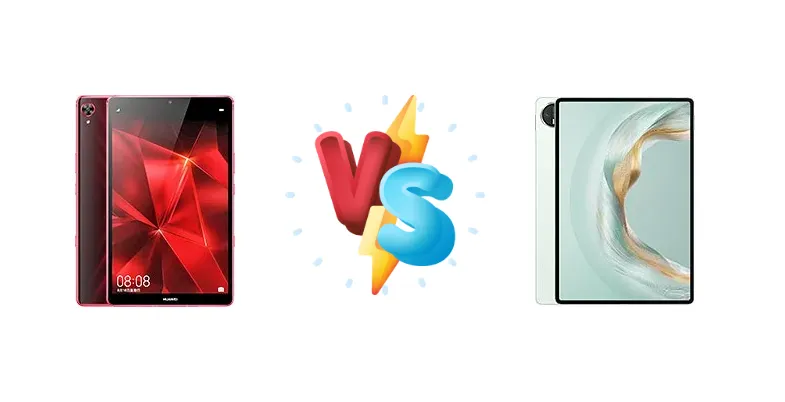
Huawei's tablet lineup offers options for diverse needs. The MediaPad M6 Turbo 8.4, while older, remains a compelling choice due to its proven Kirin 980 chipset. However, the newer MatePad Pro 12.2 (2025) introduces a larger display, significantly faster charging, and a newer Kirin T92A processor. This comparison dissects these differences to help you determine which tablet best suits your workflow and entertainment habits.
🏆 Quick Verdict
For most users, the Huawei MatePad Pro 12.2 (2025) is the superior choice. Its dramatically faster 100W charging, coupled with a brighter, larger display, outweighs the MediaPad M6 Turbo 8.4’s established performance. While the M6 Turbo remains capable, the Pro offers a more modern and convenient experience.
| Network |
|---|
| 2G bands | GSM 850 / 900 / 1800 / 1900 | N/A |
| 3G bands | HSDPA 800 / 850 / 900 / 1700(AWS) / 1900 / 2100 | N/A |
| 4G bands | 1, 3, 4, 5, 8, 19, 34, 38, 39, 40, 41 | N/A |
| EDGE | - | No |
| GPRS | - | No |
| Speed | HSPA 42.2/5.76 Mbps, LTE (3CA) Cat12 600/75 Mbps - cellular model only | - |
| Technology | GSM / CDMA / HSPA / LTE | No cellular connectivity |
| | CDMA 800 & TD-SCDMA | - |
| Launch |
|---|
| Announced | 2019, September. Released 2019, September | 2025, May 15 |
| Status | Discontinued | Available. Released 2025, May 15 |
| Body |
|---|
| Dimensions | 206.4 x 125.2 x 8.2 mm (8.13 x 4.93 x 0.32 in) | 271.3 x 182.5 x 5.5 mm (10.68 x 7.19 x 0.22 in) |
| SIM | Nano-SIM (cellular model only) | No |
| Weight | 340 g (11.99 oz) | 508 g (1.12 lb) |
| Display |
|---|
| Resolution | 2560 x 1600 pixels, 16:10 ratio (~359 ppi density) | 2800 x 1840 pixels, 3:2 ratio (~275 ppi density) |
| Size | 8.4 inches, 204.6 cm2 (~79.2% screen-to-body ratio) | 12.2 inches, 440.7 cm2 (~89.0% screen-to-body ratio) |
| Type | IPS LCD | Double-layer OLED, 1B colors, 144Hz, 2000 nits (peak), HDR Vivid |
| Platform |
|---|
| CPU | Octa-core (2x2.6 GHz Cortex-A76 & 2x1.92 GHz Cortex-A76 & 4x1.8 GHz Cortex-A55) | Octa-core (1x2.4 GHz & 3x2.00 GHz & 4x1.6GHz) |
| Chipset | Kirin 980 (7 nm) | Kirin T92A (7 nm) |
| GPU | Mali-G76 MP10 | Maleoon 920 |
| OS | Android 9.0 (Pie), EMUI 9.1 | HarmonyOS 4.3 |
| Memory |
|---|
| Card slot | microSDXC (dedicated slot) | No |
| Internal | 128GB 6GB RAM | 256GB 12GB RAM, 512GB 12GB RAM, 1TB 16GB RAM |
| | UFS 2.1 | - |
| Main Camera |
|---|
| Dual | - | 50 MP, f/1.8, (wide), PDAF
8 MP, f/2.2, (ultrawide) |
| Features | LED flash, HDR, panorama | LED flash, HDR, panorama |
| Single | 13 MP, f/1.8, PDAF | - |
| Video | 1080p@30fps | 4K@30fps, 1080p@30fps |
| Selfie camera |
|---|
| Single | 8 MP, f/2.0 | 8 MP, f/2.0 |
| Video | 1080p@30fps | 1080p@30fps |
| Sound |
|---|
| 3.5mm jack | No | - |
| 35mm jack | No | No |
| Loudspeaker | Yes, with stereo speakers | Yes, with stereo speakers (4 speakers) |
| | Tuned by Harman Kardon
| - |
| Comms |
|---|
| Bluetooth | 5.0, A2DP, LE | 5.2, A2DP, LE |
| NFC | No | No |
| Positioning | GPS, GLONASS, BDS - cellular model only | GPS, GLONASS, BDS, GALILEO, QZSS |
| Radio | No | No |
| USB | USB Type-C 2.0, OTG | USB Type-C 3.1, OTG |
| WLAN | Wi-Fi 802.11 a/b/g/n/ac, dual-band, Wi-Fi Direct | Wi-Fi 802.11 a/b/g/n/ac/6/7, dual-band |
| Features |
|---|
| Sensors | Accelerometer, gyro, proximity, compass | Fingerprint (side-mounted), accelerometer, gyro, proximity (accessories only), compass |
| Battery |
|---|
| Charging | - | 100W wired, 85% in 40 min, 100% in 55 min
7.5W reverse wired |
| Type | Li-Po 6100 mAh, non-removable | Li-Po 10100 mAh |
| Misc |
|---|
| Colors | Phantom Red, Phantom Blue | Black, Green |
| Models | VRD-AL10, VRD-W10, VRD-W09, VRD-AL09 | MRDI-W09 |
| Price | About 350 EUR | About 850 EUR |
Huawei MediaPad M6 Turbo 8.4
- More compact and portable 8.4-inch form factor.
- Proven Kirin 980 performance is still capable for everyday tasks.
- Potentially lower price point compared to the MatePad Pro.
- Significantly slower charging speeds.
- Smaller display less ideal for multitasking and media consumption.
- Older chipset may struggle with demanding games and applications.
Huawei MatePad Pro 12.2 (2025)
- Massively faster 100W charging for minimal downtime.
- Larger, brighter 12.2-inch display for immersive viewing.
- Newer Kirin T92A chipset offers improved performance and efficiency.
- Larger size can be less convenient for one-handed use.
- Higher price point.
- Larger size may not be ideal for travel.
Display Comparison
The MatePad Pro 12.2 (2025) boasts a significantly larger 12.2-inch display compared to the MediaPad M6 Turbo 8.4’s 8.4-inch screen. More importantly, the Pro achieves a measured peak brightness of 1045 nits, offering superior visibility in bright environments. While the M6 Turbo’s panel specifications aren’t provided, it’s likely to fall considerably short of this figure. The larger screen real estate of the Pro is ideal for multitasking and content creation, while the higher brightness enhances the viewing experience for videos and photos. We expect the Pro to have a higher resolution as well, given the larger screen size.
Camera Comparison
Camera details are sparse for both devices. Given the focus on tablet use cases, camera quality is less critical. However, the MatePad Pro 12.2 (2025) is likely to feature a more advanced camera system, potentially with a larger main sensor and improved image processing capabilities, due to its position as a flagship device. The M6 Turbo 8.4 likely prioritizes cost savings in this area. Without specific sensor details, a direct comparison is difficult, but the Pro is expected to deliver better image quality in most scenarios.
Performance
Both tablets utilize 7nm chipsets, but the Kirin T92A in the MatePad Pro 12.2 (2025) represents a generational leap over the Kirin 980 found in the M6 Turbo 8.4. The T92A’s octa-core configuration (1x2.4 GHz & 3x2.00 GHz & 4x1.6GHz) differs from the 980’s (2x2.6 GHz Cortex-A76 & 2x1.92 GHz Cortex-A76 & 4x1.8 GHz Cortex-A55). While the 980 features two high-performance Cortex-A76 cores clocked slightly higher, the T92A’s architecture is likely more efficient and optimized for tablet workloads. The Pro’s newer chipset will likely translate to better sustained performance and improved power efficiency, though real-world gains will depend on software optimization. RAM specifications are not provided, but the Pro is likely to benefit from faster LPDDR5x RAM.
Battery Life
The Huawei MatePad Pro 12.2 (2025) shines in the battery and charging department. It achieves an active use score of 11:24 hours, demonstrating excellent endurance. Crucially, it supports 100W wired charging, capable of reaching 85% charge in just 40 minutes and 100% in 55 minutes. This is a game-changer for users who need to quickly top up their device. The M6 Turbo 8.4’s battery capacity and charging speed are not specified, but it’s safe to assume they are significantly slower. The Pro also offers 7.5W reverse wired charging, allowing it to charge other devices.
Buying Guide
Buy the Huawei MediaPad M6 Turbo 8.4 if you prioritize a more compact form factor and are comfortable with slower charging speeds, seeking a reliable performer at a potentially lower price point. Buy the Huawei MatePad Pro 12.2 (2025) if you value a large, vibrant display for media consumption and productivity, and demand the convenience of incredibly fast 100W charging, even if it comes at a higher cost.
Frequently Asked Questions
❓ Does the Kirin T92A in the MatePad Pro 12.2 (2025) offer a noticeable performance improvement over the Kirin 980 in the M6 Turbo 8.4 for gaming?
While both chipsets are 7nm, the Kirin T92A benefits from architectural improvements and potentially more efficient thermal management. This should translate to smoother gameplay and less throttling in demanding titles, especially during extended gaming sessions. The M6 Turbo 8.4 will still be capable of playing many games, but may require lower graphics settings.
❓ How significant is the difference in charging speed between the two tablets in real-world use?
The difference is substantial. The MatePad Pro 12.2 (2025)'s 100W charging can take the battery from 0% to 85% in just 40 minutes, and fully charge it in 55 minutes. The M6 Turbo 8.4, lacking this technology, will likely take several hours to fully charge, making the Pro a much more convenient option for users on the go.
❓ Is the larger screen of the MatePad Pro 12.2 (2025) worth the trade-off in portability?
That depends on your usage. If you frequently use your tablet for multitasking, content creation, or media consumption, the larger screen is a significant benefit. However, if portability is a top priority, the M6 Turbo 8.4’s smaller size may be more appealing. Consider how you primarily intend to use the tablet.