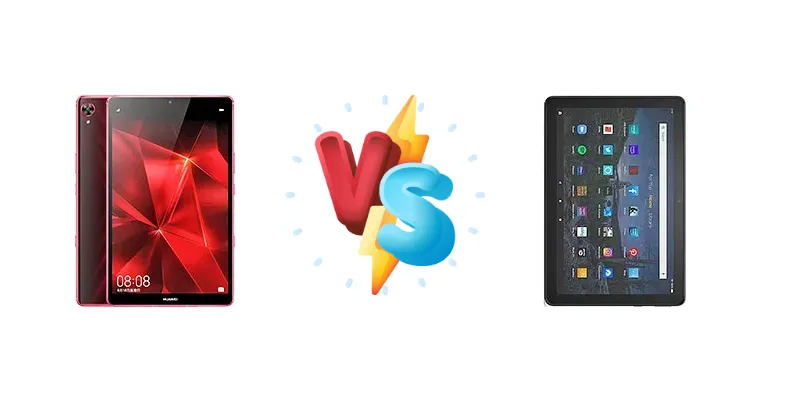
The tablet market offers a wide range of options, but narrowing down the choices can be challenging. We pit the Huawei MediaPad M6 Turbo 8.4, powered by the flagship-class Kirin 980, against the Amazon Fire HD 10 Plus (2021), featuring the Mediatek Helio P60T. This comparison focuses on how these differing chipsets and feature sets translate into real-world performance and usability, particularly for users seeking a balance between portability and functionality.
🏆 Quick Verdict
For users prioritizing performance and a more versatile Android experience, the Huawei MediaPad M6 Turbo 8.4 is the clear winner. Its Kirin 980 chipset delivers significantly faster processing speeds. However, the Amazon Fire HD 10 Plus (2021) offers compelling value with wireless charging and a larger screen, making it ideal for casual media consumption within the Amazon ecosystem.
| Network |
|---|
| 2G bands | GSM 850 / 900 / 1800 / 1900 | N/A |
| 3G bands | HSDPA 800 / 850 / 900 / 1700(AWS) / 1900 / 2100 | - |
| 4G bands | 1, 3, 4, 5, 8, 19, 34, 38, 39, 40, 41 | - |
| EDGE | - | No |
| GPRS | - | No |
| Speed | HSPA 42.2/5.76 Mbps, LTE (3CA) Cat12 600/75 Mbps - cellular model only | - |
| Technology | GSM / CDMA / HSPA / LTE | No cellular connectivity |
| | CDMA 800 & TD-SCDMA | - |
| Launch |
|---|
| Announced | 2019, September. Released 2019, September | 2021, April 27. Released 2021, May 26 |
| Status | Discontinued | Discontinued |
| Body |
|---|
| Dimensions | 206.4 x 125.2 x 8.2 mm (8.13 x 4.93 x 0.32 in) | 247 x 166 x 9.2 mm (9.72 x 6.54 x 0.36 in) |
| SIM | Nano-SIM (cellular model only) | No |
| Weight | 340 g (11.99 oz) | 468 g (1.03 lb) |
| Display |
|---|
| Protection | - | Aluminosilicate glass |
| Resolution | 2560 x 1600 pixels, 16:10 ratio (~359 ppi density) | 1920 x 1200 pixels, 16:10 ratio (~224 ppi density) |
| Size | 8.4 inches, 204.6 cm2 (~79.2% screen-to-body ratio) | 10.1 inches, 295.8 cm2 (~72.1% screen-to-body ratio) |
| Type | IPS LCD | IPS LCD |
| Platform |
|---|
| CPU | Octa-core (2x2.6 GHz Cortex-A76 & 2x1.92 GHz Cortex-A76 & 4x1.8 GHz Cortex-A55) | Octa-core (4x2.0 GHz Cortex-A73 & 4x2.0 GHz Cortex-A53) |
| Chipset | Kirin 980 (7 nm) | Mediatek MT8183 Helio P60T (12 nm) |
| GPU | Mali-G76 MP10 | Mali-G72 MP3 |
| OS | Android 9.0 (Pie), EMUI 9.1 | Android 9.0 (Pie), Fire OS 7 |
| Memory |
|---|
| Card slot | microSDXC (dedicated slot) | microSDXC (dedicated slot) |
| Internal | 128GB 6GB RAM | 32GB 4GB RAM, 64GB 4GB RAM |
| | UFS 2.1 | eMMC 5.1 |
| Main Camera |
|---|
| Features | LED flash, HDR, panorama | - |
| Single | 13 MP, f/1.8, PDAF | 5 MP |
| Video | 1080p@30fps | 720p |
| Selfie camera |
|---|
| Single | 8 MP, f/2.0 | 2 MP |
| Video | 1080p@30fps | 720p |
| Sound |
|---|
| 3.5mm jack | No | Yes |
| 35mm jack | No | Yes |
| Loudspeaker | Yes, with stereo speakers | Yes, with stereo speakers |
| | Tuned by Harman Kardon
| - |
| Comms |
|---|
| Bluetooth | 5.0, A2DP, LE | 5.0, A2DP, LE |
| NFC | No | No |
| Positioning | GPS, GLONASS, BDS - cellular model only | No |
| Radio | No | No |
| USB | USB Type-C 2.0, OTG | USB Type-C 2.0, OTG |
| WLAN | Wi-Fi 802.11 a/b/g/n/ac, dual-band, Wi-Fi Direct | Wi-Fi 802.11 a/b/g/n/ac, dual-band |
| Features |
|---|
| Sensors | Accelerometer, gyro, proximity, compass | Accelerometer |
| | - | Text-to-Speech English-language content reader |
| Battery |
|---|
| Charging | - | Wireless |
| Type | Li-Po 6100 mAh, non-removable | Li-Ion |
| Misc |
|---|
| Colors | Phantom Red, Phantom Blue | Slate |
| Models | VRD-AL10, VRD-W10, VRD-W09, VRD-AL09 | T76N2P |
| Price | About 350 EUR | About 150 EUR |
Huawei MediaPad M6 Turbo 8.4
- Significantly faster processor (Kirin 980)
- More efficient chipset for longer battery life
- Potentially sharper display due to higher pixel density
- Lacks wireless charging
- Smaller screen size compared to the Fire HD 10 Plus
Amazon Fire HD 10 Plus (2021)
- Wireless charging for added convenience
- Larger 10.1-inch display for immersive viewing
- Lower price point, offering excellent value
- Slower processor (Helio P60T)
- Less efficient chipset, potentially shorter battery life
- Performance may struggle with demanding tasks
Display Comparison
While both tablets offer adequate displays for their price points, key differences exist. The MediaPad M6 Turbo’s 8.4-inch screen offers a higher pixel density, potentially resulting in a sharper image. The Fire HD 10 Plus boasts a larger 10.1-inch display, beneficial for viewing content. However, the context data lacks specifics on panel technology (IPS, TFT) or brightness levels for either device. Given Amazon’s history, the Fire HD 10 Plus likely prioritizes size over color accuracy, while Huawei typically aims for a more balanced visual experience. Bezels are also a factor; the MediaPad M6 Turbo’s smaller form factor may translate to slimmer bezels, enhancing immersion.
Camera Comparison
Camera performance is unlikely to be a primary concern for most tablet users, but differences exist. The context data doesn’t provide specific camera specs for either device beyond the chipsets. However, given Huawei’s emphasis on camera technology in its smartphones, the MediaPad M6 Turbo likely features a more capable camera system. The Fire HD 10 Plus’s camera is likely geared towards basic video calls and casual snapshots. Without detailed sensor information, it’s difficult to make a definitive judgment, but the Kirin 980’s image signal processor (ISP) likely offers superior image processing capabilities.
Performance
The core of this comparison lies in the chipsets. Huawei’s Kirin 980 (7nm) is a significant leap ahead of the Mediatek Helio P60T (12nm). The Kirin 980’s architecture – featuring a combination of Cortex-A76 cores – provides substantially more processing power and efficiency. The Helio P60T, while an octa-core processor, utilizes older Cortex-A73 and A53 cores. This translates to noticeable differences in app loading times, multitasking smoothness, and gaming performance. The 7nm fabrication process of the Kirin 980 also implies better thermal management, reducing the likelihood of performance throttling during sustained workloads. The MediaPad M6 Turbo will handle graphically intensive games and applications with greater ease.
Battery Life
Battery life is a crucial consideration. The context data lacks specific battery capacities for both devices. However, the MediaPad M6 Turbo’s more efficient Kirin 980 chipset should contribute to longer battery life despite potentially having a smaller battery capacity. The Fire HD 10 Plus compensates with wireless charging, a feature absent on the MediaPad M6 Turbo. Wireless charging adds convenience, but it’s generally slower than wired charging. The Fire HD 10 Plus’s charging wattage is also unknown, but the inclusion of wireless charging suggests a focus on user convenience over rapid charging speeds.
Buying Guide
Buy the Huawei MediaPad M6 Turbo 8.4 if you need a tablet capable of handling demanding tasks like gaming, video editing, or multitasking, and value a full Android experience. Buy the Amazon Fire HD 10 Plus (2021) if you prefer a larger screen for media consumption, appreciate the convenience of wireless charging, and are heavily invested in Amazon’s services and content library.
Frequently Asked Questions
❓ Does the Kirin 980 in the MediaPad M6 Turbo 8.4 experience significant throttling during extended gaming sessions?
The Kirin 980’s 7nm process and Huawei’s thermal management solutions generally mitigate throttling effectively. While some heat generation is inevitable during prolonged gaming, the MediaPad M6 Turbo 8.4 is likely to maintain higher sustained performance levels compared to the Fire HD 10 Plus, which uses a less efficient chipset.
❓ How well does the Amazon Fire HD 10 Plus (2021) integrate with non-Amazon services like Google Play Store?
The Amazon Fire HD 10 Plus runs Fire OS, a heavily customized version of Android. While it offers access to the Amazon Appstore, Google Play Store is not natively supported. Users can sideload the Play Store, but this process is not officially supported by Amazon and may require technical expertise.
❓ Is the difference in CPU architecture (Cortex-A76 vs Cortex-A73) noticeable in everyday tasks like web browsing and video playback?
Yes, the Cortex-A76 cores in the Kirin 980 offer a significant performance advantage over the Cortex-A73 cores in the Helio P60T. This translates to snappier app launches, smoother scrolling, and faster web page rendering, even in everyday tasks.