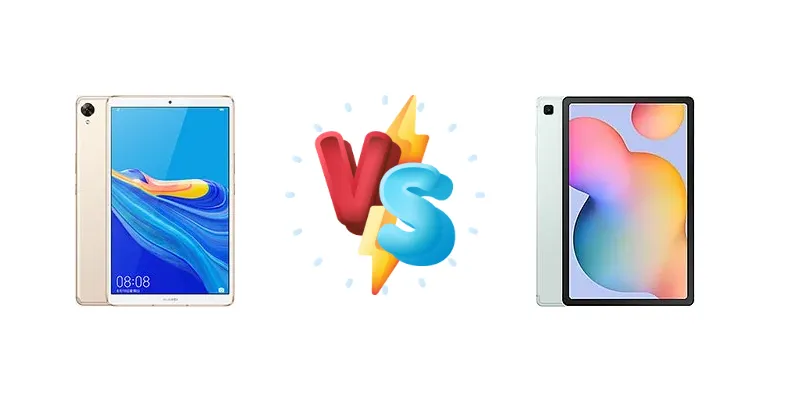
The tablet market offers a compelling middle ground between smartphones and laptops, and the Huawei MediaPad M6 8.4 and the Samsung Galaxy Tab S6 Lite (2024) represent two popular choices. The MediaPad M6 8.4, while older, boasts a powerful Kirin 980 chipset. The Tab S6 Lite (2024) arrives with Samsung’s newer Exynos 1280, promising improved efficiency. This comparison dissects these tablets to determine which delivers the best experience for your needs.
🏆 Quick Verdict
For the average user prioritizing long-term software support and efficient performance, the Samsung Galaxy Tab S6 Lite (2024) is the better choice. While the MediaPad M6 8.4’s Kirin 980 offers raw power, the Exynos 1280’s 5nm process and Samsung’s software ecosystem provide a smoother, more sustainable experience.
| Network |
|---|
| 2G bands | GSM 850 / 900 / 1800 / 1900 | GSM 850 / 900 / 1800 / 1900 |
| 3G bands | HSDPA 850 / 900 / 1900 / 2100 | HSDPA 850 / 900 / 1700(AWS) / 1900 / 2100 |
| 4G bands | LTE | 1, 2, 3, 4, 5, 7, 8, 12, 17, 20, 25, 26, 28, 38, 40, 41, 66 |
| Speed | HSPA 42.2/5.76 Mbps, LTE (3CA) Cat12 600/75 Mbps - cellular model only | HSPA, LTE - cellular model only |
| Technology | GSM / HSPA / LTE | GSM / HSPA / LTE |
| Launch |
|---|
| Announced | 2019, June. Released 2019, July | 2024, March 26 |
| Status | Discontinued | Available. Released 2024, March 28 |
| Body |
|---|
| Build | - | Glass front, aluminum back, aluminum frame |
| Dimensions | 206.4 x 125.2 x 7.4 mm (8.13 x 4.93 x 0.29 in) | 244.5 x 154.3 x 7 mm (9.63 x 6.07 x 0.28 in) |
| SIM | Nano-SIM (cellular model only) | Nano-SIM (cellular model only) |
| Weight | 320 g (11.29 oz) | 465/467 g (1.03 lb) |
| Display |
|---|
| Resolution | 2560 x 1600 pixels, 16:10 ratio (~359 ppi density) | 1200 x 2000 pixels, 5:3 ratio (~224 ppi density) |
| Size | 8.4 inches, 204.6 cm2 (~79.2% screen-to-body ratio) | 10.4 inches, 307.9 cm2 (~81.6% screen-to-body ratio) |
| Type | IPS LCD | TFT LCD |
| Platform |
|---|
| CPU | Octa-core (2x2.6 GHz Cortex-A76 & 2x1.92 GHz Cortex-A76 & 4x1.8 GHz Cortex-A55) | Octa-core (2x2.4 GHz Cortex-A78 & 6x2.0 GHz Cortex-A55) |
| Chipset | Kirin 980 (7 nm) | Exynos 1280 (5 nm) |
| GPU | Mali-G76 MP10 | Mali-G68 |
| OS | Android 9.0 (Pie), EMUI 9.1 | Android 14, upgradable to Android 15, One UI 7 |
| Memory |
|---|
| Card slot | microSDXC (dedicated slot) | microSDXC (dedicated slot) |
| Internal | 64GB 4GB RAM, 128GB 4GB RAM, 128GB 8GB RAM | 64GB 4GB RAM, 128GB 4GB RAM |
| | UFS 2.1 | - |
| Main Camera |
|---|
| Features | LED flash, HDR, panorama | HDR, panorama |
| Single | 13 MP, PDAF | 8 MP, (wide), 1/4.0", 1.12µm, AF |
| Video | 1080p@30fps | 1080p@30fps |
| Selfie camera |
|---|
| Single | 8 MP | 5 MP, (wide), 1/5.0", 1.12µm |
| Video | 1080p@30fps | 1080p@30fps |
| Sound |
|---|
| 3.5mm jack | No | - |
| 35mm jack | No | Yes |
| Loudspeaker | Yes, with stereo speakers | Yes, with stereo speakers |
| | Tuned by Harman Kardon
| - |
| Comms |
|---|
| Bluetooth | 5.0, A2DP, LE | 5.3, A2DP, LE |
| NFC | No | No |
| Positioning | GPS - cellular model only | GPS, GLONASS, BDS, GALILEO, QZSS - cellular model only |
| Radio | No | No |
| USB | USB Type-C 2.0 | USB Type-C 2.0 |
| WLAN | Wi-Fi 802.11 a/b/g/n/ac, dual-band, Wi-Fi Direct | Wi-Fi 802.11 a/b/g/n/ac, dual-band, Wi-Fi Direct |
| Features |
|---|
| Sensors | Accelerometer, gyro, proximity, compass | Accelerometer, proximity, gyro (wi-fi model only) |
| Battery |
|---|
| Charging | - | 15W wired |
| Type | Li-Po 6100 mAh, non-removable | Li-Po 7040 mAh |
| Misc |
|---|
| Colors | Champagne Gold | Gray, Mint, Rose Gold |
| Models | - | SM-P620, SM-P625 |
| Price | About 260 EUR | $ 215.00 |
| SAR | - | 0.95 W/kg (body) |
Huawei MediaPad M6 8.4
- Potentially higher raw CPU performance (Kirin 980)
- Mature software optimization (though Huawei ecosystem limitations apply)
- May offer a more affordable price point (depending on current deals)
- Older chipset (Kirin 980)
- Potential software update limitations due to Huawei’s restrictions
- Less efficient power consumption
Samsung Galaxy Tab S6 Lite (2024)
- More efficient chipset (Exynos 1280)
- Guaranteed software updates and support from Samsung
- Seamless integration with Samsung ecosystem
- Slower charging speed (15W)
- Potentially lower peak CPU performance compared to Kirin 980
- May be slightly more expensive
Display Comparison
Neither device’s display specifications are provided, so a direct comparison is limited. However, given the MediaPad M6 8.4’s age, it likely utilizes an LCD panel, while the Tab S6 Lite (2024) likely features an IPS LCD. The Tab S6 Lite’s newer manufacturing process likely results in narrower bezels. Color accuracy will depend on calibration, but Samsung generally offers more vibrant, saturated colors, while Huawei tends towards more natural tones. Without nit brightness data, it’s difficult to assess outdoor visibility.
Camera Comparison
Camera performance is unlikely to be a deciding factor for most tablet buyers. Without specific sensor details, it’s safe to assume both tablets feature modest camera setups. The MediaPad M6 8.4 likely has a more mature image processing pipeline, but the Exynos 1280’s ISP (Image Signal Processor) is likely more advanced. Any claims of exceptional camera quality should be viewed with skepticism. The focus should be on video conferencing capabilities rather than photography.
Performance
The core difference lies in the chipsets. The Huawei MediaPad M6 8.4’s Kirin 980 (7nm) features a complex CPU configuration with a mix of Cortex-A76 and A55 cores. The Samsung Galaxy Tab S6 Lite (2024) utilizes the Exynos 1280 (5nm). The move to a 5nm process gives the Exynos 1280 a significant efficiency advantage, reducing heat and improving sustained performance. While the Kirin 980’s A76 cores are powerful, the Exynos 1280’s Cortex-A78 cores offer improved IPC (Instructions Per Clock). The Tab S6 Lite’s likely use of LPDDR4X RAM, while not the latest standard, is sufficient for its target market. The Kirin 980 likely uses LPDDR4. The Exynos 1280’s superior thermal management will be noticeable during prolonged gaming or video editing.
Battery Life
Battery capacity is not specified for either device. However, the Exynos 1280’s 5nm process significantly improves power efficiency. The Tab S6 Lite (2024) supports 15W wired charging, which is relatively slow compared to some competitors. The MediaPad M6 8.4’s charging speed is unknown. The Exynos 1280’s efficiency will likely translate to longer real-world battery life, even if the MediaPad M6 8.4 has a slightly larger battery capacity. The slower charging speed on the Tab S6 Lite may be a drawback for users who need quick top-ups.
Buying Guide
Buy the Huawei MediaPad M6 8.4 if you prioritize raw processing power for demanding tasks and are comfortable with the potential limitations of Huawei’s software ecosystem. Buy the Samsung Galaxy Tab S6 Lite (2024) if you value efficient performance, a guaranteed software update path, and seamless integration with other Samsung devices. The Tab S6 Lite is ideal for students, media consumers, and those seeking a reliable, everyday tablet.
Frequently Asked Questions
❓ Does the Exynos 1280 in the Tab S6 Lite (2024) overheat during extended gaming sessions?
The Exynos 1280’s 5nm process is designed for efficiency, minimizing heat generation. While some throttling is inevitable during prolonged, demanding gaming, the Tab S6 Lite (2024) is less prone to overheating than devices with older, less efficient chipsets like the Kirin 980 in the MediaPad M6 8.4.
❓ How does Huawei’s software ecosystem impact the MediaPad M6 8.4’s functionality compared to the Tab S6 Lite (2024)?
The MediaPad M6 8.4 lacks full access to Google Mobile Services (GMS) due to US sanctions. This means no pre-installed Google apps like the Play Store, requiring users to rely on Huawei’s AppGallery and sideloading. The Tab S6 Lite (2024) has full GMS support, offering a seamless Android experience with access to millions of apps.
❓ Is the 15W charging on the Tab S6 Lite (2024) a significant drawback?
While 15W charging is slower than the fast charging options available on some tablets, it’s adequate for overnight charging. The Exynos 1280’s efficiency means you’re less likely to need frequent top-ups, mitigating the impact of the slower charging speed.