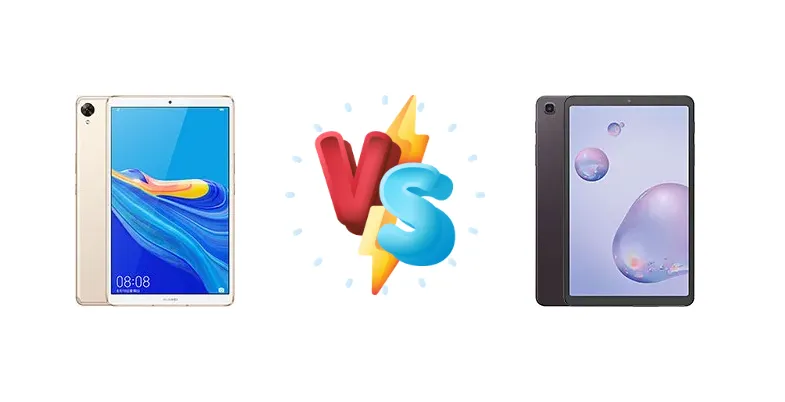
The 8-inch tablet market offers a sweet spot for portability and media consumption. The Huawei MediaPad M6 8.4, with its older but potent Kirin 980 chipset, clashes with the Samsung Galaxy Tab A 8.4 (2020), powered by the more mainstream Exynos 7904. This comparison dissects the core differences to help you decide which tablet best suits your needs, focusing on performance implications and real-world usability.
🏆 Quick Verdict
For users prioritizing sustained performance and multitasking, the Huawei MediaPad M6 8.4 is the clear winner. Its Kirin 980, built on a 7nm process, delivers significantly more processing power than the 14nm Exynos 7904 in the Tab A 8.4. However, the Tab A 8.4 offers a simpler, more readily available software experience.
| Network |
|---|
| 2G bands | GSM 850 / 900 / 1800 / 1900 | GSM 850 / 900 / 1800 / 1900 |
| 3G bands | HSDPA 850 / 900 / 1900 / 2100 | HSDPA 850 / 900 / 1900 / 2100 |
| 4G bands | LTE | 1, 3, 4, 5, 7, 13, 20, 66 |
| Speed | HSPA 42.2/5.76 Mbps, LTE (3CA) Cat12 600/75 Mbps - cellular model only | HSPA 42.2/5.76 Mbps, LTE Cat4 150/50 Mbps |
| Technology | GSM / HSPA / LTE | GSM / HSPA / LTE |
| Launch |
|---|
| Announced | 2019, June. Released 2019, July | 2020, March 25. Released 2020, March 25 |
| Status | Discontinued | Discontinued |
| Body |
|---|
| Build | - | Glass front, plastic frame, plastic back |
| Dimensions | 206.4 x 125.2 x 7.4 mm (8.13 x 4.93 x 0.29 in) | 202 x 125.2 x 7.1 mm (7.95 x 4.93 x 0.28 in) |
| SIM | Nano-SIM (cellular model only) | Nano-SIM |
| Weight | 320 g (11.29 oz) | 309 g (10.90 oz) |
| Display |
|---|
| Resolution | 2560 x 1600 pixels, 16:10 ratio (~359 ppi density) | 1200 x 1920 pixels, 16:10 ratio (~270 ppi density) |
| Size | 8.4 inches, 204.6 cm2 (~79.2% screen-to-body ratio) | 8.4 inches, 204.6 cm2 (~80.9% screen-to-body ratio) |
| Type | IPS LCD | TFT LCD |
| Platform |
|---|
| CPU | Octa-core (2x2.6 GHz Cortex-A76 & 2x1.92 GHz Cortex-A76 & 4x1.8 GHz Cortex-A55) | Octa-core (2x1.8 GHz Cortex-A73 & 6x1.6 GHz Cortex-A53) |
| Chipset | Kirin 980 (7 nm) | Exynos 7904 (14 nm) |
| GPU | Mali-G76 MP10 | Mali-G71 MP2 |
| OS | Android 9.0 (Pie), EMUI 9.1 | Android 10, upgradable to Android 11, One UI 3.1 |
| Memory |
|---|
| Card slot | microSDXC (dedicated slot) | microSDXC (dedicated slot) |
| Internal | 64GB 4GB RAM, 128GB 4GB RAM, 128GB 8GB RAM | 32GB 3GB RAM |
| | UFS 2.1 | eMMC 5.1 |
| Main Camera |
|---|
| Features | LED flash, HDR, panorama | - |
| Single | 13 MP, PDAF | 8 MP, AF |
| Video | 1080p@30fps | 1080p@30fps |
| Selfie camera |
|---|
| Single | 8 MP | 5 MP |
| Video | 1080p@30fps | - |
| Sound |
|---|
| 3.5mm jack | No | Yes |
| 35mm jack | No | Yes |
| Loudspeaker | Yes, with stereo speakers | Yes, with dual speakers |
| | Tuned by Harman Kardon
| - |
| Comms |
|---|
| Bluetooth | 5.0, A2DP, LE | 5.0, A2DP, LE |
| NFC | No | No |
| Positioning | GPS - cellular model only | GPS, GLONASS |
| Radio | No | No |
| USB | USB Type-C 2.0 | USB Type-C 2.0 |
| WLAN | Wi-Fi 802.11 a/b/g/n/ac, dual-band, Wi-Fi Direct | Wi-Fi 802.11 a/b/g/n/ac, dual-band, Wi-Fi Direct |
| Features |
|---|
| Sensors | Accelerometer, gyro, proximity, compass | Accelerometer |
| | - | ANT+ |
| Battery |
|---|
| Charging | - | Wired |
| Type | Li-Po 6100 mAh, non-removable | Li-Po 5000 mAh |
| Misc |
|---|
| Colors | Champagne Gold | Mocha |
| Models | - | SM-T307U |
| Price | About 260 EUR | About 240 EUR |
| SAR | - | 1.35 W/kg (body) |
Huawei MediaPad M6 8.4
- Significantly more powerful Kirin 980 chipset
- Superior thermal efficiency for sustained performance
- Potentially better display quality
- Software support may be limited due to Huawei’s restrictions
- Availability may be restricted in some regions
Samsung Galaxy Tab A 8.4 (2020)
- Simpler, more readily available software experience
- Guaranteed software updates (within Samsung’s support window)
- Wider availability
- Less powerful Exynos 7904 chipset
- Potential for throttling under sustained load
- Likely lower display quality
Display Comparison
While both tablets share an 8.4-inch display size, detailed display specs are missing. However, given the MediaPad M6 8.4’s positioning, it likely features a higher resolution panel and potentially better color accuracy. The Tab A 8.4 (2020) likely prioritizes cost-effectiveness, potentially resulting in a less vibrant display. Bezels are expected to be comparable, reflecting the market segment of both devices.
Camera Comparison
Camera details are sparse, but given the target market, neither tablet is expected to excel in photography. The focus is likely on basic image capture for video calls and casual snapshots. Any differences in image quality will likely be minimal and dependent on software processing rather than hardware capabilities. The presence of a 2MP macro camera on the Tab A 8.4 is unlikely to provide meaningful improvements in image quality.
Performance
The core difference lies in the chipsets. The Huawei MediaPad M6 8.4’s Kirin 980 (7nm) boasts a more advanced architecture – a combination of Cortex-A76 and A55 cores – compared to the Samsung Galaxy Tab A 8.4 (2020)’s Exynos 7904 (14nm). The 7nm fabrication process of the Kirin 980 translates to greater transistor density and improved thermal efficiency, meaning it can sustain peak performance for longer periods. The Exynos 7904, while capable for everyday tasks, will likely exhibit more throttling under sustained load. The Kirin 980’s CPU configuration (2x2.6 GHz Cortex-A76 & 2x1.92 GHz Cortex-A76 & 4x1.8 GHz Cortex-A55) provides a significant advantage in multi-core performance over the Exynos 7904’s (2x1.8 GHz Cortex-A73 & 6x1.6 GHz Cortex-A53).
Battery Life
Battery capacity details are missing for both devices. However, the Kirin 980’s superior power efficiency, stemming from its 7nm process, will likely result in better battery life on the MediaPad M6 8.4, even with a similarly sized battery. The Tab A 8.4 (2020) supports wired charging, but the charging wattage is unknown. The MediaPad M6 8.4’s charging speed is also unspecified, but the Kirin 980’s efficiency could allow for faster charging with a comparable wattage.
Buying Guide
Buy the Huawei MediaPad M6 8.4 if you need a tablet capable of handling demanding applications, moderate gaming, and multitasking without significant slowdowns. Its superior chipset makes it ideal for users who push their devices. Buy the Samsung Galaxy Tab A 8.4 (2020) if you prioritize simplicity, guaranteed software updates (within Samsung’s support window), and a more straightforward user experience, accepting a trade-off in raw processing power.
Frequently Asked Questions
❓ Does the Exynos 7904 in the Galaxy Tab A 8.4 (2020) overheat during extended gaming sessions?
The Exynos 7904, being a 14nm chip, is prone to thermal throttling under sustained load. While it can handle casual gaming, demanding titles will likely result in noticeable performance drops as the chip heats up. Expect frame rate dips and potential stuttering during longer gaming sessions.
❓ Is the Huawei MediaPad M6 8.4 still receiving software updates, given Huawei’s restrictions?
Software update support for the MediaPad M6 8.4 is a concern. While it originally shipped with EMUI, ongoing updates are less certain due to restrictions on Huawei’s access to Google Mobile Services. Users should research the current software status and community support before purchasing.
❓ How does the Kirin 980’s performance translate to real-world multitasking on the MediaPad M6 8.4?
The Kirin 980’s octa-core CPU and efficient architecture allow for smooth multitasking. Users can comfortably switch between multiple apps, run demanding applications in the background, and experience minimal lag. This makes the MediaPad M6 8.4 a better choice for productivity tasks and users who frequently juggle multiple applications.