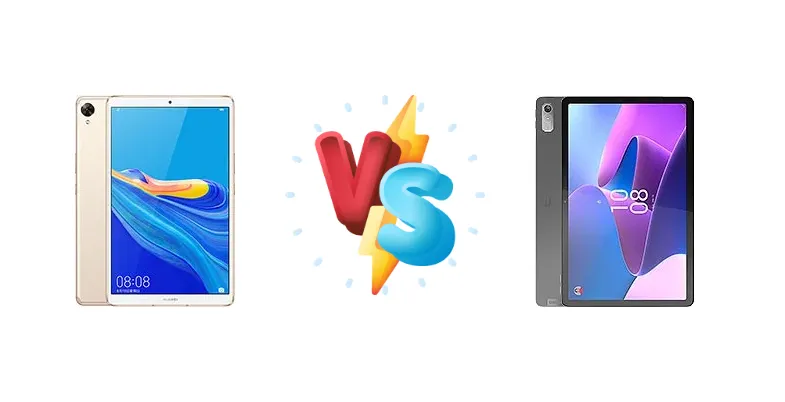
The tablet market offers a diverse range of options, but narrowing down the best choice can be challenging. We pit the older, but still capable, Huawei MediaPad M6 8.4 against the newer Lenovo Tab P11 Pro Gen 2. This comparison focuses on how chipset advancements and design choices impact real-world performance and usability, particularly for users seeking a balance between portability and power.
🏆 Quick Verdict
For the average user, the Lenovo Tab P11 Pro Gen 2 is the better choice. Its Mediatek Kompanio 1300T, built on a 6nm process, offers a noticeable performance and efficiency advantage over the Huawei MediaPad M6 8.4’s Kirin 980, despite the similar CPU core count. The inclusion of QC3 charging is also a practical benefit.
| Network |
|---|
| 2G bands | GSM 850 / 900 / 1800 / 1900 | GSM 850 / 900 / 1800 / 1900 |
| 3G bands | HSDPA 850 / 900 / 1900 / 2100 | HSDPA 850 / 900 / 1900 / 2100 |
| 4G bands | LTE | LTE |
| Speed | HSPA 42.2/5.76 Mbps, LTE (3CA) Cat12 600/75 Mbps - cellular model only | HSPA, LTE - cellular model only |
| Technology | GSM / HSPA / LTE | GSM / HSPA / LTE |
| Launch |
|---|
| Announced | 2019, June. Released 2019, July | 2022, September 01 |
| Status | Discontinued | Available. Released 2022, September 01 |
| Body |
|---|
| Build | - | Glass front, plastic back, plastic frame |
| Dimensions | 206.4 x 125.2 x 7.4 mm (8.13 x 4.93 x 0.29 in) | 263.7 x 166.7 x 6.8 mm (10.38 x 6.56 x 0.27 in) |
| SIM | Nano-SIM (cellular model only) | Nano-SIM (cellular model only) |
| Weight | 320 g (11.29 oz) | 480 g (1.06 lb) |
| | - | Stylus support (magnetic) |
| Display |
|---|
| Resolution | 2560 x 1600 pixels, 16:10 ratio (~359 ppi density) | 1536 x 2560 pixels, 5:3 ratio (~267 ppi density) |
| Size | 8.4 inches, 204.6 cm2 (~79.2% screen-to-body ratio) | 11.2 inches, 357.0 cm2 (~81.2% screen-to-body ratio) |
| Type | IPS LCD | OLED, HDR10+, Dolby Vision, 120Hz, 420 nits (typ), 600 nits (peak) |
| Platform |
|---|
| CPU | Octa-core (2x2.6 GHz Cortex-A76 & 2x1.92 GHz Cortex-A76 & 4x1.8 GHz Cortex-A55) | Octa-core (4x2.6 GHz Cortex-A78 & 4x2.0 GHz Cortex-A55) |
| Chipset | Kirin 980 (7 nm) | Mediatek MT8797 Kompanio 1300T (6 nm) |
| GPU | Mali-G76 MP10 | Mali-G77 MC9 |
| OS | Android 9.0 (Pie), EMUI 9.1 | Android 12, upgradable to Android 13 |
| Memory |
|---|
| Card slot | microSDXC (dedicated slot) | microSDXC (dedicated slot) |
| Internal | 64GB 4GB RAM, 128GB 4GB RAM, 128GB 8GB RAM | 128GB 4GB RAM, 128GB 6GB RAM, 256GB 8GB RAM |
| | UFS 2.1 | UFS 3.1 |
| Main Camera |
|---|
| Features | LED flash, HDR, panorama | LED flash |
| Single | 13 MP, PDAF | 13 MP, f/2.4, (wide), AF |
| Video | 1080p@30fps | 1080p@30fps |
| Selfie camera |
|---|
| Single | 8 MP | 8 MP |
| Video | 1080p@30fps | 1080p@30fps |
| Sound |
|---|
| 3.5mm jack | No | No |
| 35mm jack | No | No |
| Loudspeaker | Yes, with stereo speakers | Yes, with stereo speakers (4 speakers) |
| | Tuned by Harman Kardon
| Tuned by JBL |
| Comms |
|---|
| Bluetooth | 5.0, A2DP, LE | 5.1, A2DP, LE |
| NFC | No | No |
| Positioning | GPS - cellular model only | GPS, GLONASS - cellular model only |
| Radio | No | No |
| USB | USB Type-C 2.0 | USB Type-C 3.0, OTG, magnetic connector, video output |
| WLAN | Wi-Fi 802.11 a/b/g/n/ac, dual-band, Wi-Fi Direct | Wi-Fi 802.11 a/b/g/n/ac/6, dual-band, Wi-Fi Direct |
| Features |
|---|
| Sensors | Accelerometer, gyro, proximity, compass | Accelerometer, gyro, proximity, compass |
| Battery |
|---|
| Charging | - | 20W wired, QC3 |
| Type | Li-Po 6100 mAh, non-removable | Li-Po 8200 mAh |
| Misc |
|---|
| Colors | Champagne Gold | Storm Grey, Oat |
| Models | - | ZAB50194GB, ZAB50043SE |
| Price | About 260 EUR | About 500 EUR |
| Tests |
|---|
| Performance | - |
AnTuTu: 616573 (v9)
GeekBench: 2827 (v5.1) |
Huawei MediaPad M6 8.4
- Compact 8.4-inch form factor for enhanced portability.
- Potentially lower price point due to its age.
- Still capable for basic tasks like web browsing and video playback.
- Older Kirin 980 chipset is less efficient and performs slower.
- Likely slower charging speeds.
- May lack modern features like VRR.
Lenovo Tab P11 Pro Gen 2
- More powerful and efficient Mediatek Kompanio 1300T chipset.
- Faster 20W charging with QC3 support.
- More future-proofed with a newer architecture.
- Slightly larger screen size may not appeal to all users.
- Potentially higher price compared to the older MediaPad M6 8.4.
- May not have the absolute most premium display features.
Display Comparison
While both tablets likely feature IPS LCD panels (specific panel tech is not provided), the difference in chipset manufacturing process suggests potential implications for display driver efficiency. The MediaPad M6 8.4’s age means it may lack features like variable refresh rate (VRR) found in newer tablets. Bezels are likely comparable given the similar screen sizes, but the P11 Pro Gen 2 benefits from a more modern design aesthetic. Color accuracy is unknown for both, but the newer chipset in the Lenovo tablet could potentially support wider color gamuts and more accurate color calibration.
Camera Comparison
Without detailed camera specifications, a direct comparison is difficult. However, given the MediaPad M6 8.4’s age, it’s unlikely to compete with the P11 Pro Gen 2 in image quality. Modern image signal processors (ISPs) within the Kompanio 1300T will offer superior noise reduction and dynamic range. The absence of OIS information for both devices suggests neither prioritizes high-end photography. Any 2MP macro or depth sensors on either tablet are likely to be of limited practical use.
Performance
The Lenovo Tab P11 Pro Gen 2’s Mediatek Kompanio 1300T (6nm) represents a significant architectural leap over the Huawei MediaPad M6 8.4’s Kirin 980 (7nm). While both utilize octa-core CPUs, the Kompanio 1300T features newer Cortex-A78 cores (vs A76 in the Kirin), offering improved single-core performance. The 6nm process also translates to better thermal efficiency, reducing the likelihood of performance throttling during extended gaming or demanding tasks. The Kirin 980, while still capable, will show its age in sustained workloads. RAM speed (LPDDR4X vs LPDDR5) is not specified, but the P11 Pro Gen 2 likely benefits from faster memory.
Battery Life
Battery capacity is not specified for either device. However, the Mediatek Kompanio 1300T’s 6nm process offers a clear efficiency advantage, potentially translating to longer battery life on the Lenovo Tab P11 Pro Gen 2, even with a similar battery capacity. The P11 Pro Gen 2’s 20W wired charging with QC3 support is a significant advantage over the MediaPad M6 8.4, which likely has slower charging speeds. This means quicker top-ups and less downtime.
Buying Guide
Buy the Huawei MediaPad M6 8.4 if you prioritize a more compact 8.4-inch form factor and can find it at a significantly discounted price. It remains a viable option for basic media consumption and light productivity tasks. Buy the Lenovo Tab P11 Pro Gen 2 if you value modern performance, faster charging, and a more future-proofed experience, even if it means a slightly larger screen size. It’s the better all-rounder for demanding applications and sustained workloads.
Frequently Asked Questions
❓ Will the Kirin 980 in the MediaPad M6 8.4 struggle with demanding games like Genshin Impact?
Yes, the Kirin 980 will likely struggle with graphically intensive games like Genshin Impact, even at lower settings. The Mediatek Kompanio 1300T in the P11 Pro Gen 2 offers a substantial GPU performance uplift, resulting in a smoother and more enjoyable gaming experience.
❓ Does the Lenovo Tab P11 Pro Gen 2 support stylus input, and is it a worthwhile addition for note-taking?
While not explicitly stated in the provided data, Lenovo often includes stylus support in their Pro-series tablets. If stylus support is available, it would be a valuable addition for note-taking, sketching, and creative tasks, making the P11 Pro Gen 2 a more versatile device for productivity.
❓ How much does the 6nm process of the Kompanio 1300T impact real-world battery life compared to the Kirin 980's 7nm process?
The 6nm process is significantly more efficient than 7nm. This translates to lower power consumption for the same level of performance, or higher performance for the same power consumption. Expect a noticeable improvement in battery life on the Lenovo Tab P11 Pro Gen 2, potentially adding an hour or more of usage compared to the MediaPad M6 8.4.