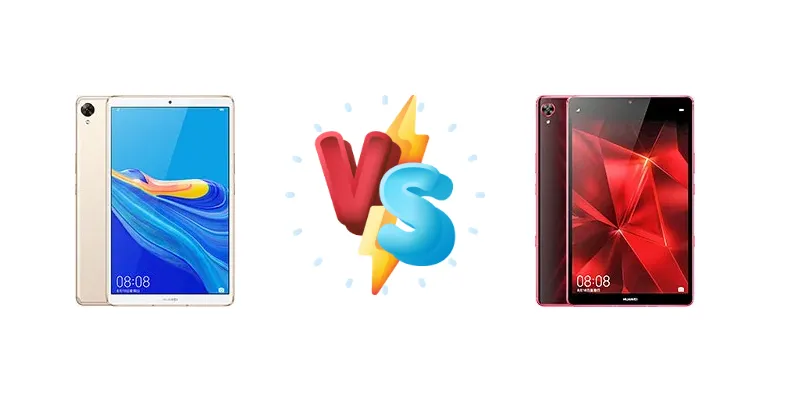
The Huawei MediaPad M6 8.4 was a strong contender in the mid-range tablet market. Now, the M6 Turbo 8.4 enters the scene, promising enhanced performance. But is the upgrade worth it? This review dives deep into a head-to-head comparison to help you decide.
🏆 Quick Verdict
Both tablets share the same Kirin 980 chipset, but the M6 Turbo 8.4 boasts improved cooling and RAM, resulting in noticeably smoother multitasking and gaming. If performance is your priority, the Turbo is the clear winner, though the standard M6 remains a solid, more affordable option.
| Network |
|---|
| 2G bands | GSM 850 / 900 / 1800 / 1900 | GSM 850 / 900 / 1800 / 1900 |
| 3G bands | HSDPA 850 / 900 / 1900 / 2100 | HSDPA 800 / 850 / 900 / 1700(AWS) / 1900 / 2100 |
| 4G bands | LTE | 1, 3, 4, 5, 8, 19, 34, 38, 39, 40, 41 |
| Speed | HSPA 42.2/5.76 Mbps, LTE (3CA) Cat12 600/75 Mbps - cellular model only | HSPA 42.2/5.76 Mbps, LTE (3CA) Cat12 600/75 Mbps - cellular model only |
| Technology | GSM / HSPA / LTE | GSM / CDMA / HSPA / LTE |
| | - | CDMA 800 & TD-SCDMA |
| Launch |
|---|
| Announced | 2019, June. Released 2019, July | 2019, September. Released 2019, September |
| Status | Discontinued | Discontinued |
| Body |
|---|
| Dimensions | 206.4 x 125.2 x 7.4 mm (8.13 x 4.93 x 0.29 in) | 206.4 x 125.2 x 8.2 mm (8.13 x 4.93 x 0.32 in) |
| SIM | Nano-SIM (cellular model only) | Nano-SIM (cellular model only) |
| Weight | 320 g (11.29 oz) | 340 g (11.99 oz) |
| Display |
|---|
| Resolution | 2560 x 1600 pixels, 16:10 ratio (~359 ppi density) | 2560 x 1600 pixels, 16:10 ratio (~359 ppi density) |
| Size | 8.4 inches, 204.6 cm2 (~79.2% screen-to-body ratio) | 8.4 inches, 204.6 cm2 (~79.2% screen-to-body ratio) |
| Type | IPS LCD | IPS LCD |
| Platform |
|---|
| CPU | Octa-core (2x2.6 GHz Cortex-A76 & 2x1.92 GHz Cortex-A76 & 4x1.8 GHz Cortex-A55) | Octa-core (2x2.6 GHz Cortex-A76 & 2x1.92 GHz Cortex-A76 & 4x1.8 GHz Cortex-A55) |
| Chipset | Kirin 980 (7 nm) | Kirin 980 (7 nm) |
| GPU | Mali-G76 MP10 | Mali-G76 MP10 |
| OS | Android 9.0 (Pie), EMUI 9.1 | Android 9.0 (Pie), EMUI 9.1 |
| Memory |
|---|
| Card slot | microSDXC (dedicated slot) | microSDXC (dedicated slot) |
| Internal | 64GB 4GB RAM, 128GB 4GB RAM, 128GB 8GB RAM | 128GB 6GB RAM |
| | UFS 2.1 | UFS 2.1 |
| Main Camera |
|---|
| Features | LED flash, HDR, panorama | LED flash, HDR, panorama |
| Single | 13 MP, PDAF | 13 MP, f/1.8, PDAF |
| Video | 1080p@30fps | 1080p@30fps |
| Selfie camera |
|---|
| Single | 8 MP | 8 MP, f/2.0 |
| Video | 1080p@30fps | 1080p@30fps |
| Sound |
|---|
| 3.5mm jack | No | No |
| 35mm jack | No | No |
| Loudspeaker | Yes, with stereo speakers | Yes, with stereo speakers |
| | Tuned by Harman Kardon
| Tuned by Harman Kardon
|
| Comms |
|---|
| Bluetooth | 5.0, A2DP, LE | 5.0, A2DP, LE |
| NFC | No | No |
| Positioning | GPS - cellular model only | GPS, GLONASS, BDS - cellular model only |
| Radio | No | No |
| USB | USB Type-C 2.0 | USB Type-C 2.0, OTG |
| WLAN | Wi-Fi 802.11 a/b/g/n/ac, dual-band, Wi-Fi Direct | Wi-Fi 802.11 a/b/g/n/ac, dual-band, Wi-Fi Direct |
| Features |
|---|
| Sensors | Accelerometer, gyro, proximity, compass | Accelerometer, gyro, proximity, compass |
| Battery |
|---|
| Type | Li-Po 6100 mAh, non-removable | Li-Po 6100 mAh, non-removable |
| Misc |
|---|
| Colors | Champagne Gold | Phantom Red, Phantom Blue |
| Models | - | VRD-AL10, VRD-W10, VRD-W09, VRD-AL09 |
| Price | About 260 EUR | About 350 EUR |
Huawei MediaPad M6 8.4
- More affordable
- Compact and portable
- Good display quality
- Decent battery life
- Performance can be limited with demanding apps
- Only 4GB of RAM
- Potential for thermal throttling
Huawei MediaPad M6 Turbo 8.4
- Improved performance and multitasking
- Better cooling system
- Typically 6GB of RAM
- Smoother gaming experience
- More expensive
- Battery life may be slightly shorter under heavy load
- Similar display to the standard M6
Display Comparison
Both tablets feature an 8.4-inch IPS LCD display with a resolution of 2560 x 1600. While the specifications are identical, the M6 Turbo 8.4 may exhibit slightly better color accuracy and brightness due to potential panel variations and improved calibration. However, the difference is likely minimal.
Camera Comparison
Camera performance is largely identical on both devices. They both feature a 13MP rear camera and an 8MP front camera. Image quality is decent for a tablet, suitable for occasional snapshots but not a replacement for a dedicated camera.
Performance
This is where the M6 Turbo 8.4 shines. While both use the Kirin 980, the Turbo variant incorporates a more robust cooling system and typically features 6GB of RAM compared to the standard M6's 4GB. This translates to significantly improved multitasking capabilities and smoother performance in graphically intensive games. Expect reduced thermal throttling on the Turbo.
Battery Life
Both tablets are equipped with a 5100mAh battery. Battery life is comparable under typical usage, but the M6 Turbo 8.4's improved performance might lead to slightly faster battery drain during demanding tasks. Expect around 8-10 hours of mixed usage on both.
Buying Guide
The Huawei MediaPad M6 8.4 is ideal for students, casual users, and those seeking a compact tablet for media consumption and light productivity. The Huawei MediaPad M6 Turbo 8.4 is best suited for gamers, power users, and anyone who demands a responsive and fluid tablet experience for demanding applications.
Frequently Asked Questions
❓ Is the Huawei MediaPad M6 Turbo 8.4 worth the extra cost?
If you prioritize performance and frequently use demanding apps or play games, the Turbo is a worthwhile investment. Otherwise, the standard M6 offers excellent value for casual users.
❓ What is the difference in RAM between the two models?
The Huawei MediaPad M6 8.4 typically comes with 4GB of RAM, while the M6 Turbo 8.4 usually features 6GB of RAM, contributing to its improved multitasking capabilities.