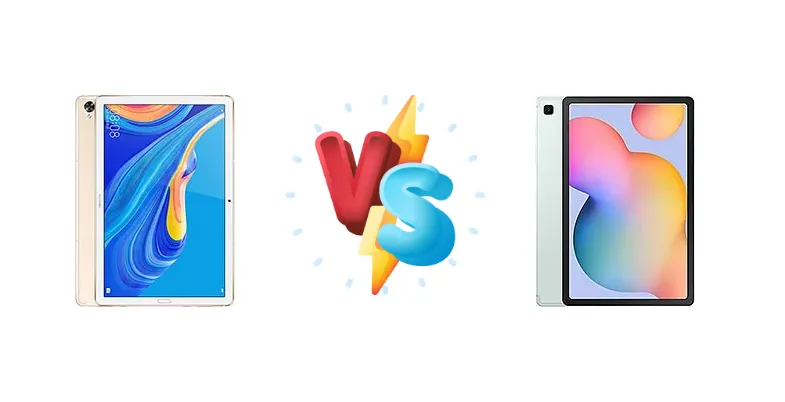
The tablet market offers a compelling middle ground between smartphones and laptops. We're pitting the Huawei MediaPad M6 10.8, a veteran known for its solid performance, against the refreshed Samsung Galaxy Tab S6 Lite (2024), which aims to deliver a modern experience with a newer chipset. This comparison focuses on how these two tablets stack up in real-world usage, considering their core specifications and target audiences.
🏆 Quick Verdict
For the average user prioritizing long-term software support and efficiency, the Samsung Galaxy Tab S6 Lite (2024) is the better choice. While the MediaPad M6 10.8’s Kirin 980 remains capable, the Exynos 1280 in the S6 Lite offers a more modern architecture and improved power efficiency, translating to better sustained performance and future-proofing.
| Network |
|---|
| 2G bands | GSM 850 / 900 / 1800 / 1900 | GSM 850 / 900 / 1800 / 1900 |
| 3G bands | HSDPA 850 / 900 / 1900 / 2100 | HSDPA 850 / 900 / 1700(AWS) / 1900 / 2100 |
| 4G bands | LTE | 1, 2, 3, 4, 5, 7, 8, 12, 17, 20, 25, 26, 28, 38, 40, 41, 66 |
| Speed | HSPA 42.2/5.76 Mbps, LTE (3CA) Cat12 600/75 Mbps - cellular model only | HSPA, LTE - cellular model only |
| Technology | GSM / HSPA / LTE | GSM / HSPA / LTE |
| Launch |
|---|
| Announced | 2019, June. Released 2019, July 10 | 2024, March 26 |
| Status | Discontinued | Available. Released 2024, March 28 |
| Body |
|---|
| Build | - | Glass front, aluminum back, aluminum frame |
| Dimensions | 257 x 170 x 7.2 mm (10.12 x 6.69 x 0.28 in) | 244.5 x 154.3 x 7 mm (9.63 x 6.07 x 0.28 in) |
| SIM | Nano-SIM (cellular model only) | Nano-SIM (cellular model only) |
| Weight | 498 g (1.10 lb) | 465/467 g (1.03 lb) |
| | Stylus support | - |
| Display |
|---|
| Resolution | 2560 x 1600 pixels, 16:10 ratio (~280 ppi density) | 1200 x 2000 pixels, 5:3 ratio (~224 ppi density) |
| Size | 10.8 inches, 338.2 cm2 (~77.4% screen-to-body ratio) | 10.4 inches, 307.9 cm2 (~81.6% screen-to-body ratio) |
| Type | IPS LCD | TFT LCD |
| Platform |
|---|
| CPU | Octa-core (2x2.6 GHz Cortex-A76 & 2x1.92 GHz Cortex-A76 & 4x1.8 GHz Cortex-A55) | Octa-core (2x2.4 GHz Cortex-A78 & 6x2.0 GHz Cortex-A55) |
| Chipset | Kirin 980 (7 nm) | Exynos 1280 (5 nm) |
| GPU | Mali-G76 MP10 | Mali-G68 |
| OS | Android 9.0 (Pie), EMUI 9.1 | Android 14, upgradable to Android 15, One UI 7 |
| Memory |
|---|
| Card slot | microSDXC (dedicated slot) | microSDXC (dedicated slot) |
| Internal | 64GB 4GB RAM, 128GB 4GB RAM, 256GB 6GB RAM | 64GB 4GB RAM, 128GB 4GB RAM |
| | UFS 2.1 | - |
| Main Camera |
|---|
| Features | LED flash, HDR, panorama | HDR, panorama |
| Single | 13 MP, PDAF | 8 MP, (wide), 1/4.0", 1.12µm, AF |
| Video | 1080p@30fps | 1080p@30fps |
| Selfie camera |
|---|
| Single | 8 MP | 5 MP, (wide), 1/5.0", 1.12µm |
| Video | 1080p@30fps | 1080p@30fps |
| Sound |
|---|
| 3.5mm jack | Yes | - |
| 35mm jack | Yes | Yes |
| Loudspeaker | Yes, with stereo speakers | Yes, with stereo speakers |
| | Tuned by Harman Kardon
| - |
| Comms |
|---|
| Bluetooth | 5.0, A2DP, LE | 5.3, A2DP, LE |
| NFC | No | No |
| Positioning | GPS - cellular model only | GPS, GLONASS, BDS, GALILEO, QZSS - cellular model only |
| Radio | No | No |
| USB | USB Type-C 2.0, magnetic connector | USB Type-C 2.0 |
| WLAN | Wi-Fi 802.11 a/b/g/n/ac, dual-band, Wi-Fi Direct | Wi-Fi 802.11 a/b/g/n/ac, dual-band, Wi-Fi Direct |
| Features |
|---|
| Sensors | Fingerprint (front-mounted), accelerometer, gyro, proximity, compass | Accelerometer, proximity, gyro (wi-fi model only) |
| Battery |
|---|
| Charging | - | 15W wired |
| Type | Li-Po 7500 mAh, non-removable | Li-Po 7040 mAh |
| Misc |
|---|
| Colors | Champagne Gold | Gray, Mint, Rose Gold |
| Models | SCM-AL09, SCM-W09 | SM-P620, SM-P625 |
| Price | About 300 EUR | $ 215.00 |
| SAR | - | 0.95 W/kg (body) |
Huawei MediaPad M6 10.8
- Proven Kirin 980 performance for everyday tasks.
- Potentially lower price point (depending on retailer).
- Mature software (though potentially limited by HMS).
- Older chipset architecture.
- Potential limitations with Google Mobile Services.
- Uncertainty regarding long-term software updates.
Samsung Galaxy Tab S6 Lite (2024)
- More efficient Exynos 1280 processor.
- Guaranteed Android updates and security patches.
- Wider app compatibility through Google Play Store.
- Slower 15W charging.
- Potentially slightly lower peak CPU performance in some benchmarks.
- May be slightly more expensive.
Display Comparison
Neither device boasts a cutting-edge display. The MediaPad M6 10.8’s display specifications are unavailable, but given its release date, it likely utilizes an IPS LCD panel. The Galaxy Tab S6 Lite (2024) also uses an IPS LCD. The key difference lies in the processing power driving the display; the Exynos 1280’s ISP likely offers slightly better image processing. Both tablets likely feature similar resolutions, around 2000x1200, suitable for media consumption. Bezels are expected to be comparable, typical of tablets in this price range. Color accuracy is likely good on both, but the S6 Lite benefits from Samsung’s display calibration expertise.
Camera Comparison
Neither tablet is a photography powerhouse. The MediaPad M6 10.8’s camera specifications are unavailable, but tablet cameras are rarely a priority. The Galaxy Tab S6 Lite (2024) also doesn’t emphasize camera capabilities. Image quality will be adequate for casual snapshots and video calls, but don’t expect flagship-level performance. The Exynos 1280’s ISP may offer slightly better image processing, but the limitations of the sensor itself will be the primary bottleneck.
Performance
This is where the most significant difference lies. The Huawei MediaPad M6 10.8’s Kirin 980 (7nm) features a tri-cluster CPU configuration with Cortex-A76 cores, offering strong multi-core performance for its time. However, the Samsung Galaxy Tab S6 Lite (2024) utilizes the Exynos 1280 (5nm). The move to a 5nm process node is crucial, providing significantly improved power efficiency and thermal headroom. While the Kirin 980’s CPU clock speeds are slightly higher on some cores (2.6GHz vs 2.4GHz), the newer Cortex-A78 cores in the Exynos 1280 offer superior instructions per clock (IPC). This translates to better sustained performance under load, particularly in demanding tasks like gaming and video editing. The S6 Lite’s GPU also benefits from the newer architecture, offering a more modern graphics experience.
Battery Life
The MediaPad M6 10.8’s battery capacity is unknown, but tablets typically prioritize battery life for media consumption. The Galaxy Tab S6 Lite (2024) supports 15W wired charging. The Exynos 1280’s 5nm process contributes to better battery efficiency, meaning the S6 Lite will likely achieve comparable or better battery life despite potentially having a similar capacity battery. The 15W charging is relatively slow compared to some competitors, but sufficient for overnight charging.
Buying Guide
Buy the Huawei MediaPad M6 10.8 if you need a tablet with a proven track record of performance and are comfortable with the Huawei ecosystem, potentially facing limitations with Google Mobile Services. Buy the Samsung Galaxy Tab S6 Lite (2024) if you prefer a streamlined Android experience with guaranteed updates, a more efficient processor, and wider app compatibility, even if it means slightly less raw processing power in some benchmarks.
Frequently Asked Questions
❓ Does the Exynos 1280 in the Galaxy Tab S6 Lite (2024) overheat during extended gaming sessions?
The Exynos 1280’s 5nm process and improved thermal design minimize overheating. While some throttling may occur during prolonged, demanding gaming, it’s unlikely to be a significant issue, and the tablet should maintain stable performance for extended periods. The Kirin 980 in the MediaPad M6 10.8, being an older 7nm chip, may throttle more noticeably.
❓ How does the lack of Google Mobile Services (GMS) on the Huawei MediaPad M6 10.8 affect app availability?
The MediaPad M6 10.8 relies on Huawei Mobile Services (HMS) and the AppGallery. While many popular apps are available through these channels, some Google-dependent apps may require workarounds or may not be compatible. This can be a significant inconvenience for users heavily reliant on the Google ecosystem.
❓ What kind of storage and RAM options are available for each tablet?
Specific storage and RAM configurations vary by region and retailer. However, the Galaxy Tab S6 Lite (2024) typically comes in configurations with 4GB or 6GB of RAM and 64GB or 128GB of storage, expandable via microSD. The MediaPad M6 10.8 also offered similar configurations, but availability may be limited due to its age.