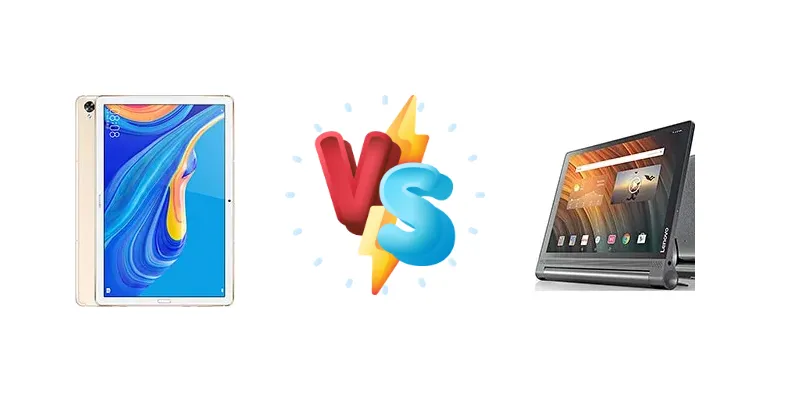
The tablet market offers a wide spectrum of choices, from budget-friendly options to premium devices. The Huawei MediaPad M6 10.8, powered by the Kirin 980, represents a significant step up in processing power compared to the Lenovo Yoga Tab 3 Plus, which comes in configurations with either the Snapdragon 625 or 652. This comparison dissects the key differences to help you determine which tablet best suits your needs and budget.
🏆 Quick Verdict
For users prioritizing performance and future-proofing, the Huawei MediaPad M6 10.8 is the clear winner. Its Kirin 980 chipset delivers substantially faster processing speeds and a smoother user experience. However, the Lenovo Yoga Tab 3 Plus remains a viable option for casual users focused on media consumption and portability, especially if budget is a primary concern.
| Network |
|---|
| 2G bands | GSM 850 / 900 / 1800 / 1900 | GSM 850 / 900 / 1800 / 1900 |
| 3G bands | HSDPA 850 / 900 / 1900 / 2100 | HSDPA 850 / 900 / 1900 / 2100 - EMEA |
| 4G bands | LTE | 1, 2, 3, 5, 7, 8, 20, 38, 39, 40, 41 - EMEA |
| Speed | HSPA 42.2/5.76 Mbps, LTE (3CA) Cat12 600/75 Mbps - cellular model only | HSPA, LTE |
| Technology | GSM / HSPA / LTE | GSM / HSPA / LTE |
| | - | 1, 2, 3, 4, 5, 7, 8, 12, 17, 19, 21, 25, 26, 28, 30, 41 - ROW |
| Launch |
|---|
| Announced | 2019, June. Released 2019, July 10 | 2016, September. Released 2016, December |
| Status | Discontinued | Discontinued |
| Body |
|---|
| Dimensions | 257 x 170 x 7.2 mm (10.12 x 6.69 x 0.28 in) | 247 x 179 mm |
| SIM | Nano-SIM (cellular model only) | Micro-SIM |
| Weight | 498 g (1.10 lb) | 637 g (Wi-Fi)/ 644 g (3G/LTE) (1.40 lb) |
| | Stylus support | Built-in 3-stage kickstand
Splash and dust resistant |
| Display |
|---|
| Resolution | 2560 x 1600 pixels, 16:10 ratio (~280 ppi density) | 1600 x 2560 pixels, 16:10 ratio (~299 ppi density) |
| Size | 10.8 inches, 338.2 cm2 (~77.4% screen-to-body ratio) | 10.1 inches, 295.8 cm2 (~66.9% screen-to-body ratio) |
| Type | IPS LCD | IPS LCD |
| Platform |
|---|
| CPU | Octa-core (2x2.6 GHz Cortex-A76 & 2x1.92 GHz Cortex-A76 & 4x1.8 GHz Cortex-A55) | Octa-core 2.0 GHz Cortex-A53 - 3G/LTE modelOcta-core (4x1.8 GHz Cortex-A72 & 4x1.4 GHz Cortex-A53) - Wi-Fi model |
| Chipset | Kirin 980 (7 nm) | Qualcomm MSM8953 Snapdragon 625 (14 nm) - 3G/LTE modelQualcomm MSM8976 Snapdragon 652 (28 nm) - Wi-Fi model |
| GPU | Mali-G76 MP10 | Adreno 506 - 3G/LTE modelAdreno 510 - Wi-Fi model |
| OS | Android 9.0 (Pie), EMUI 9.1 | Android 6.0.1 (Marshmallow), upgradable to 7.1.1 (Nougat) |
| Memory |
|---|
| Card slot | microSDXC (dedicated slot) | microSDXC (dedicated slot) |
| Internal | 64GB 4GB RAM, 128GB 4GB RAM, 256GB 6GB RAM | 32GB 3GB RAM |
| | UFS 2.1 | eMMC 5.1 |
| Main Camera |
|---|
| Features | LED flash, HDR, panorama | HDR, panorama |
| Single | 13 MP, PDAF | 13 MP, AF |
| Video | 1080p@30fps | 1080p@30fps |
| Selfie camera |
|---|
| Single | 8 MP | 5 MP |
| Video | 1080p@30fps | - |
| Sound |
|---|
| 3.5mm jack | Yes | Yes |
| 35mm jack | Yes | Yes |
| Loudspeaker | Yes, with stereo speakers | Yes, with stereo speakers (4 speakers) |
| | Tuned by Harman Kardon
| - |
| Comms |
|---|
| Bluetooth | 5.0, A2DP, LE | 4.0, A2DP |
| NFC | No | No |
| Positioning | GPS - cellular model only | GPS, GLONASS |
| Radio | No | No |
| USB | USB Type-C 2.0, magnetic connector | USB Type-C 2.0 |
| WLAN | Wi-Fi 802.11 a/b/g/n/ac, dual-band, Wi-Fi Direct | Wi-Fi 802.11 a/b/g/n/ac, dual-band, Wi-Fi Direct |
| Features |
|---|
| Sensors | Fingerprint (front-mounted), accelerometer, gyro, proximity, compass | Accelerometer, compass |
| Battery |
|---|
| Charging | - | 18W wired |
| Talk time | - | Up to 18 h (3G) |
| Type | Li-Po 7500 mAh, non-removable | Li-Ion 9300 mAh, non-removable |
| Misc |
|---|
| Colors | Champagne Gold | Black |
| Models | SCM-AL09, SCM-W09 | YT-X703F, YT-X703L, YT-X703X |
| Price | About 300 EUR | About 300 EUR |
Huawei MediaPad M6 10.8
- Significantly faster performance with the Kirin 980 chipset
- Likely superior display quality and color accuracy
- Potentially better camera performance
- Likely higher price point
- Battery life may be slightly lower than the Yoga Tab 3 Plus in light usage
Lenovo Yoga Tab 3 Plus
- More affordable price
- Good power efficiency with the Snapdragon 625 (potentially longer battery life)
- 18W fast charging
- Significantly slower performance compared to the Kirin 980
- Older chipset and potentially outdated software support
- Display quality likely inferior to the MediaPad M6 10.8
Display Comparison
While both tablets feature 10.8-inch displays, the context data lacks specifics regarding panel technology (IPS, TFT) or resolution. However, the MediaPad M6 10.8, being a more recent device, likely benefits from improved color accuracy and viewing angles. The Yoga Tab 3 Plus's display quality is likely adequate for media consumption, but will likely fall short of the MediaPad M6 10.8 in terms of vibrancy and detail. Bezels are also likely larger on the Yoga Tab 3 Plus, given its age.
Camera Comparison
Camera performance is unlikely to be a deciding factor for most tablet buyers. However, the MediaPad M6 10.8 likely features a more advanced camera system, benefiting from the Kirin 980’s image signal processor (ISP). The Yoga Tab 3 Plus’s camera specifications are not detailed enough to make a meaningful comparison, but it’s safe to assume it will lag behind the MediaPad M6 10.8 in image quality, especially in low-light conditions. We can expect the MediaPad M6 10.8 to have better dynamic range and detail.
Performance
The performance gap is the most significant differentiator. The Huawei MediaPad M6 10.8’s Kirin 980 (7nm) is a flagship-class chipset, boasting a complex octa-core configuration with both Cortex-A76 and A55 cores. This architecture provides a substantial performance boost over the Lenovo Yoga Tab 3 Plus’s Snapdragon 625 (14nm) or 652 (28nm). The Snapdragon 625 utilizes only Cortex-A53 cores, while the 652 adds Cortex-A72 cores, but both are significantly less powerful than the Kirin 980. The 7nm process node of the Kirin 980 also translates to better power efficiency and reduced thermal throttling during sustained workloads. Gamers and power users will overwhelmingly benefit from the MediaPad M6 10.8.
Battery Life
The battery capacity of both devices is not specified. However, the Snapdragon 625 is known for its excellent power efficiency, potentially allowing the Yoga Tab 3 Plus to achieve comparable or even slightly better battery life in light usage scenarios. The MediaPad M6 10.8, despite its more powerful chipset, may compensate with a larger battery capacity. The Yoga Tab 3 Plus’s 18W wired charging is a welcome feature, offering faster charging speeds than many older tablets, but the MediaPad M6 10.8 may support faster charging protocols depending on the specific model.
Buying Guide
Buy the Huawei MediaPad M6 10.8 if you need a tablet capable of handling demanding tasks like gaming, video editing, or multitasking. Its superior chipset and potentially faster RAM (though not specified) will provide a more responsive and enjoyable experience. Buy the Lenovo Yoga Tab 3 Plus if you prefer a more affordable and portable tablet primarily for basic tasks like web browsing, streaming videos, and reading ebooks. The 18W charging is a plus for quick top-ups, but don't expect flagship-level performance.
Frequently Asked Questions
❓ Does the Kirin 980 in the MediaPad M6 10.8 get hot during extended gaming sessions?
The Kirin 980's 7nm process node is designed for efficiency, and Huawei typically employs effective thermal management solutions. While some heat generation is inevitable during demanding tasks, the MediaPad M6 10.8 should handle extended gaming sessions without significant throttling, unlike the Snapdragon 625/652 which are more prone to performance drops under sustained load.
❓ Is the Snapdragon 625/652 in the Yoga Tab 3 Plus sufficient for streaming video and web browsing?
Yes, the Snapdragon 625 and 652 are perfectly capable of handling everyday tasks like streaming video (Netflix, YouTube) and web browsing. They are efficient processors that won't struggle with these common use cases. However, expect some lag or slowdown when multitasking or running more demanding applications.
❓ Which tablet is better for taking notes with a stylus?
Neither tablet is specifically marketed as a stylus-focused device. However, the MediaPad M6 10.8's more responsive chipset and potentially higher display quality might offer a slightly better experience with a compatible stylus, assuming one is purchased separately. The Yoga Tab 3 Plus will function with a stylus, but the experience will likely be less fluid.