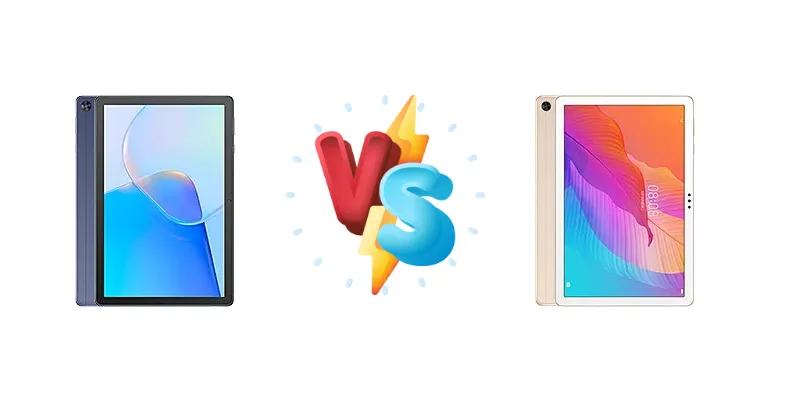
Huawei's MatePad series offers budget-friendly tablets for various needs. The MatePad SE and MatePad T 10s are two popular contenders, often leaving buyers wondering which one provides the best value. This comprehensive comparison will delve into their features, performance, and design to help you make an informed decision.
🏆 Quick Verdict
The MatePad SE edges out the T 10s thanks to its reverse charging capability and slightly more modern design. Both share the same Kirin 710A chipset, so performance is largely similar. If reverse charging is a must-have, the SE is the clear winner; otherwise, the T 10s remains a solid choice.
| Network |
|---|
| 2G bands | GSM 850 / 900 / 1800 / 1900 | GSM 850 / 900 / 1800 / 1900 |
| 3G bands | HSDPA 850 / 900 / 1900 / 2100 | HSDPA 850 / 900 / 1700(AWS) / 1900 / 2100 |
| 4G bands | LTE | 1, 3, 5, 7, 8, 18, 19, 20, 26, 28, 38, 40, 41 |
| Speed | HSPA, LTE - cellular model only | HSPA, LTE - cellular model only |
| Technology | GSM / HSPA / LTE | GSM / HSPA / LTE |
| Launch |
|---|
| Announced | 2022, April 28 | 2020, September 09. Released 2020, September 09 |
| Status | Available. Released 2022, May 10 | Discontinued |
| Body |
|---|
| Dimensions | 240.2 x 159 x 7.9 mm (9.46 x 6.26 x 0.31 in) | 240.2 x 159 x 7.9 mm (9.46 x 6.26 x 0.31 in) |
| SIM | Nano-SIM (cellular model only) | Nano-SIM (cellular model only) |
| Weight | 450 g (0.99 lb) | 450 g (0.99 lb) |
| | - | Stylus support |
| Display |
|---|
| Resolution | 1200 x 1920 pixels, 16:10 ratio (~224 ppi density) | 1200 x 1920 pixels, 16:10 ratio (~224 ppi density) |
| Size | 10.1 inches, 295.8 cm2 (~77.4% screen-to-body ratio) | 10.1 inches, 295.8 cm2 (~77.4% screen-to-body ratio) |
| Type | IPS LCD | IPS LCD |
| Platform |
|---|
| CPU | Octa-core (4x2.0 GHz Cortex-A73 & 4x1.7 GHz Cortex-A53) | Octa-core (4x2.0 GHz Cortex-A73 & 4x1.7 GHz Cortex-A53) |
| Chipset | Kirin 710A (14 nm) | Kirin 710A (14 nm) |
| GPU | Mali-G51 MP4 | Mali-G51 MP4 |
| OS | HarmonyOS 2.0 | Android 10, EMUI 10.1, no Google Play Services |
| Memory |
|---|
| Card slot | microSDXC (dedicated slot) | microSDXC |
| Internal | 32GB 3GB RAM, 64GB 4GB RAM, 128GB 4GB RAM | 16GB 2GB RAM, 32GB 2GB RAM, 64GB 3GB RAM, 64GB 4GB RAM, 128GB 4GB RAM |
| | - | eMMC 5.1 |
| Main Camera |
|---|
| Features | HDR | HDR, panorama |
| Single | 5 MP, f/2.2, AF | 5 MP, f/2.2, PDAF |
| Video | 1080p@30fps | 1080p@30fps |
| Selfie camera |
|---|
| Single | 2 MP, f/2.4 | 2 MP, f/2.4 |
| Video | 720p@30fps | - |
| Sound |
|---|
| 3.5mm jack | Yes | Yes |
| 35mm jack | Yes | Yes |
| Loudspeaker | Yes, with stereo speakers | Yes, with stereo speakers |
| | Tuned by Harman Kardon | Tuned by Harman Kardon |
| Comms |
|---|
| Bluetooth | 5.1, A2DP, LE | 5.0, A2DP, LE |
| NFC | No | No |
| Positioning | GPS, GLONASS, BDS - cellular model only | GPS, GLONASS, BDS - cellular model only |
| Radio | No | No |
| USB | USB Type-C 2.0, OTG | USB Type-C 2.0, OTG |
| WLAN | Wi-Fi 802.11 a/b/g/n/ac, dual-band, Wi-Fi Direct | Wi-Fi 802.11 a/b/g/n/ac, dual-band, Wi-Fi Direct |
| Features |
|---|
| Sensors | Accelerometer, proximity | Accelerometer, proximity |
| Battery |
|---|
| Charging | 10W wired
5W reverse wired | 10W wired |
| Type | Li-Po 5100 mAh | Li-Po 5100 mAh |
| Misc |
|---|
| Colors | Dark Blue | Gold, Deepsea Blue |
| Models | Ags3K-W20, Ags3K-AL20, AGS5-W09 | AGS3-L09, AGS3-W09, AGS3K-W09 |
| Price | About 190 EUR | About 200 EUR |
Huawei MatePad SE
- Reverse charging capability
- Slightly more modern design
- Good value for money
- Decent front-facing camera
- Performance can be limited for demanding tasks
- No expandable storage (typically)
- 10W charging is relatively slow
Huawei MatePad T 10s
- Affordable price point
- Reliable performance for basic tasks
- Good for media consumption
- Decent battery life
- No reverse charging
- Slightly older design
- Performance can be limited for demanding tasks
- No expandable storage (typically)
Display Comparison
Both tablets feature a 10.1-inch IPS LCD display with a resolution of 1920 x 1200. While the panels are similar in quality, the MatePad SE often has a slightly more modern bezel design, offering a marginally more immersive viewing experience. Color accuracy is adequate for everyday use but not exceptional for professional photo or video editing.
Camera Comparison
The MatePad SE generally has a slightly better front-facing camera, which is beneficial for video calls. Both tablets feature a rear camera suitable for casual snapshots, but image quality is not a strong point for either device. Expect decent performance in well-lit conditions.
Performance
Powered by the Kirin 710A chipset and 4GB of RAM (typically), both tablets offer adequate performance for everyday tasks like browsing, streaming, and light gaming. Don't expect flagship-level performance; these are budget-oriented devices. Multitasking is manageable, but demanding games may require lower graphics settings.
Battery Life
Both tablets typically house a 5100mAh battery, providing around 8-10 hours of mixed usage. The MatePad SE's reverse charging capability allows it to act as a power bank for other devices, a significant advantage over the T 10s.
Buying Guide
The Huawei MatePad SE is ideal for students or users who need a tablet for basic tasks, media consumption, and occasional note-taking, especially if reverse charging is beneficial. The MatePad T 10s is a great option for families or those seeking a reliable, affordable tablet for entertainment and light productivity.
Frequently Asked Questions
❓ Can I expand the storage on either tablet?
Typically, neither the MatePad SE nor the MatePad T 10s offer expandable storage via microSD card. You'll need to rely on cloud storage or internal storage.
❓ What operating system do these tablets run?
Both tablets run Huawei's EMUI, based on Android. However, due to US trade restrictions, they do not have access to Google Mobile Services (GMS). They utilize Huawei Mobile Services (HMS) instead.