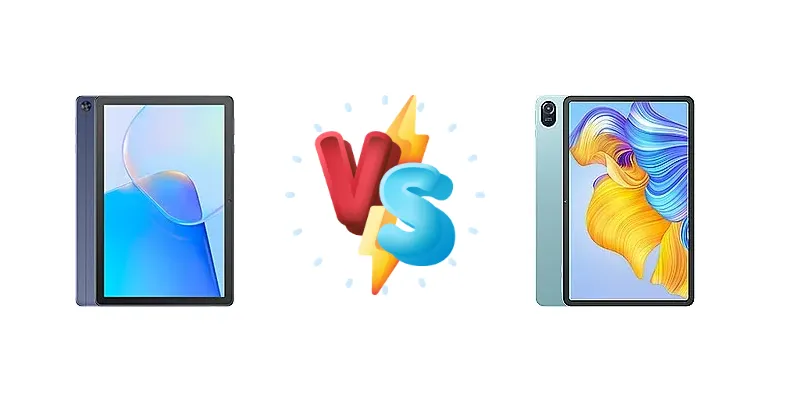
The Huawei MatePad SE and Honor Pad 8 represent compelling options in the increasingly competitive budget tablet space. While both aim to deliver a functional Android experience without breaking the bank, they diverge significantly in their core hardware choices. This comparison dissects those differences, focusing on performance, display quality, and charging capabilities to determine which tablet best suits your needs.
🏆 Quick Verdict
For most users, the Honor Pad 8 emerges as the better choice. Its more modern Snapdragon 680 chipset, built on a 6nm process, offers a noticeable performance advantage and improved efficiency over the Huawei MatePad SE’s Kirin 710A. The faster 22.5W charging is also a significant benefit.
| Network |
|---|
| 2G bands | GSM 850 / 900 / 1800 / 1900 | N/A |
| 3G bands | HSDPA 850 / 900 / 1900 / 2100 | N/A |
| 4G bands | LTE | N/A |
| EDGE | - | No |
| GPRS | - | No |
| Speed | HSPA, LTE - cellular model only | - |
| Technology | GSM / HSPA / LTE | No cellular connectivity |
| Launch |
|---|
| Announced | 2022, April 28 | 2022, July 22 |
| Status | Available. Released 2022, May 10 | Available. Released 2022, July 29 |
| Body |
|---|
| Build | - | Glass front, aluminum frame, aluminum back |
| Dimensions | 240.2 x 159 x 7.9 mm (9.46 x 6.26 x 0.31 in) | 278.5 x 174.1 x 6.9 mm (10.96 x 6.85 x 0.27 in) |
| SIM | Nano-SIM (cellular model only) | No |
| Weight | 450 g (0.99 lb) | 520 g (1.15 lb) |
| | - | Stylus support |
| Display |
|---|
| Resolution | 1200 x 1920 pixels, 16:10 ratio (~224 ppi density) | 1200 x 2000 pixels, 5:3 ratio (~194 ppi density) |
| Size | 10.1 inches, 295.8 cm2 (~77.4% screen-to-body ratio) | 12.0 inches, 409.9 cm2 (~84.5% screen-to-body ratio) |
| Type | IPS LCD | IPS LCD, 1B colors, 350 nits (typ) |
| Platform |
|---|
| CPU | Octa-core (4x2.0 GHz Cortex-A73 & 4x1.7 GHz Cortex-A53) | Octa-core (4x2.4 GHz Kryo 265 Gold & 4x1.9 GHz Kryo 265 Silver) |
| Chipset | Kirin 710A (14 nm) | Qualcomm SM6225 Snapdragon 680 4G (6 nm) |
| GPU | Mali-G51 MP4 | Adreno 610 |
| OS | HarmonyOS 2.0 | Android 12, Magic UI 6.1 |
| Memory |
|---|
| Card slot | microSDXC (dedicated slot) | No |
| Internal | 32GB 3GB RAM, 64GB 4GB RAM, 128GB 4GB RAM | 128GB 4GB RAM, 128GB 6GB RAM, 256GB 8GB RAM |
| Main Camera |
|---|
| Features | HDR | LED flash |
| Single | 5 MP, f/2.2, AF | 5 MP, f/2.2, 27mm (wide), 1/5.0", 1.12µm, AF |
| Video | 1080p@30fps | 1080p@30fps |
| Selfie camera |
|---|
| Single | 2 MP, f/2.4 | 5 MP, f/2.2, 27mm (wide), 1/5.0", 1.12µm |
| Video | 720p@30fps | 1080p@30fps |
| Sound |
|---|
| 3.5mm jack | Yes | No |
| 35mm jack | Yes | No |
| Loudspeaker | Yes, with stereo speakers | Yes, with stereo speakers (8 speakers) |
| | Tuned by Harman Kardon | - |
| Comms |
|---|
| Bluetooth | 5.1, A2DP, LE | 5.1, A2DP, LE |
| NFC | No | No |
| Positioning | GPS, GLONASS, BDS - cellular model only | No |
| Radio | No | No |
| USB | USB Type-C 2.0, OTG | USB Type-C, OTG |
| WLAN | Wi-Fi 802.11 a/b/g/n/ac, dual-band, Wi-Fi Direct | Wi-Fi 802.11 a/b/g/n/ac, dual-band |
| Features |
|---|
| Sensors | Accelerometer, proximity | Accelerometer |
| Battery |
|---|
| Charging | 10W wired
5W reverse wired | 22.5W wired |
| Type | Li-Po 5100 mAh | Li-Po 7250 mAh |
| Misc |
|---|
| Colors | Dark Blue | Dark Blue, Gold, Mint |
| Models | Ags3K-W20, Ags3K-AL20, AGS5-W09 | HEY-W09 |
| Price | About 190 EUR | About 330 EUR |
| Tests |
|---|
| Display | - |
Contrast ratio: 1468:1 (nominal) |
| Loudspeaker | - |
-22.7 LUFS (Excellent)
|
| Performance | - |
AnTuTu: 279242 (v9)
GeekBench: 1545 (v5.1)
GFXBench: 7.3fps (ES 3.1 onscreen) |
Huawei MatePad SE
- Lower price point makes it very accessible.
- Reverse wired charging offers added utility.
- Sufficient for basic tasks like web browsing.
- Older Kirin 710A chipset offers limited performance.
- Slow 10W charging is a significant drawback.
- Display specifications are basic, suggesting lower quality.
Honor Pad 8
- More powerful Snapdragon 680 chipset for smoother performance.
- Faster 22.5W charging reduces downtime.
- Brighter display enhances viewing experience.
- Slightly higher price compared to the MatePad SE.
- Camera performance is likely average.
- No reverse wireless charging.
Display Comparison
The Honor Pad 8 boasts a clear advantage in display technology. While both tablets share a nominal contrast ratio of 1468:1, the Honor Pad 8’s measured peak brightness of 392 nits significantly surpasses what we’d expect from the MatePad SE, which lacks published brightness data. This translates to better visibility outdoors and a more engaging viewing experience. The lack of detailed display specifications for the MatePad SE suggests a more basic panel, likely with lower color accuracy and viewing angles. The Honor Pad 8’s brighter display is particularly beneficial for users who consume a lot of video content or work with visually intensive applications.
Camera Comparison
Neither tablet is positioned as a photography powerhouse, and detailed camera specifications are limited. However, the focus should be on practical usage rather than raw specs. Given the likely similar sensor quality, the Snapdragon 680’s image signal processor (ISP) in the Honor Pad 8 will likely offer better image processing capabilities, resulting in slightly improved photo and video quality. The absence of detailed camera information for both devices suggests they are adequate for casual snapshots and video calls, but not for serious photography.
Performance
The core difference between these tablets lies in their chipsets. The Honor Pad 8 utilizes the Qualcomm Snapdragon 680 (6nm), featuring a more modern architecture with 4x2.4 GHz Kryo 265 Gold cores and 4x1.9 GHz Kryo 265 Silver cores. This contrasts with the Huawei MatePad SE’s Kirin 710A (14nm), which employs older Cortex-A73 and A53 cores clocked at 2.0 GHz and 1.7 GHz respectively. The 6nm fabrication process of the Snapdragon 680 provides superior power efficiency and thermal performance, meaning the Honor Pad 8 is less likely to throttle under sustained load. This translates to smoother multitasking and a more responsive user experience, especially for demanding applications. While both are octa-core CPUs, the architectural improvements in the Snapdragon 680 deliver a tangible performance boost.
Battery Life
The battery capacity isn’t specified for either device, making a direct comparison difficult. However, the Honor Pad 8’s 22.5W wired charging capability is a significant advantage over the MatePad SE’s slower 10W charging. This faster charging speed translates to less downtime and more time using the tablet. The MatePad SE also offers 5W reverse wired charging, a niche feature for topping up smaller devices, but the slower charging speed overall makes it less appealing for daily use. The more efficient Snapdragon 680 in the Honor Pad 8 may also contribute to longer battery life, even with a similar capacity battery.
Buying Guide
Buy the Huawei MatePad SE if you prioritize a lower initial cost and are primarily focused on basic tasks like web browsing and light media consumption. Its older chipset is sufficient for these workloads. Buy the Honor Pad 8 if you value smoother multitasking, a brighter and more vibrant display, and faster charging – all crucial for a more enjoyable and productive tablet experience, even if it comes at a slightly higher price.
Frequently Asked Questions
❓ Will the Snapdragon 680 in the Honor Pad 8 handle demanding games like PUBG Mobile?
The Snapdragon 680 is capable of running PUBG Mobile, but likely at medium settings to maintain a stable frame rate. It's not a gaming powerhouse, but it offers a significantly better gaming experience than the Kirin 710A in the MatePad SE, which would struggle with higher settings.
❓ Is the lack of detailed display specs on the Huawei MatePad SE a major concern?
Yes, the absence of brightness and color accuracy data suggests a lower-quality display compared to the Honor Pad 8. If you frequently use your tablet outdoors or value accurate color reproduction, the MatePad SE's display will likely be a noticeable compromise.
❓ How much faster is the charging on the Honor Pad 8 compared to the MatePad SE?
The Honor Pad 8's 22.5W charging is more than double the speed of the MatePad SE's 10W charging. This means a significantly shorter time to fully charge the device, reducing downtime and increasing usability.