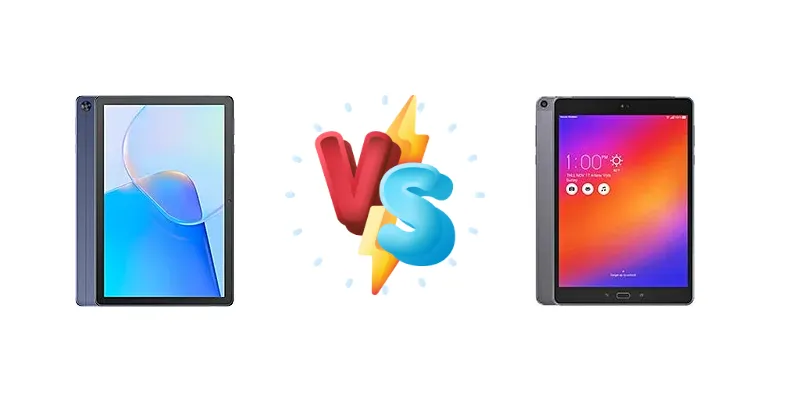
The tablet market offers a wide range of options, but finding a balance between price and performance can be challenging. We pit the Huawei MatePad SE, powered by the Kirin 710A, against the Asus Zenpad Z10 ZT500KL, featuring the Qualcomm Snapdragon 650, to determine which tablet delivers the best value for budget-conscious consumers.
🏆 Quick Verdict
For the average user prioritizing everyday tasks and media consumption, the Huawei MatePad SE emerges as the slightly better choice. Its newer Kirin 710A chipset, built on a 14nm process, offers a more modern CPU architecture and potentially better sustained performance than the older Snapdragon 650, despite the latter's higher peak clock speeds.
| Network |
|---|
| 2G bands | GSM 850 / 900 / 1800 / 1900 | N/A |
| 3G bands | HSDPA 850 / 900 / 1900 / 2100 | - |
| 4G bands | LTE | 2, 4, 5, 13 |
| EDGE | - | No |
| GPRS | - | No |
| Speed | HSPA, LTE - cellular model only | LTE Cat6 300/50 Mbps |
| Technology | GSM / HSPA / LTE | LTE |
| Launch |
|---|
| Announced | 2022, April 28 | 2016, October. Released 2016, October |
| Status | Available. Released 2022, May 10 | Discontinued |
| Body |
|---|
| Dimensions | 240.2 x 159 x 7.9 mm (9.46 x 6.26 x 0.31 in) | 242.3 x 166.1 x 7.1 mm (9.54 x 6.54 x 0.28 in) |
| SIM | Nano-SIM (cellular model only) | Nano-SIM |
| Weight | 450 g (0.99 lb) | 490 g (1.08 lb) |
| Display |
|---|
| Resolution | 1200 x 1920 pixels, 16:10 ratio (~224 ppi density) | 1536 x 2048 pixels, 4:3 ratio (~264 ppi density) |
| Size | 10.1 inches, 295.8 cm2 (~77.4% screen-to-body ratio) | 9.7 inches, 291.4 cm2 (~72.4% screen-to-body ratio) |
| Type | IPS LCD | IPS LCD |
| Platform |
|---|
| CPU | Octa-core (4x2.0 GHz Cortex-A73 & 4x1.7 GHz Cortex-A53) | Hexa-core (4x1.4 GHz Cortex-A53 & 2x1.8 GHz Cortex-A72) |
| Chipset | Kirin 710A (14 nm) | Qualcomm MSM8956 Snapdragon 650 |
| GPU | Mali-G51 MP4 | Adreno 510 |
| OS | HarmonyOS 2.0 | Android 6.0 (Marshmallow), upgradable to 7.0 (Nougat) |
| Memory |
|---|
| Card slot | microSDXC (dedicated slot) | microSDXC (dedicated slot) |
| Internal | 32GB 3GB RAM, 64GB 4GB RAM, 128GB 4GB RAM | 32GB 3GB RAM |
| | - | eMMC 4.5 |
| Main Camera |
|---|
| Features | HDR | HDR, panorama |
| Single | 5 MP, f/2.2, AF | 8 MP |
| Video | 1080p@30fps | 1080p@30fps |
| Selfie camera |
|---|
| Single | 2 MP, f/2.4 | 5 MP |
| Video | 720p@30fps | 1080p@30fps |
| Sound |
|---|
| 3.5mm jack | Yes | Yes |
| 35mm jack | Yes | Yes |
| Loudspeaker | Yes, with stereo speakers | Yes, with stereo speakers |
| | Tuned by Harman Kardon | - |
| Comms |
|---|
| Bluetooth | 5.1, A2DP, LE | 4.2, A2DP, LE |
| NFC | No | No |
| Positioning | GPS, GLONASS, BDS - cellular model only | GPS |
| Radio | No | No |
| USB | USB Type-C 2.0, OTG | USB Type-C |
| WLAN | Wi-Fi 802.11 a/b/g/n/ac, dual-band, Wi-Fi Direct | Wi-Fi 802.11 a/b/g/n/ac, dual-band, Wi-Fi Direct |
| Features |
|---|
| Sensors | Accelerometer, proximity | Accelerometer, gyro, proximity, compass |
| Battery |
|---|
| Charging | 10W wired
5W reverse wired | - |
| Stand-by | - | Up to 1344 h (3G) |
| Talk time | - | Up to 20 h (3G) |
| Type | Li-Po 5100 mAh | Li-Po 7800 mAh, non-removable |
| Misc |
|---|
| Colors | Dark Blue | Gray |
| Models | Ags3K-W20, Ags3K-AL20, AGS5-W09 | - |
| Price | About 190 EUR | About 300 EUR |
| SAR | - | 1.25 W/kg (head) |
Huawei MatePad SE
- More modern chipset architecture (Kirin 710A)
- Potential for better sustained performance
- Reverse wired charging capability
- Charging speed is relatively slow (10W)
- Limited information available on display quality
Asus Zenpad Z10 ZT500KL
- Qualcomm chipset may offer broader app compatibility
- Potentially higher peak CPU clock speeds
- Established Snapdragon ecosystem
- Older chipset (Snapdragon 650)
- Likely less efficient power consumption
- Charging specifications unknown
Display Comparison
Neither device's display specifications are provided, so a direct comparison is limited. However, given the market positioning, both likely utilize IPS LCD panels. The Zenpad Z10, being an older model, may suffer from wider bezels. The MatePad SE, benefiting from more recent manufacturing techniques, may offer slightly better color accuracy and viewing angles. Without specific nit brightness or color gamut data, it's difficult to definitively declare a winner.
Camera Comparison
Camera specifications are absent for both devices. Given their budget nature, it's safe to assume both tablets feature modest camera setups geared towards casual snapshots and video calls. Image quality will likely be comparable, with neither device excelling in low-light conditions. Without sensor size or aperture information, a detailed comparison is impossible.
Performance
The core difference lies in the chipsets. The Huawei MatePad SE’s Kirin 710A utilizes an octa-core configuration with four Cortex-A73 cores clocked at 2.0 GHz and four Cortex-A53 cores at 1.7 GHz. This contrasts with the Asus Zenpad Z10’s Snapdragon 650, a hexa-core processor with two Cortex-A72 cores at 1.8 GHz and four Cortex-A53 cores at 1.4 GHz. While the Snapdragon 650 boasts higher clock speeds on its A72 cores, the Kirin 710A’s newer architecture and additional cores suggest superior multi-tasking capabilities. The 14nm fabrication process of the Kirin 710A also implies potentially better thermal efficiency, reducing the likelihood of performance throttling during extended use.
Battery Life
Battery capacity is not specified for either device. However, the MatePad SE offers 10W wired charging and 5W reverse wired charging, while the Zenpad Z10’s charging capabilities are unknown. The inclusion of reverse wired charging on the MatePad SE provides added versatility, allowing it to charge other devices. Without knowing battery capacities, it’s difficult to assess real-world battery life, but the Kirin 710A’s potentially better power efficiency could give the MatePad SE an edge.
Buying Guide
Buy the Huawei MatePad SE if you need a tablet for general productivity, streaming video, and light gaming, and value a more modern chipset architecture for potentially better long-term software support. Buy the Asus Zenpad Z10 ZT500KL if you prioritize a potentially wider range of app compatibility due to Qualcomm's broader ecosystem, and are comfortable with an older chipset that may show its age with demanding tasks.
Frequently Asked Questions
❓ Will the Snapdragon 650 in the Zenpad Z10 struggle with modern Android apps?
The Snapdragon 650 is an older chipset. While it can handle basic Android functionality, demanding apps and games may experience performance limitations or compatibility issues compared to the Kirin 710A-powered MatePad SE.
❓ Does the Kirin 710A in the MatePad SE support Huawei Mobile Services (HMS) and what does that mean for app availability?
The MatePad SE utilizes Huawei Mobile Services (HMS) due to US trade restrictions. This means it doesn't have access to Google Play Services natively. Users rely on the AppGallery and sideloading apps, which may limit app availability compared to the Zenpad Z10's potential access to the Google Play Store.
❓ Is the 10W charging on the MatePad SE significantly slower than other tablets?
Yes, 10W charging is relatively slow by today's standards. Expect a longer charging time from 0-100% compared to tablets with 18W or higher charging capabilities. However, for casual users, this may not be a significant drawback.