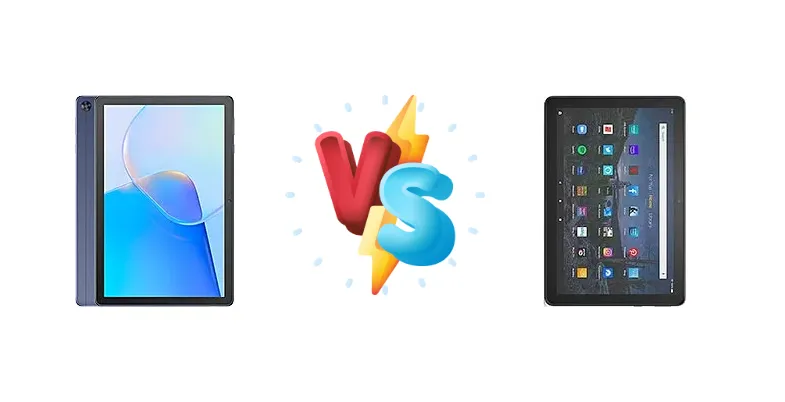
The budget tablet market is fiercely competitive, and the Huawei MatePad SE and Amazon Fire HD 10 Plus (2021) represent compelling options for users seeking affordable entertainment and productivity. This comparison dives deep into their specifications, performance, and features to determine which tablet delivers the most value, particularly considering the differing software ecosystems and target audiences.
🏆 Quick Verdict
For users prioritizing a more open Android experience and slightly better CPU architecture, the Huawei MatePad SE is the stronger choice. However, the Amazon Fire HD 10 Plus (2021) counters with the convenience of wireless charging, making it ideal for those heavily invested in the Amazon ecosystem and seeking a hassle-free charging experience.
| Network |
|---|
| 2G bands | GSM 850 / 900 / 1800 / 1900 | N/A |
| 3G bands | HSDPA 850 / 900 / 1900 / 2100 | - |
| 4G bands | LTE | - |
| EDGE | - | No |
| GPRS | - | No |
| Speed | HSPA, LTE - cellular model only | - |
| Technology | GSM / HSPA / LTE | No cellular connectivity |
| Launch |
|---|
| Announced | 2022, April 28 | 2021, April 27. Released 2021, May 26 |
| Status | Available. Released 2022, May 10 | Discontinued |
| Body |
|---|
| Dimensions | 240.2 x 159 x 7.9 mm (9.46 x 6.26 x 0.31 in) | 247 x 166 x 9.2 mm (9.72 x 6.54 x 0.36 in) |
| SIM | Nano-SIM (cellular model only) | No |
| Weight | 450 g (0.99 lb) | 468 g (1.03 lb) |
| Display |
|---|
| Protection | - | Aluminosilicate glass |
| Resolution | 1200 x 1920 pixels, 16:10 ratio (~224 ppi density) | 1920 x 1200 pixels, 16:10 ratio (~224 ppi density) |
| Size | 10.1 inches, 295.8 cm2 (~77.4% screen-to-body ratio) | 10.1 inches, 295.8 cm2 (~72.1% screen-to-body ratio) |
| Type | IPS LCD | IPS LCD |
| Platform |
|---|
| CPU | Octa-core (4x2.0 GHz Cortex-A73 & 4x1.7 GHz Cortex-A53) | Octa-core (4x2.0 GHz Cortex-A73 & 4x2.0 GHz Cortex-A53) |
| Chipset | Kirin 710A (14 nm) | Mediatek MT8183 Helio P60T (12 nm) |
| GPU | Mali-G51 MP4 | Mali-G72 MP3 |
| OS | HarmonyOS 2.0 | Android 9.0 (Pie), Fire OS 7 |
| Memory |
|---|
| Card slot | microSDXC (dedicated slot) | microSDXC (dedicated slot) |
| Internal | 32GB 3GB RAM, 64GB 4GB RAM, 128GB 4GB RAM | 32GB 4GB RAM, 64GB 4GB RAM |
| | - | eMMC 5.1 |
| Main Camera |
|---|
| Features | HDR | - |
| Single | 5 MP, f/2.2, AF | 5 MP |
| Video | 1080p@30fps | 720p |
| Selfie camera |
|---|
| Single | 2 MP, f/2.4 | 2 MP |
| Video | 720p@30fps | 720p |
| Sound |
|---|
| 3.5mm jack | Yes | Yes |
| 35mm jack | Yes | Yes |
| Loudspeaker | Yes, with stereo speakers | Yes, with stereo speakers |
| | Tuned by Harman Kardon | - |
| Comms |
|---|
| Bluetooth | 5.1, A2DP, LE | 5.0, A2DP, LE |
| NFC | No | No |
| Positioning | GPS, GLONASS, BDS - cellular model only | No |
| Radio | No | No |
| USB | USB Type-C 2.0, OTG | USB Type-C 2.0, OTG |
| WLAN | Wi-Fi 802.11 a/b/g/n/ac, dual-band, Wi-Fi Direct | Wi-Fi 802.11 a/b/g/n/ac, dual-band |
| Features |
|---|
| Sensors | Accelerometer, proximity | Accelerometer |
| | - | Text-to-Speech English-language content reader |
| Battery |
|---|
| Charging | 10W wired
5W reverse wired | Wireless |
| Type | Li-Po 5100 mAh | Li-Ion |
| Misc |
|---|
| Colors | Dark Blue | Slate |
| Models | Ags3K-W20, Ags3K-AL20, AGS5-W09 | T76N2P |
| Price | About 190 EUR | About 150 EUR |
Huawei MatePad SE
- Standard Android OS with Google Play Store access
- Potentially better CPU architecture with Kirin 710A
- Reverse wired charging for accessories
- Slower 10W wired charging
- Lacks wireless charging
Amazon Fire HD 10 Plus (2021)
- Convenient wireless charging
- Tight integration with Amazon ecosystem
- Potentially slightly better power efficiency with Helio P60T
- Fire OS is a limited Android fork
- Restricted app access compared to standard Android
Display Comparison
Neither device boasts a particularly impressive display. Both likely utilize IPS LCD panels, given their price points. However, the core difference lies in the underlying chipsets impacting display processing. While specific display specs (resolution, brightness) are missing, the MatePad SE’s Kirin 710A may offer slightly better image processing capabilities due to its more modern architecture. The Fire HD 10 Plus’s wireless charging capability suggests a focus on stationary use, potentially mitigating the impact of a less-refined display.
Camera Comparison
Camera performance is unlikely to be a deciding factor for either tablet. Both are positioned as budget devices, and camera quality is typically sacrificed. Without specific sensor details, it’s safe to assume both feature basic camera setups suitable for casual snapshots and video calls. Focusing on the processors, the image signal processor (ISP) within the Kirin 710A might offer slightly better image processing capabilities, but the difference will be negligible in most scenarios.
Performance
The performance battle centers around the Kirin 710A (14nm) in the MatePad SE and the MediaTek Helio P60T (12nm) in the Fire HD 10 Plus. Both CPUs feature the same core configuration – four Cortex-A73 cores at 2.0 GHz and four Cortex-A53 cores at 1.7/2.0 GHz respectively. The Helio P60T’s 12nm process *should* theoretically offer better power efficiency and potentially slightly higher clock speeds, but the Kirin 710A benefits from Huawei’s optimizations. The 12nm node of the Helio P60T provides a marginal advantage in thermal efficiency, potentially leading to slightly sustained performance under heavy load. However, the real-world difference will likely be minimal for typical tablet tasks like browsing, video streaming, and light gaming.
Battery Life
Battery life will depend heavily on usage patterns. While mAh ratings are unavailable, the Fire HD 10 Plus gains a significant advantage with its wireless charging support. This eliminates the need for cables and offers a convenient charging solution, particularly for users who frequently use the tablet in a stationary location. The MatePad SE offers 10W wired charging and 5W reverse wired charging, providing some flexibility but lacking the convenience of wireless charging. The 12nm process of the Helio P60T *could* translate to slightly better battery efficiency, but this advantage is likely offset by the Fire OS’s resource management and Amazon’s app ecosystem.
Buying Guide
Buy the Huawei MatePad SE if you need a tablet running a standard Android build with access to the Google Play Store, and value a more versatile experience beyond Amazon’s walled garden. This is ideal for students or users who need to run a wider range of apps. Buy the Amazon Fire HD 10 Plus (2021) if you primarily consume Amazon content (Prime Video, Kindle books, Audible audiobooks) and prefer a simplified, curated experience with the convenience of wireless charging and tight Amazon integration.
Frequently Asked Questions
❓ Does the Amazon Fire HD 10 Plus’s Fire OS significantly limit app compatibility compared to standard Android?
Yes, Fire OS is a heavily customized version of Android that lacks full Google Play Store support. While Amazon’s Appstore offers a selection of popular apps, many Android applications are not available or require sideloading, which can be complex for less tech-savvy users.
❓ Is the 12nm process of the Helio P60T in the Fire HD 10 Plus noticeable in real-world battery life compared to the 14nm Kirin 710A?
The difference in process node (12nm vs 14nm) is likely to be marginal in real-world battery life. While the 12nm process *should* be more efficient, the overall battery performance will be more heavily influenced by software optimization, display usage, and app activity.
❓ Can I easily install Google Play Store on the Amazon Fire HD 10 Plus?
Installing Google Play Store on the Fire HD 10 Plus is possible, but it requires sideloading and is not officially supported by Amazon. The process can be complex and may void your warranty. It's not a straightforward experience and requires technical knowledge.