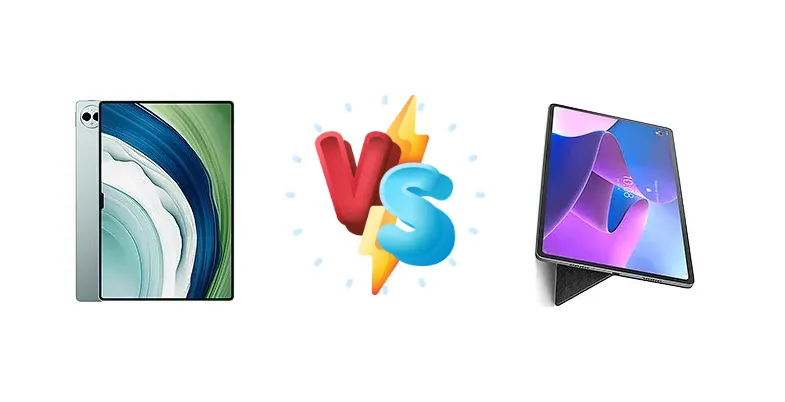
The high-end Android tablet space is heating up, with both Huawei and Lenovo offering compelling options. The Huawei MatePad Pro 13.2, with its in-house Kirin 9000S chipset and rapid 88W charging, goes head-to-head with the Lenovo Tab P12 Pro, powered by the well-established Qualcomm Snapdragon 870 5G. This comparison dissects the key differences to determine which tablet best suits your needs.
🏆 Quick Verdict
For the average user prioritizing fast charging and potentially smoother software integration within the Huawei ecosystem, the Huawei MatePad Pro 13.2 is the better choice. Its 88W charging significantly outperforms the Lenovo Tab P12 Pro’s 45W, and the Kirin 9000S offers competitive performance. However, the Snapdragon 870 remains a strong contender.
| Network |
|---|
| 2G bands | GSM 850 / 900 / 1800 / 1900 | GSM 850 / 900 / 1800 / 1900 |
| 3G bands | HSDPA 850 / 900 / 1900 / 2100 | HSDPA 850 / 900 / 1900 / 2100 |
| 4G bands | LTE | 1, 2, 3, 4, 5, 7, 8, 19, 20, 26, 28, 34, 38, 39, 40, 41 |
| 5G bands | - | 1, 3, 7, 8, 20, 28, 38, 41, 77, 78 SA/NSA/Sub6 |
| Speed | HSPA, LTE - cellular model only | HSPA, LTE, 5G - cellular model only |
| Technology | GSM / HSPA / LTE | GSM / HSPA / LTE / 5G |
| Launch |
|---|
| Announced | 2023, September 25 | 2021, September 08 |
| Status | Available. Released 2023, September 26 | Available. Released 2021, November 19 |
| Body |
|---|
| Dimensions | 289.1 x 196.1 x 5.5 mm (11.38 x 7.72 x 0.22 in) | 285.6 x 184.5 x 5.6 mm (11.24 x 7.26 x 0.22 in) |
| SIM | Nano-SIM (cellular model only) | Nano-SIM (cellular model only) |
| Weight | 580 g (1.28 lb) | 565 g (1.25 lb) |
| | - | Stylus support |
| Display |
|---|
| Resolution | 2880 x 1920 pixels, 3:2 ratio (~262 ppi density) | 1600 x 2560 pixels, 16:10 ratio (~240 ppi density) |
| Size | 13.2 inches, 518.8 cm2 (~91.5% screen-to-body ratio) | 12.6 inches, 460.3 cm2 (~87.4% screen-to-body ratio) |
| Type | OLED, 1B colors, 144Hz, HDR, 1000 nits (peak) | AMOLED, 120Hz, HDR10+, Dolby Vision, 600 nits (HBM) |
| Platform |
|---|
| CPU | Octa-core (1x2.62 GHz Taishan Big & 3x2.15 GHz Taishan Mid & 4x1.53GHz Cortex-A510) | Octa-core (1x3.2 GHz Kryo 585 & 3x2.42 GHz Kryo 585 & 4x1.80 GHz Kryo 585) |
| Chipset | Kirin 9000S (7 nm) | Qualcomm SM8250-AC Snapdragon 870 5G (7 nm) |
| GPU | Maleoon 910 MP4 | Adreno 650 |
| OS | Harmony OS 4.0 | Android 11 |
| Memory |
|---|
| Card slot | No | microSDXC (dedicated slot) |
| Internal | 256GB 12GB RAM, 512GB 12GB RAM, 1TB 16GB RAM | 128GB 6GB RAM, 256GB 8GB RAM |
| Main Camera |
|---|
| Dual | 13 MP, f/1.8, (wide), PDAF
8 MP, f/2.2, (ultrawide) | 13 MP, (wide), AF
5 MP, (ultrawide) |
| Features | LED flash | - |
| Video | 4K@30fps, 1080p@30fps | 4K@30fps, 1080p@30fps |
| Selfie camera |
|---|
| Single | 16 MP, f/2.2
TOF 3D, (depth/biometrics sensor) | 8 MP, (wide)
8 MP, IR TOF 3D, (biometrics sensor only) |
| Video | 1080p@30fps | 1080p@30fps |
| Sound |
|---|
| 3.5mm jack | - | No |
| 35mm jack | No | No |
| Loudspeaker | Yes, with stereo speakers (6 speakers) | Yes, with stereo speakers (4 speakers) |
| | - | JBL speakers |
| Comms |
|---|
| Bluetooth | 5.2, A2DP, LE | 5.2, A2DP, LE |
| NFC | No | Yes (wireless charging and data transfer only) |
| Positioning | GPS, GLONASS, BDS | GPS, GLONASS, BDS - cellular model only |
| Radio | No | Unspecified |
| USB | USB Type-C 3.1, OTG, DisplayPort 1.2, accessory connector pins | USB Type-C 3.1 |
| WLAN | Wi-Fi 802.11 a/b/g/n/ac/6, dual-band | Wi-Fi 802.11 a/b/g/n/ac/6, dual-band, Wi-Fi Direct |
| Features |
|---|
| Sensors | Accelerometer, gyro, proximity, compass | Fingerprint (side-mounted), accelerometer, gyro, proximity |
| Battery |
|---|
| Charging | 88W wired, 85% in 40 min | 45W wired, QC4 |
| Type | Li-Po 10100 mAh | Li-Po 10200 mAh |
| Misc |
|---|
| Colors | Black, White, Green | Storm Grey |
| Models | PCE-W30, PCE-AL30 | TB-Q706Z, TB-Q706F |
| Price | About 1000 EUR | About 520 EUR |
Huawei MatePad Pro 13.2
- Ultra-fast 88W charging
- High peak display brightness (770 nits)
- Potentially optimized software experience within Huawei ecosystem
- Kirin 9000S chipset may have limited app compatibility compared to Snapdragon
- Reliance on Huawei Mobile Services (HMS) instead of Google Mobile Services (GMS)
Lenovo Tab P12 Pro
- Proven Snapdragon 870 performance and efficiency
- Integrated 5G connectivity
- Wider app compatibility due to GMS support
- Slower 45W charging
- Display brightness likely lower than MatePad Pro 13.2
Display Comparison
Both tablets feature large displays, but key differences exist. The Huawei MatePad Pro 13.2 boasts a measured peak brightness of 770 nits, suggesting excellent outdoor visibility. While the Lenovo Tab P12 Pro’s display specs aren’t provided, Lenovo typically utilizes high-quality panels. The MatePad Pro’s larger size (13.2 inches vs. 12.6 inches) offers a more immersive experience for media consumption. Without specific details on the Tab P12 Pro’s panel technology (LTPO, refresh rate), the MatePad Pro’s brightness advantage is a clear win for users in bright environments.
Camera Comparison
Camera performance details are limited. Without specific sensor information for either tablet, it’s difficult to make a definitive judgment. However, given the tablet form factor, camera quality is typically less of a priority than other features. The focus should be on video conferencing capabilities and casual snapshots. The absence of detailed camera specs suggests neither tablet is positioned as a photography powerhouse.
Performance
The core of the performance difference lies in the chipsets. The Huawei MatePad Pro 13.2 utilizes the Kirin 9000S (7nm), an octa-core processor with a unique CPU configuration – 1x2.62 GHz Taishan Big, 3x2.15 GHz Taishan Mid, and 4x1.53GHz Cortex-A510. This contrasts with the Lenovo Tab P12 Pro’s Qualcomm Snapdragon 870 5G (7nm), featuring a more conventional octa-core setup with 1x3.2 GHz Kryo 585, 3x2.42 GHz Kryo 585, and 4x1.80 GHz Kryo 585. While the Snapdragon 870 is known for its stable performance and efficiency, the Kirin 9000S aims to deliver comparable power with Huawei’s custom core designs. The Snapdragon 870’s integrated 5G modem is a notable advantage for users requiring cellular connectivity. The lack of RAM specifications for both devices makes a direct comparison difficult, but both likely utilize LPDDR5 or LPDDR5x for fast memory access.
Battery Life
The Huawei MatePad Pro 13.2 achieves an active use battery score of 8 hours and 15 minutes. The Lenovo Tab P12 Pro’s battery life is not provided. However, the MatePad Pro’s significantly faster 88W wired charging, capable of reaching 85% charge in just 40 minutes, is a major advantage over the Tab P12 Pro’s 45W charging with QC4. This faster charging dramatically reduces downtime, making the MatePad Pro more convenient for users who rely on their tablet throughout the day.
Buying Guide
Buy the Huawei MatePad Pro 13.2 if you need the fastest possible charging speeds, are invested in the Huawei ecosystem, and value a potentially more optimized software experience. Buy the Lenovo Tab P12 Pro if you prioritize a proven chipset with wide app compatibility, and prefer the Qualcomm ecosystem for 5G connectivity and broader accessory support.
Frequently Asked Questions
❓ Does the Kirin 9000S chipset suffer from significant throttling under sustained load?
While independent thermal testing is limited, Huawei has made improvements to thermal management in recent devices. The Kirin 9000S’s 7nm process should offer reasonable efficiency, but prolonged gaming or demanding tasks may still result in some performance throttling. The Snapdragon 870 is generally known for its more consistent performance under load.
❓ How does the lack of Google Mobile Services (GMS) on the Huawei MatePad Pro 13.2 impact app availability?
The Huawei MatePad Pro 13.2 utilizes Huawei Mobile Services (HMS) and the AppGallery. While many popular apps are available through these channels, some Google-dependent apps may require workarounds or may not be directly compatible. Huawei has been actively expanding the AppGallery, but GMS remains a more comprehensive ecosystem.
❓ Is the 5G connectivity on the Lenovo Tab P12 Pro truly useful for a tablet?
The utility of 5G on the Lenovo Tab P12 Pro depends on your usage. If you frequently travel and rely on mobile data for connectivity, 5G can provide significantly faster speeds than Wi-Fi or 4G. However, for primarily home or office use, the benefit of 5G may be minimal.