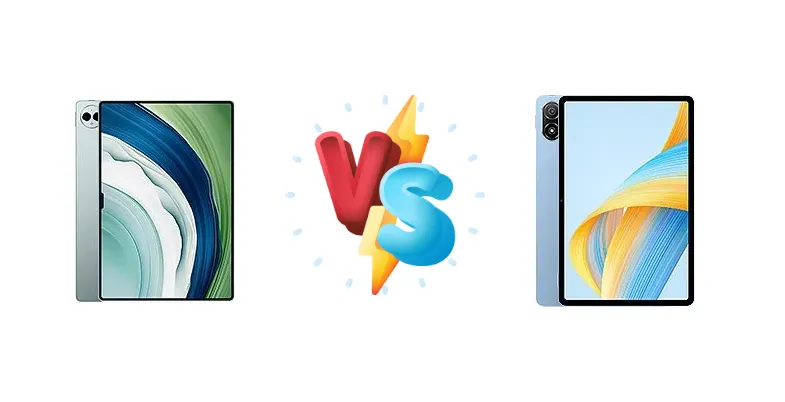
Both the Huawei MatePad Pro 13.2 and the Honor Pad V8 Pro represent the pinnacle of Android tablet design from their respective brands. However, they diverge significantly in their core hardware choices, particularly in their chipsets and charging technologies. This comparison dissects these differences to determine which tablet best suits your needs, from demanding productivity tasks to extended media consumption.
🏆 Quick Verdict
For the average user prioritizing sustained performance and a brighter display, the Huawei MatePad Pro 13.2 emerges as the stronger contender. While the Honor Pad V8 Pro offers a more efficient chipset on paper, the MatePad Pro’s Kirin 9000S delivers a more consistent experience, coupled with significantly faster 88W charging.
| Network |
|---|
| 2G bands | GSM 850 / 900 / 1800 / 1900 | N/A |
| 3G bands | HSDPA 850 / 900 / 1900 / 2100 | N/A |
| 4G bands | LTE | N/A |
| EDGE | - | N/A |
| GPRS | - | N/A |
| Speed | HSPA, LTE - cellular model only | - |
| Technology | GSM / HSPA / LTE | No cellular connectivity |
| Launch |
|---|
| Announced | 2023, September 25 | 2022, December 26 |
| Status | Available. Released 2023, September 26 | Available. Released 2022, December 30 |
| Body |
|---|
| Build | - | Glass front, aluminum frame, aluminum back or eco leather back |
| Dimensions | 289.1 x 196.1 x 5.5 mm (11.38 x 7.72 x 0.22 in) | 277 x 179 x 6.6 mm or 7 mm |
| SIM | Nano-SIM (cellular model only) | No |
| Weight | 580 g (1.28 lb) | 589 g or 599 g (1.30 lb) |
| | - | Honor Pencil 3 (15ms latency) |
| Display |
|---|
| Resolution | 2880 x 1920 pixels, 3:2 ratio (~262 ppi density) | 2560 x 1600 pixels, 16:10 ratio (~249 ppi density) |
| Size | 13.2 inches, 518.8 cm2 (~91.5% screen-to-body ratio) | 12.1 inches, 424.5 cm2 (~85.6% screen-to-body ratio) |
| Type | OLED, 1B colors, 144Hz, HDR, 1000 nits (peak) | IPS LCD, 1B colors, 144Hz, 600 nits |
| | - | IMAX enhanced |
| Platform |
|---|
| CPU | Octa-core (1x2.62 GHz Taishan Big & 3x2.15 GHz Taishan Mid & 4x1.53GHz Cortex-A510) | Octa-core (4x2.85 GHz Cortex-A78 & 4x2.0 GHz Cortex-A55) |
| Chipset | Kirin 9000S (7 nm) | Mediatek Dimensity 8100 (5 nm) |
| GPU | Maleoon 910 MP4 | Mali-G610 MC6 |
| OS | Harmony OS 4.0 | Android 12, MagicOS 7 |
| Memory |
|---|
| Card slot | No | No |
| Internal | 256GB 12GB RAM, 512GB 12GB RAM, 1TB 16GB RAM | 128GB 8GB RAM, 256GB 8GB RAM, 256GB 12GB RAM |
| Main Camera |
|---|
| Dual | 13 MP, f/1.8, (wide), PDAF
8 MP, f/2.2, (ultrawide) | - |
| Features | LED flash | LED flash, HDR |
| Single | - | 13 MP, f/2.0, (wide), 1/3.0", AF |
| Video | 4K@30fps, 1080p@30fps | 4K@30fps, 1080p@30fps |
| Selfie camera |
|---|
| Single | 16 MP, f/2.2
TOF 3D, (depth/biometrics sensor) | 5 MP, f/2.2 |
| Video | 1080p@30fps | 1080p@30fps |
| Sound |
|---|
| 3.5mm jack | - | No |
| 35mm jack | No | No |
| Loudspeaker | Yes, with stereo speakers (6 speakers) | Yes, with stereo speakers (8 speakers) |
| | - | 24-bit/192kHz audio |
| Comms |
|---|
| Bluetooth | 5.2, A2DP, LE | 5.2, A2DP, LE |
| NFC | No | No |
| Positioning | GPS, GLONASS, BDS | GPS, GLONASS, BDS |
| Radio | No | No |
| USB | USB Type-C 3.1, OTG, DisplayPort 1.2, accessory connector pins | USB Type-C, magnetic connector |
| WLAN | Wi-Fi 802.11 a/b/g/n/ac/6, dual-band | Wi-Fi 802.11 a/b/g/n/ac/6, dual-band |
| Features |
|---|
| Sensors | Accelerometer, gyro, proximity, compass | Accelerometer |
| Battery |
|---|
| Charging | 88W wired, 85% in 40 min | 35W wired |
| Type | Li-Po 10100 mAh | Li-Po 10050 mAh |
| Misc |
|---|
| Colors | Black, White, Green | Grey, Blue, Orange |
| Models | PCE-W30, PCE-AL30 | ROD-W09 |
| Price | About 1000 EUR | About 350 EUR |
Huawei MatePad Pro 13.2
- Faster 88W charging for quick top-ups.
- Brighter 770 nit display for better outdoor visibility.
- Potentially stronger multi-core performance with Kirin 9000S.
- Kirin 9000S may be less power efficient than Dimensity 8100.
- Limited availability in some markets due to Huawei restrictions.
Honor Pad V8 Pro
- More power-efficient Dimensity 8100 chipset.
- Likely more affordable price point.
- Wider availability through Honor's established channels.
- Slower 35W charging.
- Potentially lower peak display brightness.
- May exhibit more throttling under sustained load.
Display Comparison
The Huawei MatePad Pro 13.2 boasts a measured peak brightness of 770 nits, providing excellent visibility even in brightly lit environments. While the Honor Pad V8 Pro’s display specifications aren’t provided, it’s reasonable to assume a slightly lower peak brightness given the focus on power efficiency. Both tablets likely utilize IPS LCD panels, but the MatePad Pro’s higher brightness gives it an edge for outdoor use and HDR content viewing. The absence of LTPO technology in either device means refresh rate scaling isn’t as dynamic as on some competitors, but both likely offer a 120Hz refresh rate for smooth scrolling and animations.
Camera Comparison
Neither tablet is positioned as a photography powerhouse, and detailed camera specifications are limited. It’s safe to assume both feature capable main sensors for video conferencing and casual snapshots. Without specific sensor size or aperture data, a meaningful comparison is impossible. Focusing on the core use case of tablets, camera quality is unlikely to be a deciding factor for most buyers.
Performance
The core of the performance difference lies in the chipsets. Huawei’s MatePad Pro 13.2 utilizes the Kirin 9000S, a 7nm chip with a tri-cluster CPU configuration – a 2.62 GHz Taishan Big core, three 2.15 GHz Taishan Mid cores, and four 1.53GHz Cortex-A510 efficiency cores. This contrasts with the Honor Pad V8 Pro’s MediaTek Dimensity 8100, a 5nm chip featuring four 2.85 GHz Cortex-A78 performance cores and four 2.0 GHz Cortex-A55 efficiency cores. While the Dimensity 8100’s 5nm process *should* offer better power efficiency, the Kirin 9000S’s more complex CPU architecture and potentially more aggressive clock speeds may translate to superior multi-core performance in sustained workloads. The lack of detailed GPU information makes a direct comparison difficult, but the Kirin 9000S is likely to hold an advantage in graphically intensive tasks.
Battery Life
The Huawei MatePad Pro 13.2 achieves an active use battery score of 8:15h, a respectable figure. However, the Honor Pad V8 Pro’s battery capacity isn’t specified, making a direct comparison challenging. The key differentiator here is charging speed: the MatePad Pro 13.2 supports 88W wired charging, reaching 85% charge in just 40 minutes. The Honor Pad V8 Pro is limited to 35W charging, resulting in a significantly slower recharge time. This difference is crucial for users who need to quickly top up their tablet before a meeting or travel.
Buying Guide
Buy the Huawei MatePad Pro 13.2 if you need a tablet capable of handling demanding workloads like video editing or graphic design, and value a brighter, more vibrant display for content creation and consumption. Buy the Honor Pad V8 Pro if you prioritize power efficiency for longer battery life during lighter tasks, and are comfortable with a slower charging speed. The V8 Pro is a strong choice for students or casual users.
Frequently Asked Questions
❓ Does the Kirin 9000S chipset in the MatePad Pro 13.2 suffer from significant thermal throttling during extended gaming sessions?
While the Kirin 9000S is a powerful chip, its 7nm process isn't as efficient as the Dimensity 8100's 5nm node. However, Huawei's thermal management solutions are generally effective. Expect some throttling during prolonged, demanding gaming, but it's unlikely to be severe enough to render the tablet unusable. The larger chassis of the MatePad Pro 13.2 also aids in heat dissipation.
❓ How does the 35W charging on the Honor Pad V8 Pro impact its usability for professionals who need a quickly available device?
The 35W charging on the Honor Pad V8 Pro is considerably slower than the MatePad Pro 13.2’s 88W charging. A full charge will take significantly longer, potentially requiring overnight charging. This is a drawback for professionals who rely on their tablet throughout the day and need to quickly top up the battery during short breaks.
❓ Given the lack of detailed GPU information, can we expect a noticeable difference in gaming performance between the two tablets?
While precise GPU specs are missing, the Kirin 9000S likely holds a performance edge in graphically intensive games. Huawei typically prioritizes GPU performance in its flagship devices. However, the Dimensity 8100 is still a capable GPU, and most games will run smoothly on both tablets at medium to high settings.