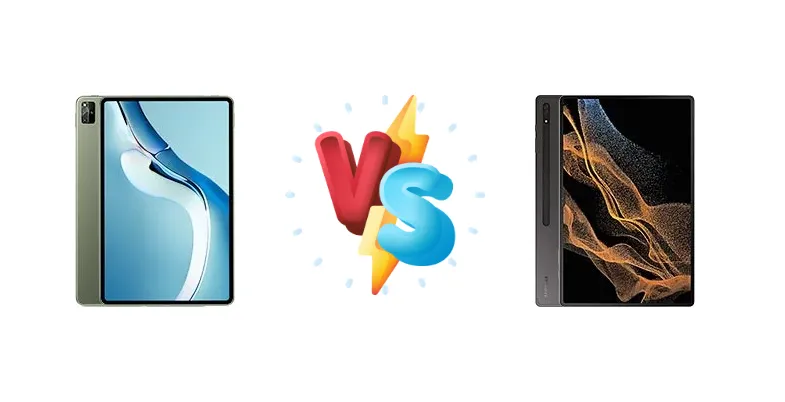
The tablet market is heating up, and two titans clash: the Huawei MatePad Pro 12.6 (2021) and the Samsung Galaxy Tab S8 Ultra. Both offer stunning displays, powerful performance, and premium features, but which one truly deserves your money? We'll break down every aspect to help you decide.
🏆 Quick Verdict
The Samsung Galaxy Tab S8 Ultra takes the crown with its superior Snapdragon 8 Gen 1 chipset, brighter display, and broader software support. While the MatePad Pro boasts a beautiful display and Huawei's strengths, the Tab S8 Ultra offers a more complete and versatile experience.
| Network |
|---|
| 2G bands | GSM 850 / 900 / 1800 / 1900 | GSM 850 / 900 / 1800 / 1900 |
| 3G bands | HSDPA 800 / 850 / 900 / 1700(AWS) / 1900 / 2100 | HSDPA 850 / 900 / 1700(AWS) / 1900 / 2100 |
| 4G bands | 1, 2, 3, 4, 5, 7, 8, 9, 12, 17, 18, 19, 20, 26, 28, 32, 34, 38, 39, 40, 41, 42, 66 | LTE |
| 5G bands | 1, 3, 5, 7, 8, 28, 38, 40, 41, 66, 77, 78, 79, 80, 84 SA/NSA | SA/NSA |
| Speed | HSPA, LTE, 5G - cellular model only | HSPA, LTE, 5G - cellular model only |
| Technology | GSM / HSPA / LTE / 5G | GSM / HSPA / LTE / 5G |
| Launch |
|---|
| Announced | 2021, June 02 | 2022, February 09 |
| Status | Available. Released 2021, June 25 | Available. Released 2022, April 30 |
| Body |
|---|
| Dimensions | 286.5 x 184.7 x 6.7 mm (11.28 x 7.27 x 0.26 in) | 326.4 x 208.6 x 5.5 mm (12.85 x 8.21 x 0.22 in) |
| SIM | Nano-SIM (cellular model only) | Nano-SIM (cellular model only) |
| Weight | 609 g (1.34 lb) | 726 g (Wi-Fi), 728 g (5G) (1.60 lb) |
| | - | Stylus, 2.8ms latency (Bluetooth integration, accelerometer, gyro) |
| Display |
|---|
| Protection | - | Corning Gorilla Glass 5 |
| Resolution | 2560 x 1600 pixels, 16:10 ratio (~240 ppi density) | 1848 x 2960 pixels, 16:10 ratio (~240 ppi density) |
| Size | 12.6 inches, 460.3 cm2 (~87.0% screen-to-body ratio) | 14.6 inches, 612.6 cm2 (~90.0% screen-to-body ratio) |
| Type | OLED | Super AMOLED, 120Hz, HDR10+ |
| Platform |
|---|
| CPU | Octa-core (1x3.13 GHz Cortex-A77 & 3x2.54 GHz Cortex-A77 & 4x2.05 GHz Cortex-A55) | Octa-core (1x3.00 GHz Cortex-X2 & 3x2.50 GHz Cortex-A710 & 4x1.80 GHz Cortex-A510) |
| Chipset | Kirin 9000E 5G (5 nm) - Wi-Fi modelKirin 9000 5G (5 nm) - 5G model | Qualcomm SM8450 Snapdragon 8 Gen 1 (4 nm) |
| GPU | Mali-G78 MP22 - Wi-Fi modelMali-G78 MP24 - 5G model | Adreno 730 |
| OS | HarmonyOS 2.0 | Android 12, up to 4 major Android upgrades, One UI 6.1.1 |
| Memory |
|---|
| Card slot | Nano Memory (dedicated slot) | microSDXC (dedicated slot) |
| Internal | 128GB 8GB RAM, 256GB 4GB RAM, 256GB 8GB RAM, 256GB 12GB RAM, 512GB 12GB RAM | 128GB 8GB RAM, 256GB 8GB RAM, 256GB 12GB RAM, 256GB 16GB RAM, 512GB 12GB RAM, 512GB 16GB RAM |
| | - | UFS |
| Main Camera |
|---|
| Dual | 13 MP, f/1.8, (wide), PDAF
8 MP, f/2.4, (ultrawide)
TOF 3D | 13 MP, f/2.0, 26mm (wide), 1/3.4", 1.0µm, AF
6 MP, f/2.2, (ultrawide) |
| Features | LED flash, HDR, panorama | LED flash, HDR, panorama |
| Video | 4K@30fps, 1080p@30fps | 4K@30/60fps, 1080p@30fps |
| Selfie camera |
|---|
| Dual | - | 12 MP, f/2.2, 26mm (wide)
12 MP, f/2.4, 120˚ (ultrawide) |
| Features | - | HDR |
| Single | 8 MP, f/2.0 | - |
| Video | 1080p@30fps | 4K@30/60fps, 1080p@30fps |
| Sound |
|---|
| 3.5mm jack | No | No |
| 35mm jack | No | No |
| Loudspeaker | Yes, with stereo speakers (8 speakers) | Yes, with stereo speakers (4 speakers) |
| | - | Tuned by AKG |
| Comms |
|---|
| Bluetooth | 5.2, A2DP, LE | 5.2, A2DP, LE |
| NFC | No | No |
| Positioning | GPS, GLONASS, BDS, GALILEO, QZSS - cellular model only | GPS, GLONASS, BDS, GALILEO - cellular model only |
| Radio | No | No |
| USB | USB Type-C 3.1, OTG | USB Type-C 3.2, magnetic connector |
| WLAN | Wi-Fi 802.11 a/b/g/n/ac/6, dual-band, Wi-Fi Direct | Wi-Fi 802.11 a/b/g/n/ac/6e, dual-band, Wi-Fi Direct |
| Features |
|---|
| Sensors | Accelerometer, gyro, proximity, compass | Fingerprint (under display, optical), accelerometer, gyro, proximity, compass |
| | - | Wireless Samsung DeX |
| Battery |
|---|
| Charging | 40W wired
27W wireless
10W wireless reversed
5W reverse wired | 45W wired, 100% in 82 min |
| Type | Li-Po 10,050 mAh | Li-Po 11200 mAh |
| Misc |
|---|
| Colors | Matte Gray, Green, Silver | Graphite |
| Models | WGR-W09, WGR-W19, WGR-AN19 | SM-X900, SM-X906, SM-X906B, SM-X906U, SM-X906N |
| Price | About 800 EUR | About 1150 EUR |
| SAR EU | - | 0.69 W/kg (body) |
| Tests |
|---|
| Display |
Contrast ratio: Infinite (nominal) | - |
| Loudspeaker |
-23.1 LUFS (Very good)
| - |
Huawei MatePad Pro 12.6 (2021)
- Stunning OLED display
- Elegant design
- Huawei's unique features (e.g., multi-screen collaboration)
- Competitive price (often)
- Lower brightness compared to Tab S8 Ultra
- Less powerful chipset
- Limited Google Services (due to restrictions)
- Slower charging
Samsung Galaxy Tab S8 Ultra
- Exceptional performance (Snapdragon 8 Gen 1)
- Brighter and larger display
- Superior camera system
- Seamless Android integration
- Fast charging
- Higher price
- Large size may not be ideal for everyone
- S Pen sold separately
Display Comparison
The MatePad Pro 12.6 (2021) features a gorgeous 12.6-inch OLED display with a 120Hz refresh rate and a reported infinite contrast ratio. However, its 382 nits max brightness lags behind the Tab S8 Ultra's significantly brighter panel. The Tab S8 Ultra's 14.6-inch Super AMOLED display delivers vibrant colors, exceptional clarity, and excellent outdoor visibility. The Tab S8 Ultra's larger size also provides more screen real estate for multitasking and content consumption.
Camera Comparison
The Tab S8 Ultra boasts a significantly more versatile and capable camera system. Its rear camera array includes a 13MP ultrawide and a 6MP depth sensor, alongside a 108MP main camera. The MatePad Pro's camera setup is more basic. The Tab S8 Ultra's front-facing cameras are also superior, offering a wider field of view for video calls and content creation.
Performance
Here's where the Tab S8 Ultra truly shines. The Snapdragon 8 Gen 1 chipset provides a noticeable performance boost over the Kirin 9000E/9000, especially in demanding tasks like gaming and video editing. While the MatePad Pro is capable, the Tab S8 Ultra offers smoother performance and better sustained performance under load. The Tab S8 Ultra also benefits from better thermal management.
Battery Life
Both tablets offer respectable battery life. The Tab S8 Ultra's larger battery capacity (11,200 mAh) and efficient Snapdragon chipset generally provide slightly longer usage times. The Tab S8 Ultra also supports faster 45W charging, while the MatePad Pro tops out at 40W wired and 27W wireless.
Buying Guide
Who should buy Huawei MatePad Pro 12.6 (2021)? Users deeply invested in the Huawei ecosystem, appreciating its unique features and potentially seeking a more affordable premium option. Who should buy Samsung Galaxy Tab S8 Ultra? Those prioritizing top-tier performance, a vibrant display, excellent camera capabilities, and seamless integration with the Android ecosystem.
Frequently Asked Questions
❓ Does the Huawei MatePad Pro 12.6 (2021) have Google Play Services?
No, the Huawei MatePad Pro 12.6 (2021) does not have Google Play Services. It uses Huawei's AppGallery and Huawei Mobile Services, which offer alternative apps, but the selection is not as extensive as Google's.
❓ Is the S Pen included with the Samsung Galaxy Tab S8 Ultra?
No, the S Pen is included with the Samsung Galaxy Tab S8 Ultra. However, the keyboard cover is sold separately.