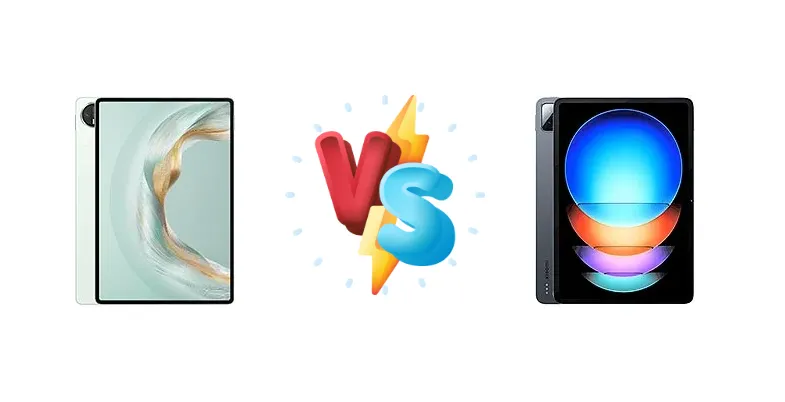
The 12-inch-plus tablet space is heating up, with Huawei and Xiaomi both delivering premium experiences. The Huawei MatePad Pro 12.2 (2025) aims to blend productivity with a refined user experience, while the Xiaomi Pad 6S Pro 12.4 prioritizes raw performance and rapid charging. This comparison dissects the key differences to help you choose the right tablet for your needs.
🏆 Quick Verdict
For the average user prioritizing sustained performance and incredibly fast charging, the Xiaomi Pad 6S Pro 12.4 emerges as the winner. Its Snapdragon 8 Gen 2 chipset and 120W charging significantly outperform the MatePad Pro 12.2's Kirin T92A and 100W charging, despite a negligible difference in battery life.
| Network |
|---|
| 2G bands | N/A | N/A |
| 3G bands | N/A | N/A |
| 4G bands | N/A | - |
| EDGE | No | N/A |
| GPRS | No | N/A |
| Technology | No cellular connectivity | No cellular connectivity |
| Launch |
|---|
| Announced | 2025, May 15 | 2024, February 22 |
| Status | Available. Released 2025, May 15 | Available. Released 2024, February 22 |
| Body |
|---|
| Build | - | Glass front (Gorilla Glass 5), aluminum frame, aluminum back |
| Dimensions | 271.3 x 182.5 x 5.5 mm (10.68 x 7.19 x 0.22 in) | 278.7 x 191.6 x 6.3 mm (10.97 x 7.54 x 0.25 in) |
| SIM | No | No |
| Weight | 508 g (1.12 lb) | 590 g (1.30 lb) |
| Display |
|---|
| Protection | - | Corning Gorilla Glass 5 |
| Resolution | 2800 x 1840 pixels, 3:2 ratio (~275 ppi density) | 2032 x 3048 pixels, 3:2 ratio (~295 ppi density) |
| Size | 12.2 inches, 440.7 cm2 (~89.0% screen-to-body ratio) | 12.4 inches, 457.8 cm2 (~85.7% screen-to-body ratio) |
| Type | Double-layer OLED, 1B colors, 144Hz, 2000 nits (peak), HDR Vivid | IPS LCD, 68B colors, 144Hz, HDR10, Dolby Vision, 900 nits (peak) |
| Platform |
|---|
| CPU | Octa-core (1x2.4 GHz & 3x2.00 GHz & 4x1.6GHz) | Octa-core (1x3.2 GHz Cortex-X3 & 2x2.8 GHz Cortex-A715 & 2x2.8 GHz Cortex-A710 & 3x2.0 GHz Cortex-A510) |
| Chipset | Kirin T92A (7 nm) | Qualcomm SM8550-AB Snapdragon 8 Gen 2 (4 nm) |
| GPU | Maleoon 920 | Adreno 740 |
| OS | HarmonyOS 4.3 | Android 14, up to 3 major Android upgrades, HyperOS |
| Memory |
|---|
| Card slot | No | No |
| Internal | 256GB 12GB RAM, 512GB 12GB RAM, 1TB 16GB RAM | 256GB 8GB RAM, 256GB 12GB RAM, 512GB 12GB RAM, 1TB 16GB RAM |
| Main Camera |
|---|
| Dual | 50 MP, f/1.8, (wide), PDAF
8 MP, f/2.2, (ultrawide) | 50 MP, f/1.8, (wide), 1/2.76", 0.64µm, PDAF
Auxiliary lens |
| Features | LED flash, HDR, panorama | LED flash, HDR, panorama |
| Video | 4K@30fps, 1080p@30fps | 4K@30/60fps, 1080p@30/60fps |
| Selfie camera |
|---|
| Single | 8 MP, f/2.0 | 32 MP, f/2.2, (wide), 1/3.6", 0.61µm |
| Video | 1080p@30fps | 1080p@30fps |
| Sound |
|---|
| 35mm jack | No | No |
| Loudspeaker | Yes, with stereo speakers (4 speakers) | Yes, with stereo speakers (6 speakers) |
| Comms |
|---|
| Bluetooth | 5.2, A2DP, LE | 5.3, A2DP, LE, LHDC |
| NFC | No | Yes (file transfer only) |
| Positioning | GPS, GLONASS, BDS, GALILEO, QZSS | No |
| Radio | No | No |
| USB | USB Type-C 3.1, OTG | USB Type-C 3.2, accessory connector |
| WLAN | Wi-Fi 802.11 a/b/g/n/ac/6/7, dual-band | Wi-Fi 802.11 a/b/g/n/a/6/7, dual-band, Wi-Fi Direct |
| Features |
|---|
| Sensors | Fingerprint (side-mounted), accelerometer, gyro, proximity (accessories only), compass | Fingerprint (side-mounted), accelerometer, gyro, proximity (accessories only), compass |
| Battery |
|---|
| Charging | 100W wired, 85% in 40 min, 100% in 55 min
7.5W reverse wired | 120W wired, PD3.0, QC4, 45% in 10 min, 100% in 35 min |
| Type | Li-Po 10100 mAh | 10000 mAh |
| Misc |
|---|
| Colors | Black, Green | Black, Blue, Green |
| Models | MRDI-W09 | 24018RPACG |
| Price | About 850 EUR | About 700 EUR |
| SAR EU | - | 0.99 W/kg (body) |
Huawei MatePad Pro 12.2 (2025)
- Slightly brighter display (1045 nits)
- Potentially optimized software experience within Huawei ecosystem
- 7.5W reverse wired charging
- Less powerful chipset (Kirin T92A)
- Slower charging speed (100W)
- Less efficient 7nm process
Xiaomi Pad 6S Pro 12.4
- Significantly faster chipset (Snapdragon 8 Gen 2)
- Much faster charging (120W)
- Superior contrast ratio (1378:1)
- Slightly lower peak brightness
- Potentially less refined software experience (depending on user preference)
- No reverse wireless charging
Display Comparison
Both tablets feature large 12.2-12.4 inch displays, but diverge in key specs. The Xiaomi Pad 6S Pro 12.4 boasts a superior 1378:1 contrast ratio, promising deeper blacks and a more vibrant image, while the MatePad Pro 12.2 reaches a higher peak brightness of 1045 nits, making it marginally better suited for outdoor use. While both are excellent, the contrast ratio difference is more noticeable in everyday use, impacting media consumption. We expect both to utilize high-refresh-rate panels, though the exact technology (LTPO) isn't specified, which would further enhance efficiency.
Camera Comparison
Neither tablet is positioned as a photography powerhouse, but the Xiaomi Pad 6S Pro 12.4 likely holds an edge. While specific camera specs are missing, Xiaomi generally prioritizes camera performance even in its tablets. The Snapdragon 8 Gen 2’s ISP (Image Signal Processor) is also more advanced than what’s found in the Kirin T92A. We anticipate better image processing and low-light performance from the Xiaomi device. Focusing on the main sensor is key, as secondary sensors are typically of limited utility.
Performance
The performance gap is significant. The Xiaomi Pad 6S Pro 12.4 leverages the Qualcomm Snapdragon 8 Gen 2 (4nm), a flagship chipset known for its exceptional CPU and GPU capabilities. Its octa-core configuration, featuring a Cortex-X3 prime core clocked at 3.2 GHz, provides a substantial advantage over the Huawei MatePad Pro 12.2’s Kirin T92A (7nm). The Snapdragon’s 4nm process also translates to better thermal efficiency, reducing the likelihood of performance throttling during extended gaming or demanding tasks. While the Kirin T92A is a capable chip, it simply cannot match the raw power of the Snapdragon 8 Gen 2.
Battery Life
Battery life is remarkably similar, with both tablets achieving around 11 hours of active use. The Xiaomi Pad 6S Pro 12.4’s advantage lies in its charging speed. 120W wired charging, capable of reaching 45% in just 10 minutes and 100% in 35 minutes, is significantly faster than the Huawei MatePad Pro 12.2’s 100W charging (85% in 40 minutes, 100% in 55 minutes). This difference is crucial for users who need to quickly top up their battery before a meeting or long journey. The 7.5W reverse wired charging on the Huawei is a nice-to-have, but unlikely to be a deciding factor.
Buying Guide
Buy the Huawei MatePad Pro 12.2 (2025) if you prioritize a potentially more optimized software experience within the Huawei ecosystem and value a slightly brighter display. Buy the Xiaomi Pad 6S Pro 12.4 if you demand the highest possible Android tablet performance, need the fastest charging available, and prefer a more open software environment.
Frequently Asked Questions
❓ Will the Kirin T92A in the MatePad Pro 12.2 struggle with demanding games like Genshin Impact?
While the Kirin T92A is capable, the Snapdragon 8 Gen 2 in the Xiaomi Pad 6S Pro 12.4 offers a significantly smoother gaming experience, especially at higher settings. The Snapdragon’s superior GPU and thermal efficiency will prevent throttling and maintain consistent frame rates for longer periods.
❓ How much faster is the 120W charging on the Xiaomi Pad 6S Pro 12.4 compared to the Huawei MatePad Pro 12.2 in real-world use?
The difference is substantial. The Xiaomi Pad 6S Pro 12.4 can gain 45% charge in just 10 minutes, while the Huawei MatePad Pro 12.2 takes considerably longer to reach that level. This translates to significantly less downtime and more convenience for users who need a quick power boost.
❓ Does the Xiaomi Pad 6S Pro 12.4 support stylus input and keyboard accessories?
Yes, the Xiaomi Pad 6S Pro 12.4 is fully compatible with Xiaomi's Smart Pen (sold separately) and a range of keyboard accessories, transforming it into a powerful productivity tool. The Huawei MatePad Pro 12.2 also supports similar accessories, but the Xiaomi's overall performance advantage makes it a more compelling option for demanding tasks.