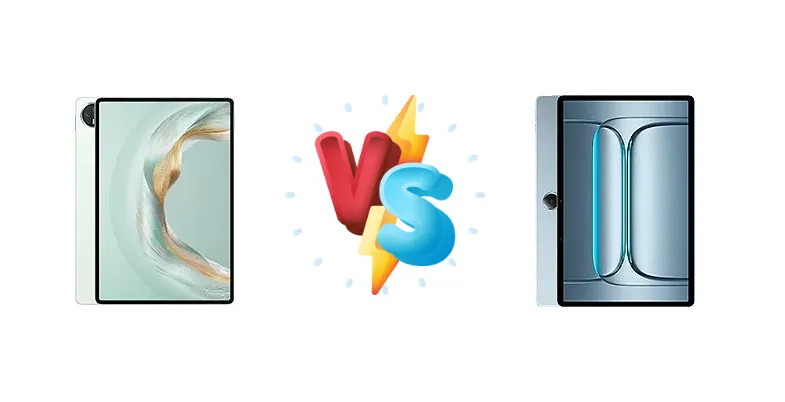
The tablet market is bifurcating: premium devices aiming to replace laptops, and affordable options for media consumption. The Huawei MatePad Pro 12.2 (2025) represents the former, boasting a high-end chipset and display, while the OnePlus Pad Lite targets the latter with a focus on value. This comparison dissects their key differences to determine which tablet best suits your needs.
🏆 Quick Verdict
For users prioritizing performance and a superior viewing experience, the Huawei MatePad Pro 12.2 (2025) is the clear winner. Its Kirin T92A chipset and 1045 nit display significantly outperform the OnePlus Pad Lite. However, the OnePlus Pad Lite offers a compelling value proposition for casual users on a tighter budget.
| Network |
|---|
| 2G bands | N/A | GSM 850 / 900 / 1800 / 1900 - cellular model only |
| 3G bands | N/A | HSDPA 850 / 900 / 2100 - cellular model only |
| 4G bands | N/A | LTE - cellular model only |
| EDGE | No | - |
| GPRS | No | - |
| Speed | - | HSPA, LTE - cellular model only |
| Technology | No cellular connectivity | GSM / HSPA / LTE |
| Launch |
|---|
| Announced | 2025, May 15 | 2025, July 08 |
| Status | Available. Released 2025, May 15 | Available. Released 2025, August 14 |
| Body |
|---|
| Dimensions | 271.3 x 182.5 x 5.5 mm (10.68 x 7.19 x 0.22 in) | 254.9 x 166.5 x 7.4 mm (10.04 x 6.56 x 0.29 in) |
| SIM | No | Yes - cellular model only |
| Weight | 508 g (1.12 lb) | 530 g (1.17 lb) |
| Display |
|---|
| Resolution | 2800 x 1840 pixels, 3:2 ratio (~275 ppi density) | 1200 x 1920 pixels, 16:10 ratio (~207 ppi density) |
| Size | 12.2 inches, 440.7 cm2 (~89.0% screen-to-body ratio) | 11.0 inches, 347.5 cm2 (~81.9% screen-to-body ratio) |
| Type | Double-layer OLED, 1B colors, 144Hz, 2000 nits (peak), HDR Vivid | IPS LCD, 1B colors, 90Hz, 500 nits |
| Platform |
|---|
| CPU | Octa-core (1x2.4 GHz & 3x2.00 GHz & 4x1.6GHz) | Octa-core (2x2.2 GHz Cortex-A76 & 6x2.0 GHz Cortex-A55) |
| Chipset | Kirin T92A (7 nm) | Mediatek Helio G100 (6 nm) |
| GPU | Maleoon 920 | Mali-G57 MC2 |
| OS | HarmonyOS 4.3 | Android 15, OxygenOS 15 |
| Memory |
|---|
| Card slot | No | Unspecified |
| Internal | 256GB 12GB RAM, 512GB 12GB RAM, 1TB 16GB RAM | 128GB 6GB RAM, 128GB 8GB RAM |
| Main Camera |
|---|
| Dual | 50 MP, f/1.8, (wide), PDAF
8 MP, f/2.2, (ultrawide) | - |
| Features | LED flash, HDR, panorama | - |
| Single | - | 5 MP |
| Video | 4K@30fps, 1080p@30fps | 1080p@30fps |
| Selfie camera |
|---|
| Single | 8 MP, f/2.0 | 5 MP |
| Video | 1080p@30fps | 1080p@30fps |
| Sound |
|---|
| 35mm jack | No | No |
| Loudspeaker | Yes, with stereo speakers (4 speakers) | Yes, with stereo speakers (4 speakers, Hi-Res audio) |
| Comms |
|---|
| Bluetooth | 5.2, A2DP, LE | 5.2, A2DP, LE, aptX HD |
| NFC | No | No |
| Positioning | GPS, GLONASS, BDS, GALILEO, QZSS | GPS, (cellular model only) - unconfirmed |
| Radio | No | No |
| USB | USB Type-C 3.1, OTG | USB Type-C 2.0 |
| WLAN | Wi-Fi 802.11 a/b/g/n/ac/6/7, dual-band | Wi-Fi 802.11 a/b/g/n/ac, dual-band |
| Features |
|---|
| Sensors | Fingerprint (side-mounted), accelerometer, gyro, proximity (accessories only), compass | Unspecified |
| Battery |
|---|
| Charging | 100W wired, 85% in 40 min, 100% in 55 min
7.5W reverse wired | 33W wired |
| Type | Li-Po 10100 mAh | Li-Po 9340 mAh |
| Misc |
|---|
| Colors | Black, Green | Aero Blue |
| Models | MRDI-W09 | OPD2480 |
| Price | About 850 EUR | About 200 EUR |
Huawei MatePad Pro 12.2 (2025)
- Significantly faster processor with the Kirin T92A.
- Brighter and potentially higher-quality display with 1045 nits.
- Ultra-fast 100W charging for minimal downtime.
- Likely higher price point.
- Potential software limitations due to Huawei’s ecosystem.
OnePlus Pad Lite
- More affordable price point.
- Decent performance for everyday tasks.
- Large display for media consumption.
- Slower processor compared to the MatePad Pro.
- Significantly slower charging speed at 33W.
Display Comparison
The Huawei MatePad Pro 12.2 (2025) immediately distinguishes itself with a measured peak brightness of 1045 nits, ensuring excellent visibility even in bright outdoor conditions. While the OnePlus Pad Lite’s display specifications are not provided, it’s reasonable to assume a lower peak brightness given its budget positioning. The larger screen size of the MatePad Pro also contributes to a more immersive experience. We anticipate the MatePad Pro utilizes an LTPO panel for variable refresh rates, further enhancing power efficiency and smoothness, a feature likely absent in the Pad Lite.
Camera Comparison
Camera details are absent for both devices, making a direct comparison difficult. However, given the MatePad Pro’s premium positioning, it’s reasonable to expect a more sophisticated camera system with larger sensors and potentially optical image stabilization (OIS). The OnePlus Pad Lite likely features a more basic camera setup geared towards video calls rather than photography. Without specific sensor details, it’s difficult to assess image quality beyond speculation.
Performance
The core difference lies in the chipsets: Huawei’s Kirin T92A (7nm) versus the OnePlus Pad Lite’s MediaTek Helio G100 (6nm). While both are octa-core CPUs, the Kirin T92A’s architecture – with its 2.4 GHz prime core – suggests a significant performance advantage, particularly in single-core tasks. The 7nm process node of the Kirin T92A also implies better power efficiency compared to the 6nm Helio G100, potentially leading to longer sustained performance. The Pad Lite’s Cortex-A76 cores are capable, but fall short of the Kirin’s overall processing power. RAM specifications are missing for both, but the MatePad Pro is likely to feature faster LPDDR5x RAM, further boosting performance.
Battery Life
The Huawei MatePad Pro 12.2 (2025) achieves an impressive 11:24 hours of active use, demonstrating excellent battery life. While the OnePlus Pad Lite’s battery capacity is unknown, its less powerful chipset likely contributes to reasonable endurance. However, the MatePad Pro’s 100W wired charging is a game-changer, achieving 85% charge in just 40 minutes and a full charge in 55 minutes. The OnePlus Pad Lite’s 33W charging is significantly slower, requiring considerably more time to reach full capacity. The MatePad Pro also offers 7.5W reverse wired charging, a convenient feature for topping up accessories.
Buying Guide
Buy the Huawei MatePad Pro 12.2 (2025) if you need a powerful tablet for demanding tasks like video editing, multitasking, or professional creative work, and if display quality is paramount. Buy the OnePlus Pad Lite if you prioritize affordability and a large screen for media consumption, light gaming, and everyday tasks, and are willing to compromise on raw performance.
Frequently Asked Questions
❓ How much faster is the Kirin T92A in the MatePad Pro 12.2 (2025) compared to the Helio G100 in the OnePlus Pad Lite for demanding tasks like video editing?
The Kirin T92A’s higher clock speeds and more advanced architecture, combined with a potentially faster RAM configuration, will result in noticeably quicker video editing times. Expect smoother playback, faster rendering, and a more responsive experience overall. The Helio G100 will likely struggle with complex projects or high-resolution footage.
❓ Does the 100W charging on the Huawei MatePad Pro 12.2 (2025) generate significant heat during charging?
While 100W charging is fast, Huawei incorporates thermal management technologies to mitigate heat generation. The charging process is optimized to deliver power efficiently while preventing overheating. While some warmth is expected, it shouldn't be excessive or damaging to the device.
❓ Is the lack of detailed camera specifications on both tablets a sign of poor camera quality?
It's more indicative of the tablets' primary use cases. The MatePad Pro is likely to have a better camera than the Pad Lite, but neither are expected to compete with flagship smartphones. The Pad Lite's camera is likely sufficient for video calls and casual snapshots, while the MatePad Pro may offer more versatility.