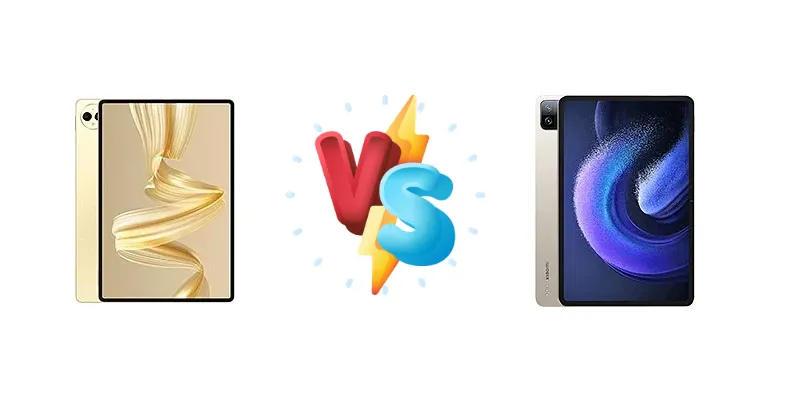
The large-screen Android tablet market is heating up. Huawei’s MatePad Pro 12.2 (2024) enters the fray with its in-house Kirin 9000S chipset and expansive display, challenging the established Xiaomi Pad 6 Pro, powered by the Snapdragon 8+ Gen 1. This comparison dissects the key differences to help you determine which tablet best suits your workflow and entertainment needs.
🏆 Quick Verdict
For most users, the Xiaomi Pad 6 Pro offers a more compelling package. Its Snapdragon 8+ Gen 1 provides a performance edge, particularly in sustained workloads, and its 67W charging is efficient. While the MatePad Pro 12.2 boasts a brighter display, the Xiaomi Pad 6 Pro’s overall value is higher.
| Network |
|---|
| 2G bands | GSM 850 / 900 / 1800 / 1900 - cellular model only | N/A |
| 3G bands | HSDPA 850 / 900 / 1900 / 2100 - cellular model only | N/A |
| 4G bands | LTE - cellular model only | - |
| EDGE | - | N/A |
| GPRS | - | N/A |
| Speed | HSPA, LTE - cellular model only | - |
| Technology | GSM / HSPA / LTE | No cellular connectivity |
| Launch |
|---|
| Announced | 2024, August 06 | 2023, April 18 |
| Status | Available. Released 2024, August 13 | Available. Released 2023, April 30 |
| Body |
|---|
| Build | - | Glass front (Gorilla Glass 3), aluminum frame, aluminum back |
| Dimensions | 271.3 x 182.5 x 5.5 mm (10.68 x 7.19 x 0.22 in) | 254 x 165.2 x 6.5 mm (10.0 x 6.50 x 0.26 in) |
| SIM | Nano-SIM (cellular model only) | No |
| Weight | 508 g (1.12 lb) | 490 g (1.08 lb) |
| | - | Stylus support (magnetic) |
| Display |
|---|
| Protection | - | Corning Gorilla Glass 3 |
| Resolution | 2800 x 1840 pixels, 3:2 ratio (~275 ppi density) | 1800 x 2880 pixels, 16:10 ratio (~309 ppi density) |
| Size | 12.2 inches, 440.7 cm2 (~89.0% screen-to-body ratio) | 11.0 inches, 350.9 cm2 (~83.6% screen-to-body ratio) |
| Type | Dual-layer OLED, 1B colors, 144Hz, 2000 nits (peak) | IPS LCD, 1B colors, 144Hz, HDR10, Dolby Vision, 550 nits |
| Platform |
|---|
| CPU | Octa-core (1x2.62GHz & 3x2.15GHz & 4x1.53GHz) | Octa-core (1x3.19 GHz Cortex-X2 & 3x2.75 GHz Cortex-A710 & 4x1.80 GHz Cortex-A510) |
| Chipset | Kirin 9000S (7 nm) | Qualcomm SM8475 Snapdragon 8+ Gen 1 (4 nm) |
| GPU | Maleoon 910 MP4 | Adreno 730 |
| OS | HarmonyOS 4.2 | Android 13, MIUI 14 |
| Memory |
|---|
| Card slot | No | No |
| Internal | 256GB 12GB RAM, 512GB 12GB RAM, 512GB 16GB RAM, 1TB 16GB RAM | 128GB 8GB RAM, 256GB 8GB RAM, 256GB 12GB RAM, 512GB 12GB RAM |
| | - | UFS 3.1 |
| Main Camera |
|---|
| Dual | 13 MP, f/1.8, (wide), PDAF
8 MP, f/2.2, (ultrawide) | 50 MP, f/1.8, (wide), 1/2.76", 0.64µm, PDAF
Auxiliary lens |
| Features | LED flash, HDR, panorama | Dual-LED flash, HDR, panorama |
| Video | 4K@30fps, 1080p@30fps | 4K@30/60fps, 1080p@30/60fps |
| Selfie camera |
|---|
| Single | 16 MP, f/2.2 | 20 MP, f/2.2, (wide), 1/3.4", 0.8µm |
| Video | 1080p@30fps | 1080p@30/60fps |
| Sound |
|---|
| 3.5mm jack | - | No |
| 35mm jack | No | No |
| Loudspeaker | Yes, with stereo speakers (4 speakers) | Yes, with stereo speakers (4 speakers) |
| | - | 24-bit/192kHz audio |
| Comms |
|---|
| Bluetooth | 5.2, A2DP, LE | 5.3, A2DP, LE |
| NFC | No | No |
| Positioning | GPS, GLONASS, BDS, GALILEO, QZSS | No |
| Radio | No | No |
| USB | USB Type-C 3.1, OTG | USB Type-C 3.2, accessory connector |
| WLAN | Wi-Fi 802.11 a/b/g/n/ac, dual-band | Wi-Fi 802.11 a/b/g/n/a/6e, dual-band, Wi-Fi Direct |
| Features |
|---|
| Sensors | Fingerprint (side-mounted), accelerometer, gyro, proximity (accessories only), compass | Accelerometer, gyro, proximity (accessories only) |
| Battery |
|---|
| Charging | 100W wired, 85% in 40 min, 100% in 55 min | 67W wired, PD3.0, QC4, 100% in 1 hour |
| Type | Li-Po 10100 mAh | Li-Po 8600 mAh |
| Misc |
|---|
| Colors | Gold, White, Black | Black, Blue, Gold |
| Models | MRO-W09, MRO-W00, MRO-W10, MRO-AL10 | 23046RP50C |
| Price | About 570 EUR | About 330 EUR |
Huawei MatePad Pro 12.2 (2024)
- Brighter display (1047 nits)
- Faster charging (100W)
- Larger screen size for immersive viewing
- Less powerful chipset (Kirin 9000S)
- Potentially lower sustained performance
- Huawei ecosystem lock-in
Xiaomi Pad 6 Pro
- More powerful chipset (Snapdragon 8+ Gen 1)
- Better thermal efficiency
- Faster app loading and smoother multitasking
- Likely lower peak display brightness
- Slower charging (67W)
- May lack Huawei’s ecosystem features
Display Comparison
The Huawei MatePad Pro 12.2 (2024) leads in peak brightness, achieving a measured 1047 nits, making it ideal for outdoor use or brightly lit environments. While the Xiaomi Pad 6 Pro’s display specs aren’t provided, it’s likely lower. The larger screen size of the MatePad Pro also contributes to a more immersive viewing experience. However, without knowing the panel technology (LTPO or not) of the Xiaomi Pad 6 Pro, it’s difficult to assess power efficiency. The MatePad Pro’s size will also impact portability, making the Xiaomi Pad 6 Pro a better choice for frequent travelers.
Camera Comparison
Neither tablet is positioned as a photography powerhouse, but the Xiaomi Pad 6 Pro likely has an advantage. While specific camera specs are unavailable for both, Xiaomi generally prioritizes camera performance in its tablets. The Kirin 9000S’s ISP capabilities are unknown, but Huawei’s image processing tends to favor vibrant, sometimes oversaturated, colors. Without detailed camera specs, it’s difficult to make a definitive judgment, but the Xiaomi Pad 6 Pro is likely the better option for casual photography.
Performance
The core difference lies in the chipsets. The Xiaomi Pad 6 Pro’s Snapdragon 8+ Gen 1 (4nm) benefits from a more advanced manufacturing process than the Huawei MatePad Pro 12.2’s Kirin 9000S (7nm). This translates to better thermal efficiency and sustained performance under load. The Snapdragon’s Cortex-X2 prime core, clocked at 3.19 GHz, offers a significant single-core performance boost compared to the Kirin 9000S’s 2.62 GHz core. While the Kirin 9000S is a capable chip, the Snapdragon 8+ Gen 1 is generally considered superior for demanding tasks like gaming and video editing. The Xiaomi Pad 6 Pro’s likely use of faster LPDDR5X RAM further enhances its performance capabilities.
Battery Life
The Huawei MatePad Pro 12.2 (2024) supports 100W wired charging, reaching 85% in 40 minutes and 100% in 55 minutes. The Xiaomi Pad 6 Pro offers 67W charging with PD3.0 and QC4 support, taking a full hour to reach 100%. While the MatePad Pro charges faster, the actual battery life will depend on the capacity of each device (not provided). The Snapdragon 8+ Gen 1’s efficiency could offset the MatePad Pro’s faster charging, resulting in comparable real-world battery endurance. The Xiaomi Pad 6 Pro’s support for widely adopted charging standards (PD3.0, QC4) offers greater compatibility with existing chargers.
Buying Guide
Buy the Huawei MatePad Pro 12.2 (2024) if you prioritize absolute peak display brightness and are deeply embedded within the Huawei ecosystem, valuing features like seamless multi-device collaboration. Buy the Xiaomi Pad 6 Pro if you prioritize raw performance for gaming and demanding applications, coupled with faster charging and a more open Android experience.
Frequently Asked Questions
❓ Does the Kirin 9000S chipset in the MatePad Pro 12.2 (2024) throttle under sustained gaming loads?
The 7nm process of the Kirin 9000S is less efficient than the 4nm Snapdragon 8+ Gen 1. This means the MatePad Pro 12.2 (2024) is more likely to experience thermal throttling during extended gaming sessions, potentially leading to reduced frame rates and performance.
❓ How does the charging speed of the MatePad Pro 12.2 (2024) compare to real-world usage scenarios?
While 100W charging is fast, the actual benefit depends on battery capacity (unspecified). The 85% charge in 40 minutes is useful, but if battery life is comparable to the Xiaomi Pad 6 Pro, the difference in charging time may be less noticeable in daily use.
❓ Is the lack of Google Mobile Services (GMS) on the Huawei MatePad Pro 12.2 (2024) a significant drawback?
Yes, for users heavily reliant on Google apps like Gmail, YouTube, and Google Maps, the absence of GMS is a major limitation. Huawei’s AppGallery offers alternatives, but compatibility and functionality may vary. Sideloading apps is possible, but not a seamless experience.