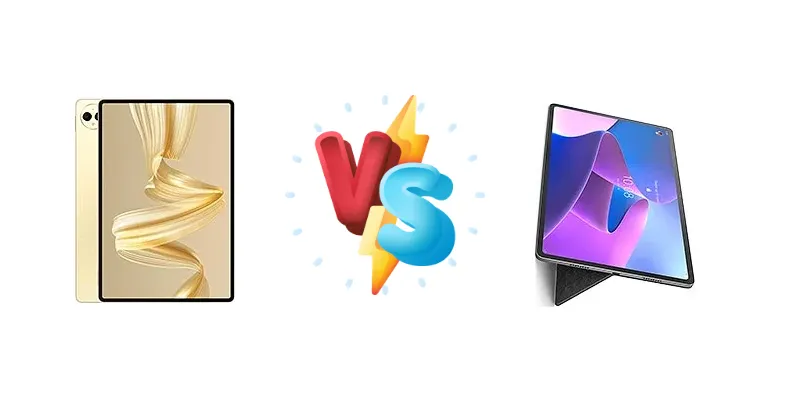
The large-screen Android tablet market is heating up. Huawei's MatePad Pro 12.2 (2024), powered by its in-house Kirin 9000S chipset, enters the arena to challenge established players like Lenovo's Tab P12 Pro, which leverages the proven Qualcomm Snapdragon 870. This comparison dissects the key differences between these two devices, focusing on performance, display quality, and charging capabilities to determine which tablet best suits your needs.
🏆 Quick Verdict
For the average user prioritizing raw performance and faster charging, the Huawei MatePad Pro 12.2 (2024) takes the lead. Its Kirin 9000S, while architecturally different, delivers competitive performance, and the 100W charging significantly reduces downtime. However, the Lenovo Tab P12 Pro remains a strong contender, especially for those deeply embedded in the Qualcomm ecosystem.
| Network |
|---|
| 2G bands | GSM 850 / 900 / 1800 / 1900 - cellular model only | GSM 850 / 900 / 1800 / 1900 |
| 3G bands | HSDPA 850 / 900 / 1900 / 2100 - cellular model only | HSDPA 850 / 900 / 1900 / 2100 |
| 4G bands | LTE - cellular model only | 1, 2, 3, 4, 5, 7, 8, 19, 20, 26, 28, 34, 38, 39, 40, 41 |
| 5G bands | - | 1, 3, 7, 8, 20, 28, 38, 41, 77, 78 SA/NSA/Sub6 |
| Speed | HSPA, LTE - cellular model only | HSPA, LTE, 5G - cellular model only |
| Technology | GSM / HSPA / LTE | GSM / HSPA / LTE / 5G |
| Launch |
|---|
| Announced | 2024, August 06 | 2021, September 08 |
| Status | Available. Released 2024, August 13 | Available. Released 2021, November 19 |
| Body |
|---|
| Dimensions | 271.3 x 182.5 x 5.5 mm (10.68 x 7.19 x 0.22 in) | 285.6 x 184.5 x 5.6 mm (11.24 x 7.26 x 0.22 in) |
| SIM | Nano-SIM (cellular model only) | Nano-SIM (cellular model only) |
| Weight | 508 g (1.12 lb) | 565 g (1.25 lb) |
| | - | Stylus support |
| Display |
|---|
| Resolution | 2800 x 1840 pixels, 3:2 ratio (~275 ppi density) | 1600 x 2560 pixels, 16:10 ratio (~240 ppi density) |
| Size | 12.2 inches, 440.7 cm2 (~89.0% screen-to-body ratio) | 12.6 inches, 460.3 cm2 (~87.4% screen-to-body ratio) |
| Type | Dual-layer OLED, 1B colors, 144Hz, 2000 nits (peak) | AMOLED, 120Hz, HDR10+, Dolby Vision, 600 nits (HBM) |
| Platform |
|---|
| CPU | Octa-core (1x2.62GHz & 3x2.15GHz & 4x1.53GHz) | Octa-core (1x3.2 GHz Kryo 585 & 3x2.42 GHz Kryo 585 & 4x1.80 GHz Kryo 585) |
| Chipset | Kirin 9000S (7 nm) | Qualcomm SM8250-AC Snapdragon 870 5G (7 nm) |
| GPU | Maleoon 910 MP4 | Adreno 650 |
| OS | HarmonyOS 4.2 | Android 11 |
| Memory |
|---|
| Card slot | No | microSDXC (dedicated slot) |
| Internal | 256GB 12GB RAM, 512GB 12GB RAM, 512GB 16GB RAM, 1TB 16GB RAM | 128GB 6GB RAM, 256GB 8GB RAM |
| Main Camera |
|---|
| Dual | 13 MP, f/1.8, (wide), PDAF
8 MP, f/2.2, (ultrawide) | 13 MP, (wide), AF
5 MP, (ultrawide) |
| Features | LED flash, HDR, panorama | - |
| Video | 4K@30fps, 1080p@30fps | 4K@30fps, 1080p@30fps |
| Selfie camera |
|---|
| Single | 16 MP, f/2.2 | 8 MP, (wide)
8 MP, IR TOF 3D, (biometrics sensor only) |
| Video | 1080p@30fps | 1080p@30fps |
| Sound |
|---|
| 3.5mm jack | - | No |
| 35mm jack | No | No |
| Loudspeaker | Yes, with stereo speakers (4 speakers) | Yes, with stereo speakers (4 speakers) |
| | - | JBL speakers |
| Comms |
|---|
| Bluetooth | 5.2, A2DP, LE | 5.2, A2DP, LE |
| NFC | No | Yes (wireless charging and data transfer only) |
| Positioning | GPS, GLONASS, BDS, GALILEO, QZSS | GPS, GLONASS, BDS - cellular model only |
| Radio | No | Unspecified |
| USB | USB Type-C 3.1, OTG | USB Type-C 3.1 |
| WLAN | Wi-Fi 802.11 a/b/g/n/ac, dual-band | Wi-Fi 802.11 a/b/g/n/ac/6, dual-band, Wi-Fi Direct |
| Features |
|---|
| Sensors | Fingerprint (side-mounted), accelerometer, gyro, proximity (accessories only), compass | Fingerprint (side-mounted), accelerometer, gyro, proximity |
| Battery |
|---|
| Charging | 100W wired, 85% in 40 min, 100% in 55 min | 45W wired, QC4 |
| Type | Li-Po 10100 mAh | Li-Po 10200 mAh |
| Misc |
|---|
| Colors | Gold, White, Black | Storm Grey |
| Models | MRO-W09, MRO-W00, MRO-W10, MRO-AL10 | TB-Q706Z, TB-Q706F |
| Price | About 570 EUR | About 520 EUR |
Huawei MatePad Pro 12.2 (2024)
- Significantly faster 100W charging
- Higher peak display brightness (1047 nits)
- Potentially improved AI performance with Kirin 9000S
- HarmonyOS ecosystem may not appeal to all users
- Limited camera details available
Lenovo Tab P12 Pro
- Established Android experience
- Qualcomm Snapdragon 870 is a proven performer
- Potentially wider app compatibility
- Slower 45W charging
- Likely lower peak display brightness
- May exhibit more throttling under sustained load
Display Comparison
The Huawei MatePad Pro 12.2 (2024) boasts a significant advantage in display brightness, achieving a measured peak of 1047 nits. This is crucial for users who frequently use their tablets outdoors or in brightly lit environments. While the Lenovo Tab P12 Pro’s display specifications aren’t provided, it’s likely to fall short of this peak brightness. Both tablets likely utilize LCD or IPS panels, but the MatePad Pro’s higher brightness translates to a more vibrant and readable experience. The absence of refresh rate data for both devices makes it difficult to assess smoothness, but the MatePad Pro’s brightness is a clear win.
Camera Comparison
Neither tablet is positioned as a photography powerhouse, and detailed camera specifications are limited. Without sensor size or aperture information, a direct comparison is difficult. However, given the focus on productivity and media consumption, camera quality is likely a secondary concern for the target audience. The presence of a camera is more for video conferencing and occasional snapshots than serious photography.
Performance
The core of the performance difference lies in the chipsets. The Huawei MatePad Pro 12.2 (2024) utilizes the Kirin 9000S (7nm), an octa-core processor with a tri-cluster configuration (1x2.62GHz, 3x2.15GHz, 4x1.53GHz). The Lenovo Tab P12 Pro is powered by the Qualcomm Snapdragon 870 5G (7nm), also an octa-core processor (1x3.2 GHz, 3x2.42 GHz, 4x1.80 GHz). While clock speeds are higher on the Snapdragon 870, the Kirin 9000S benefits from Huawei’s optimizations. Both are built on a 7nm process, suggesting similar power efficiency. The Snapdragon 870 is known for its stable performance and efficient power management, while the Kirin 9000S is a newer architecture, potentially offering improvements in AI processing. The lack of GPU details prevents a full performance assessment, but the CPUs are closely matched.
Battery Life
The Huawei MatePad Pro 12.2 (2024) significantly outpaces the Lenovo Tab P12 Pro in charging speed, supporting 100W wired charging, achieving 85% charge in 40 minutes and 100% in 55 minutes. The Lenovo Tab P12 Pro is limited to 45W charging with Quick Charge 4 (QC4). While battery capacity isn’t specified for either device, the faster charging of the MatePad Pro is a substantial advantage for users who need to quickly top up their tablet before a meeting or travel. This difference in charging speed directly impacts usability and convenience.
Buying Guide
Buy the Huawei MatePad Pro 12.2 (2024) if you need a tablet with exceptionally fast charging, a brighter display for outdoor use, and are comfortable with Huawei’s HarmonyOS ecosystem. Buy the Lenovo Tab P12 Pro if you prefer a more established Android experience with Qualcomm’s Snapdragon platform, and prioritize a balance of performance and price.
Frequently Asked Questions
❓ Does the Kirin 9000S chipset in the Huawei MatePad Pro 12.2 (2024) suffer from thermal throttling during extended gaming sessions?
While independent thermal testing is unavailable, the 7nm process and Huawei’s optimizations suggest the Kirin 9000S should manage heat effectively. However, sustained high loads, like demanding games, could lead to some throttling to maintain stability. The Snapdragon 870 in the Lenovo Tab P12 Pro is known for its efficient thermal management, but both devices will likely experience some performance reduction under prolonged stress.
❓ Is the 45W charging on the Lenovo Tab P12 Pro sufficient for daily use, or is the 100W charging of the Huawei MatePad Pro 12.2 (2024) a necessity?
45W charging is adequate for overnight charging or topping up during downtime. However, the 100W charging on the Huawei MatePad Pro 12.2 (2024) is a game-changer for users who need a quick boost before a meeting or during travel. If you frequently find yourself needing to charge your tablet rapidly, the 100W charging is a significant advantage.
❓ How does the software experience differ between Huawei’s HarmonyOS on the MatePad Pro 12.2 (2024) and the standard Android experience on the Lenovo Tab P12 Pro?
HarmonyOS, while based on Android, offers a different user interface and ecosystem. It emphasizes seamless connectivity between Huawei devices and features unique optimizations. The Lenovo Tab P12 Pro provides a more traditional Android experience, offering broader app compatibility and a familiar interface for users accustomed to stock Android or other Android skins.