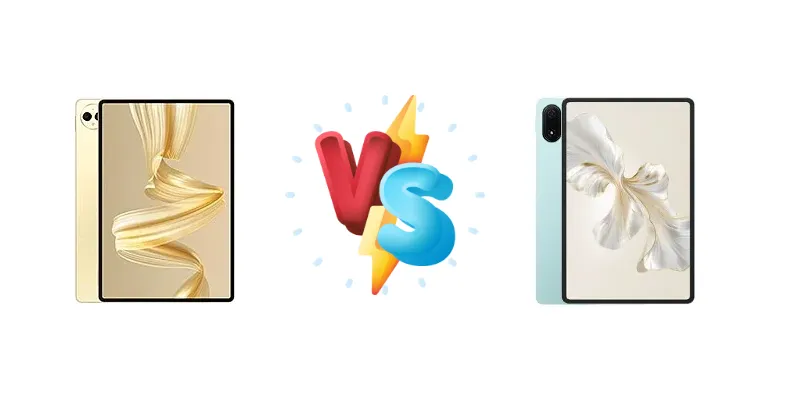
Huawei and Honor both offer compelling Android tablet experiences, but cater to slightly different priorities. The Huawei MatePad Pro 12.2 (2024) represents Huawei’s premium offering, leveraging its in-house Kirin chipset, while the Honor Pad 9 Pro aims for a balance of performance and value with a MediaTek Dimensity processor. This comparison dissects the key differences to determine which tablet best suits your needs.
🏆 Quick Verdict
For users prioritizing raw performance and display quality, the Huawei MatePad Pro 12.2 (2024) is the superior choice. Its Kirin 9000S chipset and significantly brighter display justify the price premium. However, the Honor Pad 9 Pro offers a strong value proposition for those seeking a capable tablet at a more accessible price point.
| Network |
|---|
| 2G bands | GSM 850 / 900 / 1800 / 1900 - cellular model only | N/A |
| 3G bands | HSDPA 850 / 900 / 1900 / 2100 - cellular model only | N/A |
| 4G bands | LTE - cellular model only | - |
| EDGE | - | No |
| GPRS | - | No |
| Speed | HSPA, LTE - cellular model only | - |
| Technology | GSM / HSPA / LTE | No cellular connectivity |
| Launch |
|---|
| Announced | 2024, August 06 | 2024, July 12 |
| Status | Available. Released 2024, August 13 | Available. Released 2024, July 12 |
| Body |
|---|
| Build | - | Glass front, aluminum frame, aluminum back |
| Dimensions | 271.3 x 182.5 x 5.5 mm (10.68 x 7.19 x 0.22 in) | 277 x 179.9 x 6.6 mm (10.91 x 7.08 x 0.26 in) |
| SIM | Nano-SIM (cellular model only) | No |
| Weight | 508 g (1.12 lb) | 589 g (1.30 lb) |
| Display |
|---|
| Resolution | 2800 x 1840 pixels, 3:2 ratio (~275 ppi density) | 1600 x 2560 pixels, 16:10 ratio (~249 ppi density) |
| Size | 12.2 inches, 440.7 cm2 (~89.0% screen-to-body ratio) | 12.1 inches, 424.5 cm2 (~85.2% screen-to-body ratio) |
| Type | Dual-layer OLED, 1B colors, 144Hz, 2000 nits (peak) | IPS LCD, 1B colors, 144Hz |
| Platform |
|---|
| CPU | Octa-core (1x2.62GHz & 3x2.15GHz & 4x1.53GHz) | Octa-core (4x2.85 GHz Cortex-A78 & 4x2.0 GHz Cortex-A55) |
| Chipset | Kirin 9000S (7 nm) | Mediatek Dimensity 8100 (5 nm) |
| GPU | Maleoon 910 MP4 | Mali-G610 MC6 |
| OS | HarmonyOS 4.2 | Android 14, Magic OS 8.1 |
| Memory |
|---|
| Card slot | No | No |
| Internal | 256GB 12GB RAM, 512GB 12GB RAM, 512GB 16GB RAM, 1TB 16GB RAM | 256GB 12GB RAM, 256GB 8GB RAM |
| Main Camera |
|---|
| Dual | 13 MP, f/1.8, (wide), PDAF
8 MP, f/2.2, (ultrawide) | - |
| Features | LED flash, HDR, panorama | HDR |
| Single | - | 13 MP, f/2.0, (wide), AF |
| Video | 4K@30fps, 1080p@30fps | 4K@30fps, 1080p@30fps |
| Selfie camera |
|---|
| Single | 16 MP, f/2.2 | 5 MP, f/2.2, (wide) |
| Video | 1080p@30fps | 1080p@30fps |
| Sound |
|---|
| 35mm jack | No | No |
| Loudspeaker | Yes, with stereo speakers (4 speakers) | Yes, with stereo speakers (8 speakers) |
| Comms |
|---|
| Bluetooth | 5.2, A2DP, LE | 5.2, A2DP, LE |
| NFC | No | No |
| Positioning | GPS, GLONASS, BDS, GALILEO, QZSS | No |
| Radio | No | No |
| USB | USB Type-C 3.1, OTG | USB Type-C 2.0, OTG |
| WLAN | Wi-Fi 802.11 a/b/g/n/ac, dual-band | Wi-Fi 802.11 a/b/g/n/ac/6, dual-band, Wi-Fi Direct |
| Features |
|---|
| Sensors | Fingerprint (side-mounted), accelerometer, gyro, proximity (accessories only), compass | Accelerometer |
| Battery |
|---|
| Charging | 100W wired, 85% in 40 min, 100% in 55 min | 35W wired |
| Type | Li-Po 10100 mAh | Li-Po 10050 mAh |
| Misc |
|---|
| Colors | Gold, White, Black | Sky Blue, Star Gray |
| Models | MRO-W09, MRO-W00, MRO-W10, MRO-AL10 | - |
| Price | About 570 EUR | About 290 EUR |
Huawei MatePad Pro 12.2 (2024)
- Significantly brighter display (1047 nits)
- Faster 100W charging
- Potentially superior performance with Kirin 9000S
- Higher price point
- Potential software restrictions due to Huawei’s situation
Honor Pad 9 Pro
- More affordable price
- Efficient 5nm Dimensity 8100 chipset
- Good value for everyday tasks
- Slower 35W charging
- Likely lower display brightness
Display Comparison
The Huawei MatePad Pro 12.2 (2024) boasts a significant advantage in display technology, achieving a measured peak brightness of 1047 nits. This is crucial for outdoor visibility and HDR content consumption. While the Honor Pad 9 Pro’s display specifications aren’t provided, it’s reasonable to assume a lower peak brightness given the price difference. The larger screen size of the MatePad Pro also contributes to a more immersive viewing experience. We expect both to utilize IPS LCD panels, but the Huawei’s brightness is a clear differentiator.
Camera Comparison
Given the tablet form factor, camera performance isn’t a primary concern for most users. However, if photography is a consideration, the Huawei MatePad Pro 12.2 (2024) is likely to offer a more refined experience due to Huawei’s established camera processing algorithms. Without specific camera specs for either device, it’s difficult to make a definitive statement, but Huawei generally invests more heavily in camera technology. We can assume both will feature multi-camera setups, but the quality of the sensors and image processing will likely differ.
Performance
The core of the performance difference lies in the chipsets. Huawei’s Kirin 9000S (7nm) is a custom-designed SoC, while the Honor Pad 9 Pro utilizes the MediaTek Dimensity 8100 (5nm). Although the Dimensity 8100 features a more modern 5nm process, potentially offering better efficiency, the Kirin 9000S’s architecture and optimization within Huawei’s ecosystem likely deliver superior overall performance, particularly in sustained workloads. The CPU configuration of the Dimensity 8100 (4x2.85 GHz Cortex-A78 & 4x2.0 GHz Cortex-A55) emphasizes peak clock speeds, while the Kirin 9000S (1x2.62GHz & 3x2.15GHz & 4x1.53GHz) appears to prioritize a more balanced core configuration. The lack of LPDDR5x RAM specification for the Honor Pad 9 Pro suggests it may use a slower RAM standard, further widening the performance gap.
Battery Life
The Honor Pad 9 Pro’s 35W wired charging is significantly slower than the Huawei MatePad Pro 12.2 (2024)’s 100W wired charging. Huawei claims 85% charge in 40 minutes and 100% in 55 minutes. This faster charging is a substantial convenience factor for users who frequently need to top up their device. While battery capacity isn’t specified for either tablet, the faster charging of the MatePad Pro mitigates any potential disadvantage from a slightly smaller battery.
Buying Guide
Buy the Huawei MatePad Pro 12.2 (2024) if you demand the best possible performance for demanding tasks like video editing or gaming, and if a stunningly bright, high-quality display is paramount. Buy the Honor Pad 9 Pro if you prioritize value, seeking a well-rounded tablet experience for everyday tasks, media consumption, and light productivity without breaking the bank.
Frequently Asked Questions
❓ Does the Kirin 9000S chipset in the MatePad Pro 12.2 (2024) suffer from significant thermal throttling during extended gaming sessions?
While the Kirin 9000S is a powerful chipset, thermal throttling is always a possibility during prolonged, demanding tasks. However, the larger form factor of the MatePad Pro 12.2 (2024) provides more space for heat dissipation compared to smaller devices, suggesting it should manage temperatures reasonably well. Independent testing will be needed to confirm the extent of any throttling.
❓ How does the software experience differ between the Huawei MatePad Pro 12.2 (2024) and the Honor Pad 9 Pro, considering Huawei’s restrictions?
The Huawei MatePad Pro 12.2 (2024) runs HarmonyOS, which lacks full Google Mobile Services (GMS) support. This means users may need to rely on Huawei’s AppGallery and workarounds for accessing popular Google apps. The Honor Pad 9 Pro, on the other hand, runs a standard Android build with full GMS support, providing a more familiar and seamless experience for users accustomed to the Google ecosystem.
❓ Is the 35W charging on the Honor Pad 9 Pro slow enough to be a major inconvenience for daily use?
While 35W charging isn't the fastest available, it's still adequate for overnight charging and topping up the battery during downtime. However, users accustomed to the rapid charging speeds of devices like the MatePad Pro 12.2 (2024) may find it noticeably slower. The impact will depend on individual usage patterns and charging habits.