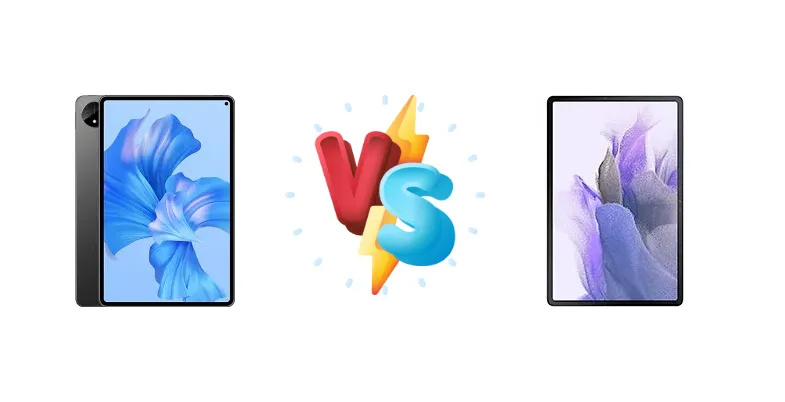
The Android tablet market is heating up, and two contenders are vying for your attention: the Huawei MatePad Pro 11 (2022) and the Samsung Galaxy Tab S7 FE. Both offer compelling features, but cater to slightly different needs. Let's dive into a detailed comparison to help you decide which one is right for you.
🏆 Quick Verdict
The MatePad Pro 11 (2022) boasts superior performance thanks to its Snapdragon 870/888 chipset and brighter display. However, the Tab S7 FE offers a larger screen, S Pen support, and a more established ecosystem. For power users, the Huawei wins; for versatility and creative tasks, the Samsung takes the lead.
| Network |
|---|
| 2G bands | GSM 850 / 900 / 1800 / 1900 | GSM 850 / 900 / 1800 / 1900 |
| 3G bands | HSDPA 800 / 850 / 900 / 1700(AWS) / 1900 / 2100 | HSDPA 850 / 900 / 1700(AWS) / 1900 / 2100 |
| 4G bands | LTE | 1, 2, 3, 4, 5, 7, 8, 12, 13, 17, 20, 25, 26, 28, 32, 38, 40, 41, 66 |
| 5G bands | - | 1, 3, 5, 7, 8, 20, 28, 38, 40, 41, 77, 78 SA/NSA/Sub6 |
| Speed | HSPA, LTE - cellular model only | HSPA, LTE, 5G - cellular model only |
| Technology | GSM / HSPA / LTE | GSM / HSPA / LTE / 5G |
| Launch |
|---|
| Announced | 2022, July 27 | 2021, May 25 |
| Status | Available. Released 2022, August 10 | Available. Released 2021, June 18 |
| Body |
|---|
| Build | - | Glass front, aluminum back, aluminum frame |
| Dimensions | 249.2 x 160.4 x 5.9 mm (9.81 x 6.31 x 0.23 in) | 284.8 x 185 x 6.3 mm (11.21 x 7.28 x 0.25 in) |
| SIM | Nano-SIM (cellular model only) | Nano-SIM (cellular model only) |
| Weight | 449 g (455 g cellular model) (15.84 oz) | 608 g (1.34 lb) |
| | Stylus support | Stylus support |
| Display |
|---|
| Resolution | 2560 x 1600 pixels, 16:10 ratio (~274 ppi density) | 1600 x 2560 pixels, 16:10 ratio (~243 ppi density) |
| Size | 11.0 inches, 350.9 cm2 (~87.8% screen-to-body ratio) | 12.4 inches, 445.8 cm2 (~84.6% screen-to-body ratio) |
| Type | OLED, 1B colors, 120Hz, 600 nits (typ) | TFT LCD |
| Platform |
|---|
| CPU | Octa-core (1x3.2 GHz Kryo 585 & 3x2.42 GHz Kryo 585 & 4x1.80 GHz Kryo 585) - GOT-W29Octa-core (1x2.84 GHz Cortex-X1 & 3x2.42 GHz Cortex-A78 & 4x1.80 GHz Cortex-A55) - GOT-W09, GOT-AL09, GOT-AL19 | Octa-core (2x2.2 GHz Kryo 570 & 6x1.8 GHz Kryo 570) - 5G modelOcta-core (1x2.4 GHz Cortex-A78 & 3x2.2 GHz Cortex-A78 & 4x1.9 GHz Cortex-A55) - Wi-Fi model |
| Chipset | Qualcomm SM8250-AC Snapdragon 870 5G (7 nm) - GOT-W29Qualcomm SM8350 Snapdragon 888 (5 nm) - GOT-W09, GOT-AL09, GOT-AL19 | Qualcomm SM7225 Snapdragon 750G 5G (8 nm) - 5G modelQualcomm SM7325 Snapdragon 778G 5G (6 nm) - Wi-Fi model |
| GPU | Adreno 650 - GOT-W29Adreno 660 - GOT-W09, GOT-AL09, GOT-AL19 | Adreno 619 - 5G modelAdreno 642L - Wi-Fi model |
| OS | HarmonyOS 3.0 | Android 11, upgradable to Android 14, One UI 6 |
| Memory |
|---|
| Card slot | No | microSDXC (dedicated slot) |
| Internal | 128GB 8GB RAM, 256GB 8GB RAM, 512GB 12GB RAM | 64GB 4GB RAM, 128GB 6GB RAM, 256GB 8GB RAM |
| | UFS 3.1 | - |
| Main Camera |
|---|
| Dual | 13 MP, f/1.8, (wide), PDAF
8 MP, f/2.2, (ultrawide) | - |
| Features | LED flash, HDR, panorama | - |
| Single | 16 MP, f/2.2 | 8 MP, AF |
| Video | 4K@30fps, 1080p@30fps | 1080p@30fps |
| Selfie camera |
|---|
| Single | 16 MP, f/2.2 | 5 MP |
| Video | 1080p@30fps | 1080p@30fps |
| Sound |
|---|
| 3.5mm jack | No | No |
| 35mm jack | No | No |
| Loudspeaker | Yes, with stereo speakers (6 speakers) | Yes, with stereo speakers |
| | - | Tuned by AKG |
| Comms |
|---|
| Bluetooth | 5.2, (5.1 for GOT-W29), A2DP, LE | 5.2, A2DP, LE (Wi-Fi), 5.2, A2DP, LE (5G) |
| NFC | No | No |
| Positioning | GPS, GLONASS, BDS, GALILEO, QZSS - cellular model only | GPS, GLONASS, BDS, GALILEO - cellular model only |
| Radio | No | No |
| USB | USB Type-C 3.1, OTG | USB Type-C 3.2, magnetic connector |
| WLAN | Wi-Fi 802.11 a/b/g/n/ac/6, tri-band (dual-band for GOT-W29), Wi-Fi Direct | Wi-Fi 802.11 a/b/g/n/ac/6 (Wi-Fi), Wi-Fi 802.11 a/b/g/n/ac (5G) |
| Features |
|---|
| Sensors | Accelerometer, gyro, proximity, compass | Accelerometer, proximity, compass, gyro (5G model only) |
| | - | Samsung DeX |
| Battery |
|---|
| Charging | 66W wired (GOT-W09, GOT-AL09, GOT-AL19)
40W wired (GOT-W29)
Reverse wired | 45W wired, 100% in 190 min |
| Type | Li-Po 8300 mAh | Li-Po 10090 mAh |
| Misc |
|---|
| Colors | Golden Black, Galaxy Blue, Crystal White, Brocade White | Mystic Black, Mystic Silver, Mystic Green, Mystic Pink |
| Models | GOT-W09, GOT-W29, GOT-AL09, GOT-AL19 | SM-T730, SM-T733, SM-T736B, SM-T735 |
| Price | About 500 EUR | About 650 EUR |
| SAR EU | - | 1.15 W/kg (body) |
| Tests |
|---|
| Display |
Contrast ratio: Infinite (nominal) | Contrast ratio: 1886:1 (nominal) |
| Loudspeaker |
-23.5 LUFS (Very good)
| -27.2 LUFS (Good) |
| Performance |
AnTuTu: 780161 (v9)
GeekBench: 3685 (v5.1)
GFXBench: 37fps (ES 3.1 onscreen) | AnTuTu: 292530 (v8), 355430 (v9)
GeekBench: 1904 (v5.1)
GFXBench: 9.7fps (ES 3.1 onscreen) |
Huawei MatePad Pro 11 (2022)
- Superior Performance (Snapdragon 870/888)
- Brighter and More Vibrant Display
- Sleek and Premium Design
- Faster Charging (66W)
- Huawei Ecosystem Limitations (Google Services)
- Potentially Shorter Battery Life than Tab S7 FE
- No S Pen Support
Samsung Galaxy Tab S7 FE
- Larger Display (10.9 inches)
- S Pen Support Included
- Longer Battery Life
- Established Samsung Ecosystem
- Less Powerful Processor
- Dimmer Display
- Slower Charging (45W)
Display Comparison
The MatePad Pro 11 (2022) shines with a measured peak brightness of 591 nits, offering a noticeably brighter and more vivid viewing experience, especially outdoors. Its contrast ratio is effectively infinite. The Tab S7 FE, while still good at 522 nits and a 1886:1 contrast ratio, doesn't quite match the Huawei's vibrancy. The Tab S7 FE's larger 10.9-inch display is a plus for media consumption, but the MatePad Pro 11's 11-inch display is also excellent.
Camera Comparison
Camera quality is generally not a primary concern for tablets, but the MatePad Pro 11 (2022) typically offers slightly better camera performance, with improved image processing and detail. Both tablets feature decent front-facing cameras suitable for video calls. Specific camera specs are difficult to confirm without detailed reviews, but Huawei generally has a slight edge.
Performance
Here's where the MatePad Pro 11 (2022) truly pulls ahead. The Snapdragon 870 or 888 chipset (depending on the variant) provides significantly more processing power than the Tab S7 FE's Snapdragon 750G or 778G. Expect smoother multitasking, faster app loading times, and better gaming performance on the Huawei. The Tab S7 FE is still capable, but it won't handle demanding tasks as effortlessly.
Battery Life
The Tab S7 FE has a larger battery capacity (10,000 mAh) compared to the MatePad Pro 11 (2022) (7250 mAh). While the MatePad Pro 11 (2022) supports faster 66W charging (40W for some variants), the Tab S7 FE's battery life is generally longer, potentially lasting a full day of moderate use. The Tab S7 FE takes approximately 190 minutes to charge fully at 45W.
Buying Guide
Who should buy the Huawei MatePad Pro 11 (2022)? Users prioritizing raw performance, a vibrant display, and a sleek design. Who should buy the Samsung Galaxy Tab S7 FE? Those seeking a larger screen for media consumption and productivity, S Pen functionality, and seamless integration with the Samsung ecosystem.
Frequently Asked Questions
❓ Does the Huawei MatePad Pro 11 (2022) have Google Play Store?
No, the Huawei MatePad Pro 11 (2022) does not have Google Play Store. It uses Huawei's AppGallery and supports sideloading apps.
❓ Is the S Pen included with the Samsung Galaxy Tab S7 FE?
Yes, the S Pen is included with the Samsung Galaxy Tab S7 FE.