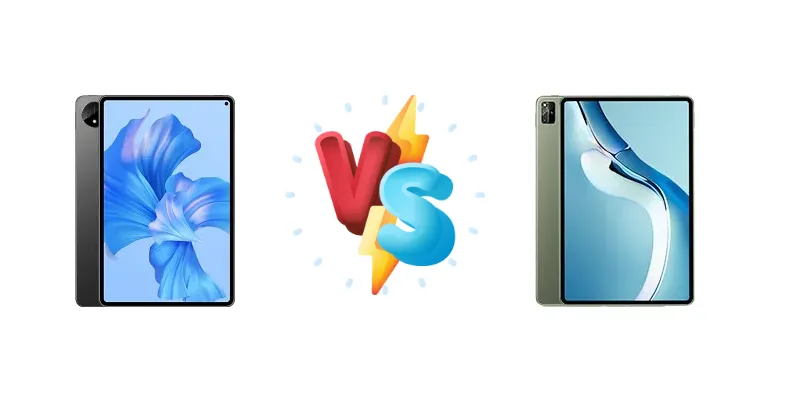
Huawei's MatePad Pro line consistently delivers premium Android tablets. But with slightly different sizes and specs, choosing between the 11-inch (2022) and 12.6-inch (2021) models can be tricky. This comprehensive comparison breaks down the key differences to help you make the right decision.
🏆 Quick Verdict
The MatePad Pro 11 (2022) offers a brighter display and a more powerful Snapdragon 870 (in some models) for better performance. The 12.6 (2021) boasts a larger, more immersive screen and a Kirin 9000E/9000, making it ideal for media consumption and creative tasks. It depends on your priorities.
| Network |
|---|
| 2G bands | GSM 850 / 900 / 1800 / 1900 | GSM 850 / 900 / 1800 / 1900 |
| 3G bands | HSDPA 800 / 850 / 900 / 1700(AWS) / 1900 / 2100 | HSDPA 800 / 850 / 900 / 1700(AWS) / 1900 / 2100 |
| 4G bands | LTE | 1, 2, 3, 4, 5, 7, 8, 9, 12, 17, 18, 19, 20, 26, 28, 32, 34, 38, 39, 40, 41, 42, 66 |
| 5G bands | - | 1, 3, 5, 7, 8, 28, 38, 40, 41, 66, 77, 78, 79, 80, 84 SA/NSA |
| Speed | HSPA, LTE - cellular model only | HSPA, LTE, 5G - cellular model only |
| Technology | GSM / HSPA / LTE | GSM / HSPA / LTE / 5G |
| Launch |
|---|
| Announced | 2022, July 27 | 2021, June 02 |
| Status | Available. Released 2022, August 10 | Available. Released 2021, June 25 |
| Body |
|---|
| Dimensions | 249.2 x 160.4 x 5.9 mm (9.81 x 6.31 x 0.23 in) | 286.5 x 184.7 x 6.7 mm (11.28 x 7.27 x 0.26 in) |
| SIM | Nano-SIM (cellular model only) | Nano-SIM (cellular model only) |
| Weight | 449 g (455 g cellular model) (15.84 oz) | 609 g (1.34 lb) |
| | Stylus support | - |
| Display |
|---|
| Resolution | 2560 x 1600 pixels, 16:10 ratio (~274 ppi density) | 2560 x 1600 pixels, 16:10 ratio (~240 ppi density) |
| Size | 11.0 inches, 350.9 cm2 (~87.8% screen-to-body ratio) | 12.6 inches, 460.3 cm2 (~87.0% screen-to-body ratio) |
| Type | OLED, 1B colors, 120Hz, 600 nits (typ) | OLED |
| Platform |
|---|
| CPU | Octa-core (1x3.2 GHz Kryo 585 & 3x2.42 GHz Kryo 585 & 4x1.80 GHz Kryo 585) - GOT-W29Octa-core (1x2.84 GHz Cortex-X1 & 3x2.42 GHz Cortex-A78 & 4x1.80 GHz Cortex-A55) - GOT-W09, GOT-AL09, GOT-AL19 | Octa-core (1x3.13 GHz Cortex-A77 & 3x2.54 GHz Cortex-A77 & 4x2.05 GHz Cortex-A55) |
| Chipset | Qualcomm SM8250-AC Snapdragon 870 5G (7 nm) - GOT-W29Qualcomm SM8350 Snapdragon 888 (5 nm) - GOT-W09, GOT-AL09, GOT-AL19 | Kirin 9000E 5G (5 nm) - Wi-Fi modelKirin 9000 5G (5 nm) - 5G model |
| GPU | Adreno 650 - GOT-W29Adreno 660 - GOT-W09, GOT-AL09, GOT-AL19 | Mali-G78 MP22 - Wi-Fi modelMali-G78 MP24 - 5G model |
| OS | HarmonyOS 3.0 | HarmonyOS 2.0 |
| Memory |
|---|
| Card slot | No | Nano Memory (dedicated slot) |
| Internal | 128GB 8GB RAM, 256GB 8GB RAM, 512GB 12GB RAM | 128GB 8GB RAM, 256GB 4GB RAM, 256GB 8GB RAM, 256GB 12GB RAM, 512GB 12GB RAM |
| | UFS 3.1 | - |
| Main Camera |
|---|
| Dual | 13 MP, f/1.8, (wide), PDAF
8 MP, f/2.2, (ultrawide) | 13 MP, f/1.8, (wide), PDAF
8 MP, f/2.4, (ultrawide)
TOF 3D |
| Features | LED flash, HDR, panorama | LED flash, HDR, panorama |
| Single | 16 MP, f/2.2 | - |
| Video | 4K@30fps, 1080p@30fps | 4K@30fps, 1080p@30fps |
| Selfie camera |
|---|
| Single | 16 MP, f/2.2 | 8 MP, f/2.0 |
| Video | 1080p@30fps | 1080p@30fps |
| Sound |
|---|
| 3.5mm jack | No | No |
| 35mm jack | No | No |
| Loudspeaker | Yes, with stereo speakers (6 speakers) | Yes, with stereo speakers (8 speakers) |
| Comms |
|---|
| Bluetooth | 5.2, (5.1 for GOT-W29), A2DP, LE | 5.2, A2DP, LE |
| NFC | No | No |
| Positioning | GPS, GLONASS, BDS, GALILEO, QZSS - cellular model only | GPS, GLONASS, BDS, GALILEO, QZSS - cellular model only |
| Radio | No | No |
| USB | USB Type-C 3.1, OTG | USB Type-C 3.1, OTG |
| WLAN | Wi-Fi 802.11 a/b/g/n/ac/6, tri-band (dual-band for GOT-W29), Wi-Fi Direct | Wi-Fi 802.11 a/b/g/n/ac/6, dual-band, Wi-Fi Direct |
| Features |
|---|
| Sensors | Accelerometer, gyro, proximity, compass | Accelerometer, gyro, proximity, compass |
| Battery |
|---|
| Charging | 66W wired (GOT-W09, GOT-AL09, GOT-AL19)
40W wired (GOT-W29)
Reverse wired | 40W wired
27W wireless
10W wireless reversed
5W reverse wired |
| Type | Li-Po 8300 mAh | Li-Po 10,050 mAh |
| Misc |
|---|
| Colors | Golden Black, Galaxy Blue, Crystal White, Brocade White | Matte Gray, Green, Silver |
| Models | GOT-W09, GOT-W29, GOT-AL09, GOT-AL19 | WGR-W09, WGR-W19, WGR-AN19 |
| Price | About 500 EUR | About 800 EUR |
| Tests |
|---|
| Display |
Contrast ratio: Infinite (nominal) |
Contrast ratio: Infinite (nominal) |
| Loudspeaker |
-23.5 LUFS (Very good)
|
-23.1 LUFS (Very good)
|
| Performance |
AnTuTu: 780161 (v9)
GeekBench: 3685 (v5.1)
GFXBench: 37fps (ES 3.1 onscreen) | - |
Huawei MatePad Pro 11 (2022)
- Brighter Display
- Potentially Faster Performance (Snapdragon 888 variant)
- More Compact and Portable
- Faster Charging (66W models)
- Smaller Screen
- Battery Life Slightly Shorter than 12.6
Huawei MatePad Pro 12.6 (2021)
- Larger, More Immersive Screen
- Excellent Battery Life
- Good Performance (Kirin 9000E/9000)
- Wireless Charging
- Lower Peak Brightness
- Slower Wired Charging (40W)
Display Comparison
The MatePad Pro 11 (2022) takes the display crown with a measured peak brightness of 591 nits, significantly brighter than the 12.6's 382 nits. Both offer excellent contrast (infinite nominal) and vibrant colors, but the 11's higher brightness makes it more usable outdoors. The 12.6's larger 12.6-inch screen (2880 x 1920) provides a more immersive experience for video and gaming, while the 11's 11-inch screen (2560 x 1600) is more compact and portable.
Camera Comparison
Camera quality is generally decent on both devices, but not a primary selling point. Both feature a 13MP main camera and a time-of-flight sensor. Image quality is comparable in good lighting conditions, with both struggling a bit in low light. The larger screen of the 12.6 makes reviewing photos easier.
Performance
Performance is a bit complex. The MatePad Pro 11 (2022) comes in two chipset variants: Snapdragon 870 and Snapdragon 888. The Snapdragon 888 variant is noticeably faster. The MatePad Pro 12.6 (2021) utilizes the Kirin 9000E/9000, which is a strong performer but generally trails the Snapdragon 888 in raw processing power. Both handle everyday tasks and multitasking with ease, but the 11 (888) has a slight edge for demanding games and apps.
Battery Life
The MatePad Pro 12.6 (2021) has a larger battery (10,050 mAh) compared to the 11 (7250 mAh). While the 12.6 has faster wired charging (40W), the 11 (some models) also offers 66W wired charging. Battery life is generally excellent on both, easily lasting a full day of moderate use. The 12.6's larger battery provides a slight advantage for extended use.
Buying Guide
The MatePad Pro 11 (2022) is perfect for users who prioritize portability, a vibrant display, and snappy performance for everyday tasks and light gaming. The MatePad Pro 12.6 (2021) is a better choice for those seeking a larger screen for immersive entertainment, creative work (drawing, note-taking), and multi-tasking.
Frequently Asked Questions
❓ Which MatePad Pro is better for drawing?
The MatePad Pro 12.6 (2021) is generally better for drawing due to its larger screen and more comfortable grip. The Huawei M-Pencil is compatible with both, but the extra screen real estate makes a difference.
❓ Does the MatePad Pro 11 (2022) have Google Play Services?
No, neither device officially has Google Play Services. Users rely on Huawei's AppGallery and workarounds to access Google apps.