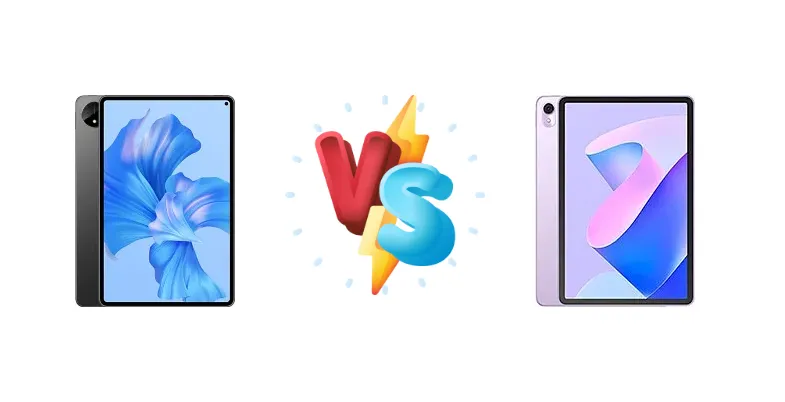
Huawei's MatePad series continues to impress, offering compelling Android tablet experiences. But with two models – the MatePad Pro 11 (2022) and the MatePad 11 (2023) – choosing the right one can be tricky. This comprehensive comparison breaks down the key differences to help you decide.
🏆 Quick Verdict
The MatePad Pro 11 (2022) offers a superior experience with its brighter display, faster charging, and potentially more powerful chipset (depending on the variant). However, the MatePad 11 (2023) might be a more budget-friendly option for those prioritizing core functionality and a slightly more modern design.
| Network |
|---|
| 2G bands | GSM 850 / 900 / 1800 / 1900 | N/A |
| 3G bands | HSDPA 800 / 850 / 900 / 1700(AWS) / 1900 / 2100 | N/A |
| 4G bands | LTE | N/A |
| EDGE | - | No |
| GPRS | - | No |
| Speed | HSPA, LTE - cellular model only | - |
| Technology | GSM / HSPA / LTE | No cellular connectivity |
| Launch |
|---|
| Announced | 2022, July 27 | 2023, March 23 |
| Status | Available. Released 2022, August 10 | Available. Released 2023, March 31 |
| Body |
|---|
| Dimensions | 249.2 x 160.4 x 5.9 mm (9.81 x 6.31 x 0.23 in) | 253.7 x 165.3 x 7.2 mm (9.99 x 6.51 x 0.28 in) |
| SIM | Nano-SIM (cellular model only) | No |
| Weight | 449 g (455 g cellular model) (15.84 oz) | 480 g (1.06 lb) |
| | Stylus support | Stylus support (magnetic) |
| Display |
|---|
| Resolution | 2560 x 1600 pixels, 16:10 ratio (~274 ppi density) | 2560 x 1600 pixels, 16:10 ratio (~275 ppi density) |
| Size | 11.0 inches, 350.9 cm2 (~87.8% screen-to-body ratio) | 11.0 inches, 348.3 cm2 (~83.1% screen-to-body ratio) |
| Type | OLED, 1B colors, 120Hz, 600 nits (typ) | IPS LCD, 120Hz |
| Platform |
|---|
| CPU | Octa-core (1x3.2 GHz Kryo 585 & 3x2.42 GHz Kryo 585 & 4x1.80 GHz Kryo 585) - GOT-W29Octa-core (1x2.84 GHz Cortex-X1 & 3x2.42 GHz Cortex-A78 & 4x1.80 GHz Cortex-A55) - GOT-W09, GOT-AL09, GOT-AL19 | Octa-core (1x3.2 GHz Kryo 585 & 3x2.42 GHz Kryo 585 & 4x1.80 GHz Kryo 585)Octa-core (1x2.84 GHz Cortex-A77 & 3x2.42 GHz Cortex-A77 & 4x1.80 GHz Cortex-A55) |
| Chipset | Qualcomm SM8250-AC Snapdragon 870 5G (7 nm) - GOT-W29Qualcomm SM8350 Snapdragon 888 (5 nm) - GOT-W09, GOT-AL09, GOT-AL19 | Qualcomm SM8250-AC Snapdragon 870 5G (7 nm)Qualcomm SM8250 Snapdragon 865 5G (7 nm+) |
| GPU | Adreno 650 - GOT-W29Adreno 660 - GOT-W09, GOT-AL09, GOT-AL19 | Adreno 650 |
| OS | HarmonyOS 3.0 | HarmonyOS 3.1 |
| Memory |
|---|
| Card slot | No | microSDXC (dedicated slot) |
| Internal | 128GB 8GB RAM, 256GB 8GB RAM, 512GB 12GB RAM | 128GB 6GB RAM, 128GB 8GB RAM, 256GB 8GB RAM |
| | UFS 3.1 | - |
| Main Camera |
|---|
| Dual | 13 MP, f/1.8, (wide), PDAF
8 MP, f/2.2, (ultrawide) | - |
| Features | LED flash, HDR, panorama | LED flash, HDR, panorama |
| Single | 16 MP, f/2.2 | 13 MP, f/1.8, PDAF |
| Video | 4K@30fps, 1080p@30fps | 4K@30fps, 1080p@30fps |
| Selfie camera |
|---|
| Single | 16 MP, f/2.2 | 8 MP, f/2.0 |
| Video | 1080p@30fps | 1080p@30fps |
| Sound |
|---|
| 3.5mm jack | No | No |
| 35mm jack | No | No |
| Loudspeaker | Yes, with stereo speakers (6 speakers) | Yes, with stereo speakers (4 speakers) |
| | - | Tuned by Harman Kardon |
| Comms |
|---|
| Bluetooth | 5.2, (5.1 for GOT-W29), A2DP, LE | 5.1, A2DP, LE |
| NFC | No | No |
| Positioning | GPS, GLONASS, BDS, GALILEO, QZSS - cellular model only | No |
| Radio | No | No |
| USB | USB Type-C 3.1, OTG | USB Type-C 3.1, OTG |
| WLAN | Wi-Fi 802.11 a/b/g/n/ac/6, tri-band (dual-band for GOT-W29), Wi-Fi Direct | Wi-Fi 802.11 a/b/g/n/ac/6, dual-band, Wi-Fi Direct |
| Features |
|---|
| Sensors | Accelerometer, gyro, proximity, compass | Accelerometer |
| Battery |
|---|
| Charging | 66W wired (GOT-W09, GOT-AL09, GOT-AL19)
40W wired (GOT-W29)
Reverse wired | 22.5W wired
5W reverse wired |
| Type | Li-Po 8300 mAh | Li-Po 7250 mAh |
| Misc |
|---|
| Colors | Golden Black, Galaxy Blue, Crystal White, Brocade White | Black, Blue, White, Purple |
| Models | GOT-W09, GOT-W29, GOT-AL09, GOT-AL19 | DBR-W10 |
| Price | About 500 EUR | About 300 EUR |
| Tests |
|---|
| Display |
Contrast ratio: Infinite (nominal) | - |
| Loudspeaker |
-23.5 LUFS (Very good)
| - |
| Performance |
AnTuTu: 780161 (v9)
GeekBench: 3685 (v5.1)
GFXBench: 37fps (ES 3.1 onscreen) | - |
Huawei MatePad Pro 11 (2022)
- Brighter Display (591 nits)
- Faster Charging (66W)
- Potentially More Powerful Chipset (Snapdragon 888 variant)
- Premium Build Quality
- Higher Price
- Potentially Less Modern Design
Huawei MatePad 11 (2023)
- More Affordable
- Slightly More Modern Design
- Reliable Performance for Everyday Tasks
- Slower Charging (22.5W)
- Less Bright Display
- Less Powerful Chipset (Snapdragon 865)
Display Comparison
The MatePad Pro 11 (2022) boasts a significantly brighter display, reaching 591 nits compared to the MatePad 11 (2023)'s likely lower brightness (typical tablet brightness is around 350-450 nits). Both feature 120Hz refresh rates for smooth scrolling, but the Pro's higher brightness provides better visibility in outdoor conditions and a more vibrant viewing experience. Both have excellent contrast ratios.
Camera Comparison
While neither tablet prioritizes camera quality, the MatePad Pro 11 (2022) generally has slightly better camera hardware. Expect similar performance in typical usage scenarios, with both capable of capturing decent photos and videos in good lighting conditions. Both lack advanced camera features.
Performance
The MatePad Pro 11 (2022) has two chipset options: Snapdragon 870 or Snapdragon 888. The Snapdragon 888 variant offers a noticeable performance boost over the MatePad 11 (2023)'s Snapdragon 865. Both tablets handle everyday tasks with ease, but the Pro (especially the 888 version) will excel in gaming and multitasking. The CPU differences are also notable, with the 888 having a Cortex-X1 core.
Battery Life
The MatePad Pro 11 (2022) supports 66W wired charging (or 40W for some variants), a significant advantage over the MatePad 11 (2023)'s 22.5W charging. This translates to much faster charging times. Battery capacity is likely similar between the two, but the faster charging of the Pro makes it more convenient.
Buying Guide
The Huawei MatePad Pro 11 (2022) is ideal for users who demand a premium display, fast charging, and potentially higher performance for demanding tasks like gaming or creative work. The Huawei MatePad 11 (2023) is a great choice for students, casual users, and those seeking a reliable tablet at a more accessible price point.
Frequently Asked Questions
❓ Is the Huawei MatePad Pro 11 (2022) worth the extra money?
If you prioritize a brighter display, faster charging, and potentially higher performance, then yes. The Pro offers a more premium experience. However, if you're on a budget, the MatePad 11 (2023) provides excellent value.
❓ Which chipset does the Huawei MatePad Pro 11 (2022) have?
It comes in two variants: one with the Snapdragon 870 and another with the Snapdragon 888. The 888 variant offers better performance.