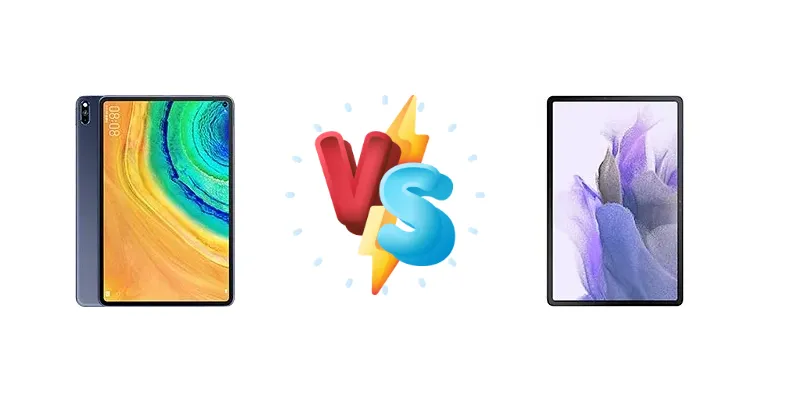
The tablet market offers a diverse range of options, but narrowing down the field can be challenging. We're pitting the 2019 Huawei MatePad Pro 10.8 5G against the Samsung Galaxy Tab S7 FE, two tablets targeting different segments with distinct approaches to performance and features. The MatePad Pro, despite its age, boasts a flagship Kirin 990 5G chipset, while the Tab S7 FE aims for a balance of features and affordability with the Snapdragon 750G (or 778G in the Wi-Fi model).
🏆 Quick Verdict
For users prioritizing raw performance and faster charging, the Huawei MatePad Pro 10.8 5G (2019) remains a compelling choice, despite its age. However, the Samsung Galaxy Tab S7 FE offers a more modern software experience and a brighter display, making it the better all-rounder for most users.
| Network |
|---|
| 2G bands | GSM 850 / 900 / 1800 / 1900 | GSM 850 / 900 / 1800 / 1900 |
| 3G bands | HSDPA 850 / 900 / 1900 / 2100 | HSDPA 850 / 900 / 1700(AWS) / 1900 / 2100 |
| 4G bands | 1, 3, 4, 5, 8, 19, 34, 38, 39, 40, 41 | 1, 2, 3, 4, 5, 7, 8, 12, 13, 17, 20, 25, 26, 28, 32, 38, 40, 41, 66 |
| 5G bands | SA/NSA | 1, 3, 5, 7, 8, 20, 28, 38, 40, 41, 77, 78 SA/NSA/Sub6 |
| Speed | HSPA, LTE, 5G - cellular model only | HSPA, LTE, 5G - cellular model only |
| Technology | GSM / HSPA / LTE / 5G | GSM / HSPA / LTE / 5G |
| Launch |
|---|
| Announced | 2020, February 24. Released 2020, May 27 | 2021, May 25 |
| Status | Discontinued | Available. Released 2021, June 18 |
| Body |
|---|
| Build | Glass front, aluminum back, aluminum frame | Glass front, aluminum back, aluminum frame |
| Dimensions | 246 x 159 x 7.2 mm (9.69 x 6.26 x 0.28 in) | 284.8 x 185 x 6.3 mm (11.21 x 7.28 x 0.25 in) |
| SIM | Nano-SIM (cellular model only) | Nano-SIM (cellular model only) |
| Weight | 460 g (1.01 lb) | 608 g (1.34 lb) |
| | Stylus support (magnetic) | Stylus support |
| Display |
|---|
| Resolution | 2560 x 1600 pixels, 16:10 ratio (~280 ppi density) | 1600 x 2560 pixels, 16:10 ratio (~243 ppi density) |
| Size | 10.8 inches, 338.2 cm2 (~86.5% screen-to-body ratio) | 12.4 inches, 445.8 cm2 (~84.6% screen-to-body ratio) |
| Type | IPS LCD, 540 nits (typ) | TFT LCD |
| Platform |
|---|
| CPU | Octa-core (2x2.86 GHz Cortex-A76 & 2x2.36 GHz Cortex-A76 & 4x1.95 GHz Cortex-A55) | Octa-core (2x2.2 GHz Kryo 570 & 6x1.8 GHz Kryo 570) - 5G modelOcta-core (1x2.4 GHz Cortex-A78 & 3x2.2 GHz Cortex-A78 & 4x1.9 GHz Cortex-A55) - Wi-Fi model |
| Chipset | Kirin 990 5G (7 nm+) | Qualcomm SM7225 Snapdragon 750G 5G (8 nm) - 5G modelQualcomm SM7325 Snapdragon 778G 5G (6 nm) - Wi-Fi model |
| GPU | Mali-G76 MP16 | Adreno 619 - 5G modelAdreno 642L - Wi-Fi model |
| OS | Android 10, EMUI 10, no Google Play Services | Android 11, upgradable to Android 14, One UI 6 |
| Memory |
|---|
| Card slot | Nano Memory (dedicated slot) | microSDXC (dedicated slot) |
| Internal | 128GB 6GB RAM, 256GB 8GB RAM, 512GB 8GB RAM | 64GB 4GB RAM, 128GB 6GB RAM, 256GB 8GB RAM |
| | UFS 3.0 | - |
| Main Camera |
|---|
| Features | LED flash, HDR, panorama | - |
| Single | 13 MP, f/1.8, PDAF | 8 MP, AF |
| Video | 4K@30fps, 1080p@30fps | 1080p@30fps |
| Selfie camera |
|---|
| Features | HDR | - |
| Single | 8 MP, f/2.0 | 5 MP |
| Video | 1080p@30fps | 1080p@30fps |
| Sound |
|---|
| 3.5mm jack | No | No |
| 35mm jack | No | No |
| Loudspeaker | Yes, with stereo speakers (4 speakers) | Yes, with stereo speakers |
| | Tuned by Harman Kardon | Tuned by AKG |
| Comms |
|---|
| Bluetooth | 5.1, A2DP, LE | 5.2, A2DP, LE (Wi-Fi), 5.2, A2DP, LE (5G) |
| Infrared port | Yes | - |
| NFC | No | No |
| Positioning | GPS, GLONASS, GALILEO, BDS, QZSS - cellular model only | GPS, GLONASS, BDS, GALILEO - cellular model only |
| Radio | No | No |
| USB | USB Type-C 3.1, OTG | USB Type-C 3.2, magnetic connector |
| WLAN | Wi-Fi 802.11 a/b/g/n/ac, dual-band, Wi-Fi Direct | Wi-Fi 802.11 a/b/g/n/ac/6 (Wi-Fi), Wi-Fi 802.11 a/b/g/n/ac (5G) |
| Features |
|---|
| Sensors | Accelerometer, gyro, proximity, compass | Accelerometer, proximity, compass, gyro (5G model only) |
| | - | Samsung DeX |
| Battery |
|---|
| Charging | 40W wired
27W wireless
7.5W reverse wireless | 45W wired, 100% in 190 min |
| Type | Li-Po 7250 mAh | Li-Po 10090 mAh |
| Misc |
|---|
| Colors | Gray, White, Green, Orange | Mystic Black, Mystic Silver, Mystic Green, Mystic Pink |
| Models | A51w | SM-T730, SM-T733, SM-T736B, SM-T735 |
| Price | About 550 EUR | About 650 EUR |
| SAR EU | - | 1.15 W/kg (body) |
| Tests |
|---|
| Display | - | Contrast ratio: 1886:1 (nominal) |
| Loudspeaker | - | -27.2 LUFS (Good) |
| Performance | - | AnTuTu: 292530 (v8), 355430 (v9)
GeekBench: 1904 (v5.1)
GFXBench: 9.7fps (ES 3.1 onscreen) |
Huawei MatePad Pro 10.8 5G (2019)
- Faster charging speeds (40W wired, 27W wireless)
- Reverse wireless charging capability
- Potentially higher peak CPU performance in specific workloads
- Older chipset architecture (Kirin 990)
- Potentially outdated software support
- Display brightness not specified
Samsung Galaxy Tab S7 FE
- Brighter display (522 nits)
- More modern Snapdragon 750G/778G chipset
- More current software ecosystem
- Slower charging speed (45W wired, 190 min to 100%)
- No wireless charging
- Less powerful CPU compared to Kirin 990 in some scenarios
Display Comparison
The Samsung Galaxy Tab S7 FE boasts a brighter display, reaching a measured 522 nits, compared to the Huawei MatePad Pro 10.8’s unspecified peak brightness. Both share a similar 1886:1 contrast ratio, suggesting comparable black levels and color depth. However, the Tab S7 FE’s higher brightness is a significant advantage for outdoor visibility. While the MatePad Pro’s display quality is likely good, Samsung’s measured data provides a concrete advantage for users who frequently use their tablets in bright environments. The lack of refresh rate information for the MatePad Pro also puts it at a disadvantage against potentially smoother displays found in newer tablets.
Camera Comparison
Neither tablet is a photography powerhouse, but the available information suggests a slight edge to the Tab S7 FE. While specific camera specs are missing for the MatePad Pro, the Tab S7 FE’s focus on a functional camera setup for video calls and document scanning is evident. The absence of detailed camera information for the MatePad Pro suggests it wasn’t a primary focus during its development. Users shouldn’t expect flagship-level image quality from either device.
Performance
The chipset is where the most significant difference lies. The Huawei MatePad Pro 10.8 5G utilizes the Kirin 990 5G (7nm+), featuring a complex CPU configuration with both Cortex-A76 cores at different clock speeds. This architecture, while powerful for its time, is built on an older process node than the Snapdragon 750G (8nm) or 778G (6nm) found in the Tab S7 FE. The Snapdragon 778G, in particular, offers a more efficient Cortex-A78 based CPU, potentially leading to better sustained performance and thermal management. The Tab S7 FE’s CPU configuration, with its single high-performance Cortex-A78 core, is optimized for responsiveness. While the Kirin 990 might excel in multi-threaded tasks, the Snapdragon 778G’s efficiency could translate to longer battery life during typical usage.
Battery Life
The Huawei MatePad Pro 10.8 5G stands out with its impressive charging capabilities: 40W wired, 27W wireless, and even 7.5W reverse wireless charging. The Samsung Galaxy Tab S7 FE offers 45W wired charging, taking approximately 190 minutes to reach 100%. While the Tab S7 FE’s charging speed is respectable, the MatePad Pro’s faster wired and wireless options provide greater convenience. The inclusion of reverse wireless charging on the MatePad Pro is a unique feature, allowing it to charge other devices wirelessly, a capability the Tab S7 FE lacks.
Buying Guide
Buy the Huawei MatePad Pro 10.8 5G (2019) if you need a tablet with strong processing power for demanding tasks like video editing or gaming, and value the convenience of 40W wired and 27W wireless charging. Buy the Samsung Galaxy Tab S7 FE if you prefer a tablet with a brighter, more easily visible display, a more current software ecosystem, and a lower price point for everyday productivity and entertainment.
Frequently Asked Questions
❓ Does the Kirin 990 in the MatePad Pro 10.8 5G suffer from significant thermal throttling during extended gaming sessions?
While the Kirin 990 is a capable chipset, its 7nm+ process node is less efficient than the 8nm or 6nm nodes used in the Snapdragon 750G/778G. This means the MatePad Pro is more likely to experience thermal throttling during prolonged, demanding tasks like gaming, potentially leading to reduced performance over time. The Tab S7 FE, with its more efficient Snapdragon chipsets, is likely to maintain more consistent performance.
❓ Which tablet is better suited for taking handwritten notes with a stylus?
Both tablets support styluses, but Samsung’s S Pen integration is generally considered more refined. The Tab S7 FE’s software offers a more seamless note-taking experience with features like screen-off memo and palm rejection. While the MatePad Pro also supports a stylus, the software experience may not be as polished or feature-rich.
❓ Is the 5G connectivity on either tablet truly useful for most users?
The usefulness of 5G connectivity depends heavily on your location and data plan. In areas with robust 5G coverage, it can provide faster download and upload speeds. However, for most users, Wi-Fi remains the primary connection method. The 5G capability adds to the cost of the tablets and may not be essential for everyone.