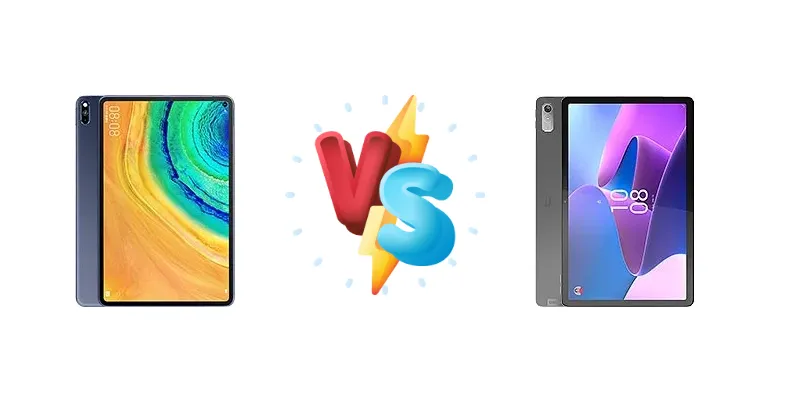
The tablet market has evolved rapidly since the 2019 launch of the Huawei MatePad Pro 10.8 5G. Now, Lenovo enters the arena with the Tab P11 Pro Gen 2, boasting a newer chipset and updated features. This comparison dissects the key differences between these two devices, helping you determine which tablet best suits your needs, considering the age difference and technological advancements.
🏆 Quick Verdict
For most users, the Lenovo Tab P11 Pro Gen 2 is the better choice. Its Mediatek Kompanio 1300T, built on a 6nm process, offers improved efficiency and performance compared to the Huawei’s older Kirin 990 5G. While the MatePad Pro 10.8 5G offers faster wired and wireless charging, the Lenovo’s more modern architecture provides a more future-proof experience.
| Network |
|---|
| 2G bands | GSM 850 / 900 / 1800 / 1900 | GSM 850 / 900 / 1800 / 1900 |
| 3G bands | HSDPA 850 / 900 / 1900 / 2100 | HSDPA 850 / 900 / 1900 / 2100 |
| 4G bands | 1, 3, 4, 5, 8, 19, 34, 38, 39, 40, 41 | LTE |
| 5G bands | SA/NSA | - |
| Speed | HSPA, LTE, 5G - cellular model only | HSPA, LTE - cellular model only |
| Technology | GSM / HSPA / LTE / 5G | GSM / HSPA / LTE |
| Launch |
|---|
| Announced | 2020, February 24. Released 2020, May 27 | 2022, September 01 |
| Status | Discontinued | Available. Released 2022, September 01 |
| Body |
|---|
| Build | Glass front, aluminum back, aluminum frame | Glass front, plastic back, plastic frame |
| Dimensions | 246 x 159 x 7.2 mm (9.69 x 6.26 x 0.28 in) | 263.7 x 166.7 x 6.8 mm (10.38 x 6.56 x 0.27 in) |
| SIM | Nano-SIM (cellular model only) | Nano-SIM (cellular model only) |
| Weight | 460 g (1.01 lb) | 480 g (1.06 lb) |
| | Stylus support (magnetic) | Stylus support (magnetic) |
| Display |
|---|
| Resolution | 2560 x 1600 pixels, 16:10 ratio (~280 ppi density) | 1536 x 2560 pixels, 5:3 ratio (~267 ppi density) |
| Size | 10.8 inches, 338.2 cm2 (~86.5% screen-to-body ratio) | 11.2 inches, 357.0 cm2 (~81.2% screen-to-body ratio) |
| Type | IPS LCD, 540 nits (typ) | OLED, HDR10+, Dolby Vision, 120Hz, 420 nits (typ), 600 nits (peak) |
| Platform |
|---|
| CPU | Octa-core (2x2.86 GHz Cortex-A76 & 2x2.36 GHz Cortex-A76 & 4x1.95 GHz Cortex-A55) | Octa-core (4x2.6 GHz Cortex-A78 & 4x2.0 GHz Cortex-A55) |
| Chipset | Kirin 990 5G (7 nm+) | Mediatek MT8797 Kompanio 1300T (6 nm) |
| GPU | Mali-G76 MP16 | Mali-G77 MC9 |
| OS | Android 10, EMUI 10, no Google Play Services | Android 12, upgradable to Android 13 |
| Memory |
|---|
| Card slot | Nano Memory (dedicated slot) | microSDXC (dedicated slot) |
| Internal | 128GB 6GB RAM, 256GB 8GB RAM, 512GB 8GB RAM | 128GB 4GB RAM, 128GB 6GB RAM, 256GB 8GB RAM |
| | UFS 3.0 | UFS 3.1 |
| Main Camera |
|---|
| Features | LED flash, HDR, panorama | LED flash |
| Single | 13 MP, f/1.8, PDAF | 13 MP, f/2.4, (wide), AF |
| Video | 4K@30fps, 1080p@30fps | 1080p@30fps |
| Selfie camera |
|---|
| Features | HDR | - |
| Single | 8 MP, f/2.0 | 8 MP |
| Video | 1080p@30fps | 1080p@30fps |
| Sound |
|---|
| 3.5mm jack | No | No |
| 35mm jack | No | No |
| Loudspeaker | Yes, with stereo speakers (4 speakers) | Yes, with stereo speakers (4 speakers) |
| | Tuned by Harman Kardon | Tuned by JBL |
| Comms |
|---|
| Bluetooth | 5.1, A2DP, LE | 5.1, A2DP, LE |
| Infrared port | Yes | - |
| NFC | No | No |
| Positioning | GPS, GLONASS, GALILEO, BDS, QZSS - cellular model only | GPS, GLONASS - cellular model only |
| Radio | No | No |
| USB | USB Type-C 3.1, OTG | USB Type-C 3.0, OTG, magnetic connector, video output |
| WLAN | Wi-Fi 802.11 a/b/g/n/ac, dual-band, Wi-Fi Direct | Wi-Fi 802.11 a/b/g/n/ac/6, dual-band, Wi-Fi Direct |
| Features |
|---|
| Sensors | Accelerometer, gyro, proximity, compass | Accelerometer, gyro, proximity, compass |
| Battery |
|---|
| Charging | 40W wired
27W wireless
7.5W reverse wireless | 20W wired, QC3 |
| Type | Li-Po 7250 mAh | Li-Po 8200 mAh |
| Misc |
|---|
| Colors | Gray, White, Green, Orange | Storm Grey, Oat |
| Models | A51w | ZAB50194GB, ZAB50043SE |
| Price | About 550 EUR | About 500 EUR |
| Tests |
|---|
| Performance | - |
AnTuTu: 616573 (v9)
GeekBench: 2827 (v5.1) |
Huawei MatePad Pro 10.8 5G (2019)
- Faster wired and wireless charging (40W/27W)
- Integrated 5G connectivity (a feature not all tablets have)
- Potentially lower price due to age
- Older chipset (Kirin 990 5G)
- Less efficient processor (7nm+ vs 6nm)
- Potentially shorter software support lifecycle
Lenovo Tab P11 Pro Gen 2
- More modern and efficient chipset (Kompanio 1300T)
- 6nm process for better thermal management
- Likely longer software support
- Improved CPU architecture (Cortex-A78)
- Slower charging speeds (20W)
- May be more expensive than the older Huawei model
- 5G connectivity not confirmed
Display Comparison
While both tablets feature 10.8-inch displays, the provided data doesn't detail panel technology (LTPO, OLED, IPS) or resolution. However, the age difference suggests the Lenovo Tab P11 Pro Gen 2 likely benefits from advancements in color accuracy and brightness. The Huawei MatePad Pro 10.8 5G, being an older model, may exhibit wider bezels. Without specific display specs, it's reasonable to assume the Lenovo offers a more visually refined experience.
Camera Comparison
The provided data lacks camera specifications for both devices. Given the tablet market's focus isn't primarily on photography, it's likely both feature competent but not exceptional camera systems. We can assume the Lenovo, being a newer device, may benefit from improved image processing algorithms. Without sensor size or aperture information, a definitive comparison is impossible, but the Lenovo likely has a slight edge due to software optimizations.
Performance
The core difference lies in the chipsets. The Huawei MatePad Pro 10.8 5G utilizes the Kirin 990 5G (7nm+), featuring a tri-cluster CPU configuration with Cortex-A76 cores. The Lenovo Tab P11 Pro Gen 2, however, employs the Mediatek Kompanio 1300T (6nm) with Cortex-A78 cores. The 6nm process node of the Kompanio 1300T inherently offers better power efficiency and thermal characteristics than the 7nm+ Kirin 990 5G. The A78 cores in the Lenovo also represent an architectural improvement over the A76 cores in the Huawei, translating to better single-core performance. This means the Lenovo will likely handle demanding tasks and multitasking more smoothly.
Battery Life
The Huawei MatePad Pro 10.8 5G boasts a significant charging advantage with 40W wired, 27W wireless, and 7.5W reverse wireless charging. The Lenovo Tab P11 Pro Gen 2 is limited to 20W wired charging with QC3. However, the more efficient Mediatek Kompanio 1300T chipset in the Lenovo may offset the charging disparity by offering longer battery life per charge. While the Huawei charges faster, the Lenovo may require charging less frequently.
Buying Guide
Buy the Huawei MatePad Pro 10.8 5G (2019) if you prioritize extremely fast charging speeds (40W wired, 27W wireless) and can find it at a significantly discounted price. Buy the Lenovo Tab P11 Pro Gen 2 if you value a more efficient processor, a potentially longer software support lifecycle, and a more modern tablet experience overall.
Frequently Asked Questions
❓ Will the Kirin 990 5G struggle with demanding games like Genshin Impact?
The Kirin 990 5G is a capable chipset, but its age and the architectural advantages of the Kompanio 1300T suggest the Lenovo Tab P11 Pro Gen 2 will deliver a smoother and more consistent gaming experience, especially with graphically intensive titles. The 6nm process will also help mitigate thermal throttling.
❓ How much does the charging speed difference *really* matter in day-to-day use?
While 40W charging on the Huawei is impressive, the Lenovo's 20W charging is still respectable. The Kompanio 1300T's efficiency means you may not need to top up as frequently. However, if you frequently run out of battery and need a quick boost, the Huawei's faster charging is a significant advantage.
❓ Is the lack of detailed camera specs a major concern?
For tablets, camera quality is often secondary to other features. Both devices likely offer adequate cameras for video calls and casual snapshots. Unless you plan to heavily rely on the tablet for photography, the lack of specific camera details shouldn't be a dealbreaker.