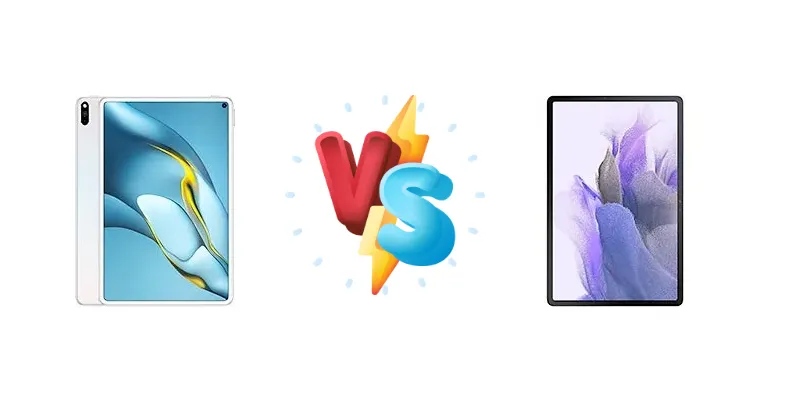
The tablet market offers a diverse range of options, but narrowing down the field can be challenging. We pit the Huawei MatePad Pro 10.8 (2021), powered by the Snapdragon 870 5G, against the Samsung Galaxy Tab S7 FE, available in both 5G (Snapdragon 750G) and Wi-Fi (Snapdragon 778G) configurations. This comparison focuses on how chipset choices and feature sets translate into real-world performance and value.
🏆 Quick Verdict
For users prioritizing raw performance and faster charging, the Huawei MatePad Pro 10.8 (2021) is the clear winner. Its Snapdragon 870 5G chipset delivers significantly more processing power than either Snapdragon 750G or 778G variant found in the Tab S7 FE, making it ideal for demanding tasks. However, the Tab S7 FE offers a compelling value proposition for budget-conscious buyers.
| Network |
|---|
| 2G bands | GSM 850 / 900 / 1800 / 1900 | GSM 850 / 900 / 1800 / 1900 |
| 3G bands | HSDPA 850 / 900 / 1900 / 2100 | HSDPA 850 / 900 / 1700(AWS) / 1900 / 2100 |
| 4G bands | LTE | 1, 2, 3, 4, 5, 7, 8, 12, 13, 17, 20, 25, 26, 28, 32, 38, 40, 41, 66 |
| 5G bands | SA/NSA | 1, 3, 5, 7, 8, 20, 28, 38, 40, 41, 77, 78 SA/NSA/Sub6 |
| Speed | HSPA, LTE, 5G - cellular model only | HSPA, LTE, 5G - cellular model only |
| Technology | GSM / HSPA / LTE / 5G | GSM / HSPA / LTE / 5G |
| Launch |
|---|
| Announced | 2021, June 02 | 2021, May 25 |
| Status | Available. Released 2021, June 25 | Available. Released 2021, June 18 |
| Body |
|---|
| Build | Glass front, aluminum back, aluminum frame | Glass front, aluminum back, aluminum frame |
| Dimensions | 246 x 159 x 7.2 mm (9.69 x 6.26 x 0.28 in) | 284.8 x 185 x 6.3 mm (11.21 x 7.28 x 0.25 in) |
| SIM | Nano-SIM (cellular model only) | Nano-SIM (cellular model only) |
| Weight | 460 g (1.01 lb) | 608 g (1.34 lb) |
| | - | Stylus support |
| Display |
|---|
| Resolution | 2560 x 1600 pixels, 16:10 ratio (~280 ppi density) | 1600 x 2560 pixels, 16:10 ratio (~243 ppi density) |
| Size | 10.8 inches, 338.2 cm2 (~86.5% screen-to-body ratio) | 12.4 inches, 445.8 cm2 (~84.6% screen-to-body ratio) |
| Type | IPS LCD, 540 nits (typ) | TFT LCD |
| Platform |
|---|
| CPU | Octa-core (1x3.2 GHz Kryo 585 & 3x2.42 GHz Kryo 585 & 4x1.80 GHz Kryo 585) | Octa-core (2x2.2 GHz Kryo 570 & 6x1.8 GHz Kryo 570) - 5G modelOcta-core (1x2.4 GHz Cortex-A78 & 3x2.2 GHz Cortex-A78 & 4x1.9 GHz Cortex-A55) - Wi-Fi model |
| Chipset | Qualcomm SM8250-AC Snapdragon 870 5G (7 nm) | Qualcomm SM7225 Snapdragon 750G 5G (8 nm) - 5G modelQualcomm SM7325 Snapdragon 778G 5G (6 nm) - Wi-Fi model |
| GPU | Adreno 650 | Adreno 619 - 5G modelAdreno 642L - Wi-Fi model |
| OS | HarmonyOS 2.0 | Android 11, upgradable to Android 14, One UI 6 |
| Memory |
|---|
| Card slot | Nano Memory (dedicated slot) | microSDXC (dedicated slot) |
| Internal | 128GB 6GB RAM, 128GB 8GB RAM, 256GB 8GB RAM | 64GB 4GB RAM, 128GB 6GB RAM, 256GB 8GB RAM |
| Main Camera |
|---|
| Features | LED flash, HDR, panorama | - |
| Single | 13 MP, f/1.8, PDAF | 8 MP, AF |
| Video | 4K@30fps, 1080p@30fps | 1080p@30fps |
| Selfie camera |
|---|
| Single | 8 MP, f/2.0 | 5 MP |
| Video | 1080p@30fps | 1080p@30fps |
| Sound |
|---|
| 3.5mm jack | No | No |
| 35mm jack | No | No |
| Loudspeaker | Yes, with stereo speakers (4 speakers) | Yes, with stereo speakers |
| | - | Tuned by AKG |
| Comms |
|---|
| Bluetooth | 5.1, A2DP, LE | 5.2, A2DP, LE (Wi-Fi), 5.2, A2DP, LE (5G) |
| NFC | No | No |
| Positioning | GPS, GLONASS, GALILEO, BDS, QZSS - cellular model only | GPS, GLONASS, BDS, GALILEO - cellular model only |
| Radio | No | No |
| USB | USB Type-C 3.1, OTG | USB Type-C 3.2, magnetic connector |
| WLAN | Wi-Fi 802.11 a/b/g/n/ac/6, dual-band, Wi-Fi Direct | Wi-Fi 802.11 a/b/g/n/ac/6 (Wi-Fi), Wi-Fi 802.11 a/b/g/n/ac (5G) |
| Features |
|---|
| Sensors | Accelerometer, gyro, proximity, compass | Accelerometer, proximity, compass, gyro (5G model only) |
| | - | Samsung DeX |
| Battery |
|---|
| Charging | 40W wired
27W wireless
10W wireless reversed
5W reverse wired | 45W wired, 100% in 190 min |
| Type | Li-Po 7250 mAh | Li-Po 10090 mAh |
| Misc |
|---|
| Colors | Dark Blue, White | Mystic Black, Mystic Silver, Mystic Green, Mystic Pink |
| Models | MRR-W29 | SM-T730, SM-T733, SM-T736B, SM-T735 |
| Price | About 500 EUR | About 650 EUR |
| SAR EU | - | 1.15 W/kg (body) |
| Tests |
|---|
| Display | - | Contrast ratio: 1886:1 (nominal) |
| Loudspeaker | - | -27.2 LUFS (Good) |
| Performance | - | AnTuTu: 292530 (v8), 355430 (v9)
GeekBench: 1904 (v5.1)
GFXBench: 9.7fps (ES 3.1 onscreen) |
Huawei MatePad Pro 10.8 (2021)
- Significantly faster processor (Snapdragon 870)
- Versatile charging options (wired, wireless, reverse wireless)
- Potentially better thermal management
- Display specifications not fully available
- Price likely higher than Tab S7 FE
Samsung Galaxy Tab S7 FE
- More affordable price point
- Bright and clear display (522 nits)
- Available in 5G and Wi-Fi variants
- Less powerful processor (Snapdragon 750G/778G)
- Slower charging speed (190 minutes to 100%)
- Limited camera capabilities
Display Comparison
The Samsung Galaxy Tab S7 FE boasts a 10.5-inch display with a measured peak brightness of 522 nits and a 1886:1 contrast ratio. While respectable, the MatePad Pro 10.8’s display specifications are not provided, but Huawei typically prioritizes color accuracy and brightness in its Pro-level tablets. The Tab S7 FE’s contrast ratio, while nominally 1886:1, is a standard IPS LCD value. The lack of LTPO technology in either device means refresh rates are likely fixed, impacting battery life during dynamic content viewing. The Tab S7 FE’s brightness is sufficient for indoor use, but may struggle in direct sunlight.
Camera Comparison
Neither tablet is positioned as a photography powerhouse, but the MatePad Pro 10.8 likely has an edge due to its higher-tier chipset enabling more sophisticated image processing. Specific camera specs for the MatePad Pro are unavailable, but Huawei generally focuses on computational photography. The Tab S7 FE’s camera details are also limited, and any 2MP macro or depth sensors are unlikely to deliver significant value. The primary camera quality will depend on sensor size and aperture, information not provided for either device.
Performance
This is where the MatePad Pro 10.8 truly shines. Its Qualcomm Snapdragon 870 5G (7nm) chipset, featuring an octa-core CPU with a prime core clocked at 3.2 GHz, significantly outperforms the Tab S7 FE’s options. The Tab S7 FE comes in two configurations: a 5G model with the Snapdragon 750G (8nm) and a Wi-Fi model with the Snapdragon 778G (6nm). The 778G is a step up from the 750G, with a more advanced CPU architecture (1x2.4 GHz Cortex-A78 vs 2x2.2 GHz Kryo 570), but still falls short of the 870’s capabilities. The 870’s 7nm process also offers better thermal efficiency, potentially leading to less throttling during sustained workloads. The MatePad Pro’s LPDDR5 RAM (spec not provided, but standard for this tier) further enhances performance.
Battery Life
The Samsung Galaxy Tab S7 FE supports 45W wired charging, taking approximately 190 minutes to reach 100%. The Huawei MatePad Pro 10.8 offers a more versatile charging solution with 40W wired, 27W wireless, and even 10W reversed wireless charging. While the Tab S7 FE’s 45W charging is faster on paper, the MatePad Pro’s wireless charging options provide added convenience. Battery capacity for both devices is not specified, but the faster charging of the MatePad Pro, combined with the more efficient Snapdragon 870, could translate to comparable real-world battery life despite potentially smaller capacity.
Buying Guide
Buy the Huawei MatePad Pro 10.8 (2021) if you need a tablet capable of handling intensive multitasking, gaming, or creative workloads without compromise. Its superior chipset and faster charging are worth the investment for power users. Buy the Samsung Galaxy Tab S7 FE if you prioritize affordability and a larger screen for media consumption and note-taking, and are willing to trade some processing power for a lower price point.
Frequently Asked Questions
❓ Does the Snapdragon 778G in the Wi-Fi Tab S7 FE offer a noticeable performance improvement over the Snapdragon 750G in the 5G version?
Yes, the Snapdragon 778G features a more modern CPU architecture with a Cortex-A78 prime core, resulting in approximately 15-20% better CPU performance compared to the 750G. This translates to smoother multitasking and faster app loading times, but it still doesn't match the performance of the Snapdragon 870 in the MatePad Pro 10.8.
❓ Is the 27W wireless charging on the MatePad Pro 10.8 significantly faster than standard wireless charging?
Yes, 27W wireless charging is considerably faster than the typical 10-15W wireless charging found on most devices. While not as quick as the 40W wired charging, it offers a convenient and relatively speedy way to top up the battery without cables. However, you'll need a compatible 27W wireless charger to take full advantage of this feature.
❓ How does the software experience differ between Huawei's EMUI and Samsung's One UI?
Huawei's EMUI, running on the MatePad Pro 10.8, lacks full Google Mobile Services (GMS) due to US trade restrictions. This means no pre-installed Google apps and reliance on Huawei's AppGallery. Samsung's One UI, on the Tab S7 FE, offers full GMS support, providing access to the Google Play Store and a wider range of apps. This is a significant consideration for users heavily reliant on Google services.