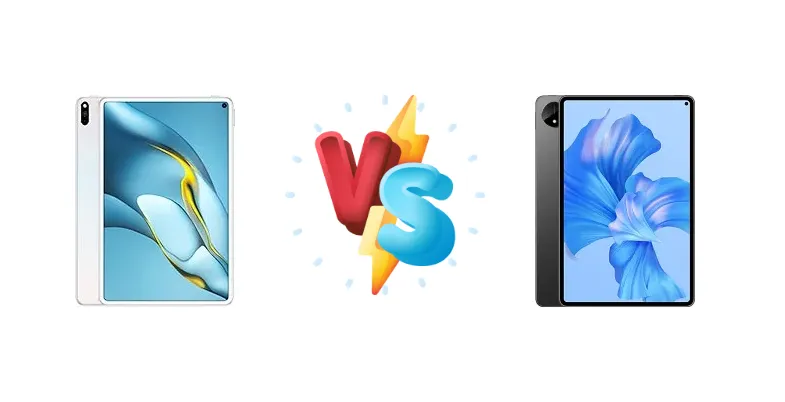
The Huawei MatePad Pro series consistently delivers premium Android tablet experiences. But with new models arriving, choosing the right one can be tricky. This comprehensive comparison pits the MatePad Pro 10.8 (2021) against the MatePad Pro 11 (2022) to help you make an informed decision.
🏆 Quick Verdict
The MatePad Pro 11 (2022) generally edges out the 10.8 thanks to its brighter display, faster charging (on some models), and potentially more powerful chipset (depending on the variant). However, the 10.8 remains a strong contender, especially if you prioritize a slightly smaller form factor and a more budget-friendly price.
| Network |
|---|
| 2G bands | GSM 850 / 900 / 1800 / 1900 | GSM 850 / 900 / 1800 / 1900 |
| 3G bands | HSDPA 850 / 900 / 1900 / 2100 | HSDPA 800 / 850 / 900 / 1700(AWS) / 1900 / 2100 |
| 4G bands | LTE | LTE |
| 5G bands | SA/NSA | - |
| Speed | HSPA, LTE, 5G - cellular model only | HSPA, LTE - cellular model only |
| Technology | GSM / HSPA / LTE / 5G | GSM / HSPA / LTE |
| Launch |
|---|
| Announced | 2021, June 02 | 2022, July 27 |
| Status | Available. Released 2021, June 25 | Available. Released 2022, August 10 |
| Body |
|---|
| Build | Glass front, aluminum back, aluminum frame | - |
| Dimensions | 246 x 159 x 7.2 mm (9.69 x 6.26 x 0.28 in) | 249.2 x 160.4 x 5.9 mm (9.81 x 6.31 x 0.23 in) |
| SIM | Nano-SIM (cellular model only) | Nano-SIM (cellular model only) |
| Weight | 460 g (1.01 lb) | 449 g (455 g cellular model) (15.84 oz) |
| | - | Stylus support |
| Display |
|---|
| Resolution | 2560 x 1600 pixels, 16:10 ratio (~280 ppi density) | 2560 x 1600 pixels, 16:10 ratio (~274 ppi density) |
| Size | 10.8 inches, 338.2 cm2 (~86.5% screen-to-body ratio) | 11.0 inches, 350.9 cm2 (~87.8% screen-to-body ratio) |
| Type | IPS LCD, 540 nits (typ) | OLED, 1B colors, 120Hz, 600 nits (typ) |
| Platform |
|---|
| CPU | Octa-core (1x3.2 GHz Kryo 585 & 3x2.42 GHz Kryo 585 & 4x1.80 GHz Kryo 585) | Octa-core (1x3.2 GHz Kryo 585 & 3x2.42 GHz Kryo 585 & 4x1.80 GHz Kryo 585) - GOT-W29Octa-core (1x2.84 GHz Cortex-X1 & 3x2.42 GHz Cortex-A78 & 4x1.80 GHz Cortex-A55) - GOT-W09, GOT-AL09, GOT-AL19 |
| Chipset | Qualcomm SM8250-AC Snapdragon 870 5G (7 nm) | Qualcomm SM8250-AC Snapdragon 870 5G (7 nm) - GOT-W29Qualcomm SM8350 Snapdragon 888 (5 nm) - GOT-W09, GOT-AL09, GOT-AL19 |
| GPU | Adreno 650 | Adreno 650 - GOT-W29Adreno 660 - GOT-W09, GOT-AL09, GOT-AL19 |
| OS | HarmonyOS 2.0 | HarmonyOS 3.0 |
| Memory |
|---|
| Card slot | Nano Memory (dedicated slot) | No |
| Internal | 128GB 6GB RAM, 128GB 8GB RAM, 256GB 8GB RAM | 128GB 8GB RAM, 256GB 8GB RAM, 512GB 12GB RAM |
| | - | UFS 3.1 |
| Main Camera |
|---|
| Dual | - | 13 MP, f/1.8, (wide), PDAF
8 MP, f/2.2, (ultrawide) |
| Features | LED flash, HDR, panorama | LED flash, HDR, panorama |
| Single | 13 MP, f/1.8, PDAF | 16 MP, f/2.2 |
| Video | 4K@30fps, 1080p@30fps | 4K@30fps, 1080p@30fps |
| Selfie camera |
|---|
| Single | 8 MP, f/2.0 | 16 MP, f/2.2 |
| Video | 1080p@30fps | 1080p@30fps |
| Sound |
|---|
| 3.5mm jack | No | No |
| 35mm jack | No | No |
| Loudspeaker | Yes, with stereo speakers (4 speakers) | Yes, with stereo speakers (6 speakers) |
| Comms |
|---|
| Bluetooth | 5.1, A2DP, LE | 5.2, (5.1 for GOT-W29), A2DP, LE |
| NFC | No | No |
| Positioning | GPS, GLONASS, GALILEO, BDS, QZSS - cellular model only | GPS, GLONASS, BDS, GALILEO, QZSS - cellular model only |
| Radio | No | No |
| USB | USB Type-C 3.1, OTG | USB Type-C 3.1, OTG |
| WLAN | Wi-Fi 802.11 a/b/g/n/ac/6, dual-band, Wi-Fi Direct | Wi-Fi 802.11 a/b/g/n/ac/6, tri-band (dual-band for GOT-W29), Wi-Fi Direct |
| Features |
|---|
| Sensors | Accelerometer, gyro, proximity, compass | Accelerometer, gyro, proximity, compass |
| Battery |
|---|
| Charging | 40W wired
27W wireless
10W wireless reversed
5W reverse wired | 66W wired (GOT-W09, GOT-AL09, GOT-AL19)
40W wired (GOT-W29)
Reverse wired |
| Type | Li-Po 7250 mAh | Li-Po 8300 mAh |
| Misc |
|---|
| Colors | Dark Blue, White | Golden Black, Galaxy Blue, Crystal White, Brocade White |
| Models | MRR-W29 | GOT-W09, GOT-W29, GOT-AL09, GOT-AL19 |
| Price | About 500 EUR | About 500 EUR |
| Tests |
|---|
| Display | - |
Contrast ratio: Infinite (nominal) |
| Loudspeaker | - |
-23.5 LUFS (Very good)
|
| Performance | - |
AnTuTu: 780161 (v9)
GeekBench: 3685 (v5.1)
GFXBench: 37fps (ES 3.1 onscreen) |
Huawei MatePad Pro 10.8 (2021)
- Excellent performance with Snapdragon 870
- Good display quality
- Sleek design
- Competitive price
- Slower charging speed
- Lower display brightness compared to 11
- No Google Mobile Services (requires Huawei AppGallery)
Huawei MatePad Pro 11 (2022)
- Brighter display
- Faster charging (on some models)
- Potentially more powerful Snapdragon 888 variant
- Modern design
- Higher price
- No Google Mobile Services (requires Huawei AppGallery)
- Some variants have slower 40W charging
Display Comparison
The MatePad Pro 11 (2022) boasts a significantly brighter display, reaching 591 nits compared to the 10.8's likely lower brightness. Both offer excellent contrast and vibrant colors, but the 11's increased brightness makes it better for outdoor use. The 11 also features a slightly more modern design with thinner bezels.
Camera Comparison
Camera performance is generally comparable between the two, offering decent image quality for a tablet. Neither excels in low-light conditions. The MatePad Pro 11 (2022) might have a slight edge due to potential software optimizations.
Performance
Both tablets utilize the Snapdragon 870, a powerful chipset. However, some MatePad Pro 11 (2022) variants feature the Snapdragon 888, offering a noticeable performance boost. Expect smoother multitasking and faster app loading times on the 888-equipped models. Both handle everyday tasks and most games with ease.
Battery Life
The MatePad Pro 11 (2022) offers significantly faster charging speeds (up to 66W on some models) compared to the 10.8's 40W. Battery life itself is similar, providing all-day usage for moderate users. The 11's faster charging is a major convenience.
Buying Guide
The Huawei MatePad Pro 10.8 (2021) is ideal for users seeking a reliable, high-performance tablet at a more accessible price point. It's great for media consumption, light productivity, and casual gaming. The Huawei MatePad Pro 11 (2022) is better suited for power users who demand the brightest display, faster charging, and potentially more processing power for demanding tasks like video editing or intensive gaming.
Frequently Asked Questions
❓ Do these tablets come with Google Play Store?
No, neither tablet comes with Google Play Store. They use Huawei's AppGallery and support sideloading apps.
❓ What is the difference between the GOT-W29 and GOT-W09/AL09/AL19 models of the MatePad Pro 11?
The GOT-W29 model has a slower 40W charging speed, while the GOT-W09, GOT-AL09, and GOT-AL19 models feature the faster 66W charging. The GOT-W09, GOT-AL09, and GOT-AL19 also use the Snapdragon 888 chipset.