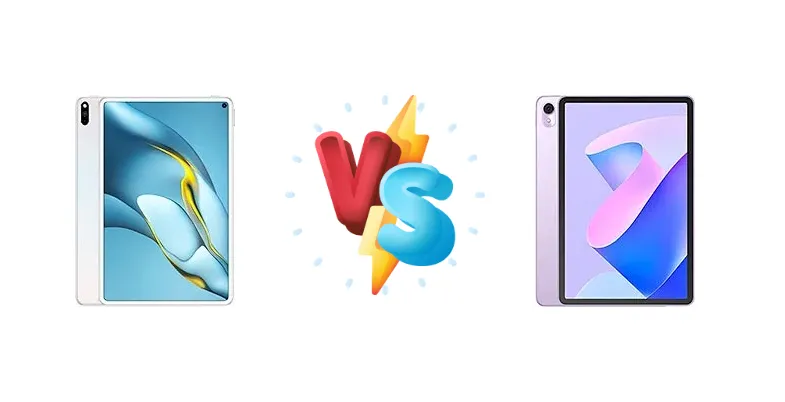
Huawei's MatePad series consistently delivers premium Android tablets, but choosing between models can be tricky. We're pitting the MatePad Pro 10.8 (2021) against the newer MatePad 11 (2023) to determine which offers the best value and performance for your needs.
🏆 Quick Verdict
The MatePad 11 (2023) edges out the Pro 10.8 thanks to its improved display (120Hz), slightly more modern design, and potentially better software support. However, the Pro 10.8 boasts significantly faster charging and a more powerful charging ecosystem with reverse wireless charging, making it a strong contender.
| Network |
|---|
| 2G bands | GSM 850 / 900 / 1800 / 1900 | N/A |
| 3G bands | HSDPA 850 / 900 / 1900 / 2100 | N/A |
| 4G bands | LTE | N/A |
| 5G bands | SA/NSA | - |
| EDGE | - | No |
| GPRS | - | No |
| Speed | HSPA, LTE, 5G - cellular model only | - |
| Technology | GSM / HSPA / LTE / 5G | No cellular connectivity |
| Launch |
|---|
| Announced | 2021, June 02 | 2023, March 23 |
| Status | Available. Released 2021, June 25 | Available. Released 2023, March 31 |
| Body |
|---|
| Build | Glass front, aluminum back, aluminum frame | - |
| Dimensions | 246 x 159 x 7.2 mm (9.69 x 6.26 x 0.28 in) | 253.7 x 165.3 x 7.2 mm (9.99 x 6.51 x 0.28 in) |
| SIM | Nano-SIM (cellular model only) | No |
| Weight | 460 g (1.01 lb) | 480 g (1.06 lb) |
| | - | Stylus support (magnetic) |
| Display |
|---|
| Resolution | 2560 x 1600 pixels, 16:10 ratio (~280 ppi density) | 2560 x 1600 pixels, 16:10 ratio (~275 ppi density) |
| Size | 10.8 inches, 338.2 cm2 (~86.5% screen-to-body ratio) | 11.0 inches, 348.3 cm2 (~83.1% screen-to-body ratio) |
| Type | IPS LCD, 540 nits (typ) | IPS LCD, 120Hz |
| Platform |
|---|
| CPU | Octa-core (1x3.2 GHz Kryo 585 & 3x2.42 GHz Kryo 585 & 4x1.80 GHz Kryo 585) | Octa-core (1x3.2 GHz Kryo 585 & 3x2.42 GHz Kryo 585 & 4x1.80 GHz Kryo 585)Octa-core (1x2.84 GHz Cortex-A77 & 3x2.42 GHz Cortex-A77 & 4x1.80 GHz Cortex-A55) |
| Chipset | Qualcomm SM8250-AC Snapdragon 870 5G (7 nm) | Qualcomm SM8250-AC Snapdragon 870 5G (7 nm)Qualcomm SM8250 Snapdragon 865 5G (7 nm+) |
| GPU | Adreno 650 | Adreno 650 |
| OS | HarmonyOS 2.0 | HarmonyOS 3.1 |
| Memory |
|---|
| Card slot | Nano Memory (dedicated slot) | microSDXC (dedicated slot) |
| Internal | 128GB 6GB RAM, 128GB 8GB RAM, 256GB 8GB RAM | 128GB 6GB RAM, 128GB 8GB RAM, 256GB 8GB RAM |
| Main Camera |
|---|
| Features | LED flash, HDR, panorama | LED flash, HDR, panorama |
| Single | 13 MP, f/1.8, PDAF | 13 MP, f/1.8, PDAF |
| Video | 4K@30fps, 1080p@30fps | 4K@30fps, 1080p@30fps |
| Selfie camera |
|---|
| Single | 8 MP, f/2.0 | 8 MP, f/2.0 |
| Video | 1080p@30fps | 1080p@30fps |
| Sound |
|---|
| 3.5mm jack | No | No |
| 35mm jack | No | No |
| Loudspeaker | Yes, with stereo speakers (4 speakers) | Yes, with stereo speakers (4 speakers) |
| | - | Tuned by Harman Kardon |
| Comms |
|---|
| Bluetooth | 5.1, A2DP, LE | 5.1, A2DP, LE |
| NFC | No | No |
| Positioning | GPS, GLONASS, GALILEO, BDS, QZSS - cellular model only | No |
| Radio | No | No |
| USB | USB Type-C 3.1, OTG | USB Type-C 3.1, OTG |
| WLAN | Wi-Fi 802.11 a/b/g/n/ac/6, dual-band, Wi-Fi Direct | Wi-Fi 802.11 a/b/g/n/ac/6, dual-band, Wi-Fi Direct |
| Features |
|---|
| Sensors | Accelerometer, gyro, proximity, compass | Accelerometer |
| Battery |
|---|
| Charging | 40W wired
27W wireless
10W wireless reversed
5W reverse wired | 22.5W wired
5W reverse wired |
| Type | Li-Po 7250 mAh | Li-Po 7250 mAh |
| Misc |
|---|
| Colors | Dark Blue, White | Black, Blue, White, Purple |
| Models | MRR-W29 | DBR-W10 |
| Price | About 500 EUR | About 300 EUR |
Huawei MatePad Pro 10.8 (2021)
- Faster Charging (40W)
- Reverse Wireless Charging
- Compact Design
- Excellent Performance (Snapdragon 870)
- 60Hz Display
- Slower Software Updates (potentially)
- Less Modern Design
Huawei MatePad 11 (2023)
- 120Hz Display
- More Modern Design
- Potentially Longer Software Support
- Excellent Performance (Snapdragon 870)
- Slower Charging (22.5W)
- No Reverse Wireless Charging
- Slightly Larger Size
Display Comparison
The MatePad 11 (2023) features a 120Hz IPS LCD display, offering a noticeably smoother scrolling and gaming experience compared to the 60Hz display on the MatePad Pro 10.8. Both tablets have excellent color accuracy and brightness, but the refresh rate difference is a key advantage for the 11.
Camera Comparison
Camera performance is comparable on both devices. Expect decent image quality in good lighting conditions, but don't expect flagship-level photography. The MatePad 11 (2023) might have a slight edge in video recording due to potential software optimizations.
Performance
Both tablets utilize the Snapdragon 870 5G chipset, ensuring excellent performance for everyday tasks and demanding games. While the MatePad 11 (2023) initially listed a Snapdragon 865, it was later confirmed to use the 870. Performance differences are minimal in real-world usage, with both handling multitasking and graphics with ease.
Battery Life
The MatePad Pro 10.8 (2021) has a larger battery capacity and significantly faster charging speeds (40W wired, 27W wireless). The MatePad 11 (2023) offers a respectable battery life but charges at a slower 22.5W wired speed.
Buying Guide
The Huawei MatePad Pro 10.8 (2021) is ideal for users prioritizing fast charging, reverse wireless charging, and a slightly more compact form factor. The Huawei MatePad 11 (2023) is better suited for those who value a smoother display experience (120Hz), a more contemporary design, and potentially longer software support.
Frequently Asked Questions
❓ Does the MatePad 11 (2023) have 5G?
Yes, both the MatePad Pro 10.8 (2021) and the MatePad 11 (2023) support 5G connectivity.
❓ What is the difference in software support?
Huawei tablets typically receive updates for a few years. The MatePad 11 (2023), being newer, is likely to receive updates for a slightly longer period, but this is not guaranteed.