
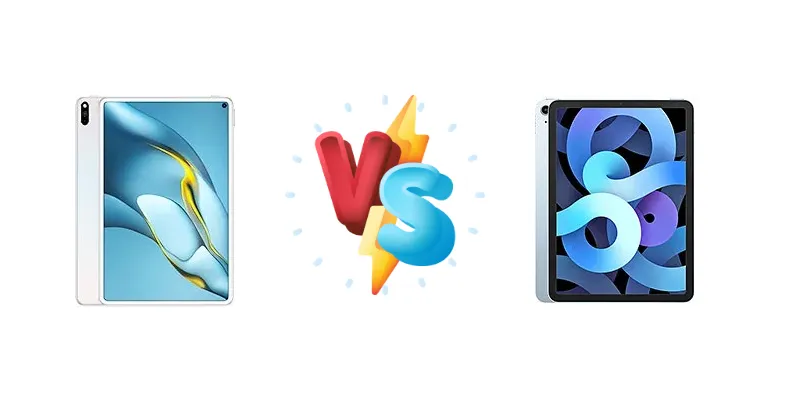
Huawei MatePad Pro 10.8 (2021) vs Apple iPad Air (2020): A Performance and Feature Showdown
| Phones Images | |||||
|---|---|---|---|---|---|
|
🏆 Quick Verdict
For the average user prioritizing raw performance and a streamlined ecosystem, the Apple iPad Air (2020) emerges as the winner. The A14 Bionic’s efficiency and iPadOS optimization provide a smoother, more responsive experience. However, the MatePad Pro 10.8 (2021) offers compelling features like faster charging and reverse wireless charging, making it a strong contender for power users.
| PHONES | ||
|---|---|---|
| Phone Names | Huawei MatePad Pro 10.8 (2021) | Apple iPad Air (2020) |
| Network | ||
|---|---|---|
| 2G bands | GSM 850 / 900 / 1800 / 1900 | GSM 850 / 900 / 1800 / 1900 |
| 3G bands | HSDPA 850 / 900 / 1900 / 2100 | HSDPA 850 / 900 / 1700(AWS) / 1900 / 2100 |
| 4G bands | LTE | 1, 2, 3, 4, 5, 7, 8, 11, 12, 13, 14, 17, 18, 19, 20, 21, 25, 26, 29, 30, 34, 38, 39, 40, 41, 46, 48, 66, 71 - A2324 |
| 5G bands | SA/NSA | - |
| Speed | HSPA, LTE, 5G - cellular model only | HSPA, LTE |
| Technology | GSM / HSPA / LTE / 5G | GSM / HSPA / LTE |
| - | 1, 2, 3, 4, 5, 7, 8, 11, 12, 13, 14, 17, 18, 19, 20, 21, 25, 26, 28, 29, 30, 32, 34, 38, 39, 40, 41, 42, 46, 48, 66 - A2072 | |
| Launch | ||
|---|---|---|
| Announced | 2021, June 02 | 2020, September 15 |
| Status | Available. Released 2021, June 25 | Available. Released 2020, October 23 |
| Body | ||
|---|---|---|
| Build | Glass front, aluminum back, aluminum frame | Glass front, aluminum back, aluminum frame |
| Dimensions | 246 x 159 x 7.2 mm (9.69 x 6.26 x 0.28 in) | 247.6 x 178.5 x 6.1 mm (9.75 x 7.03 x 0.24 in) |
| SIM | Nano-SIM (cellular model only) | Nano-SIM + eSIM |
| Weight | 460 g (1.01 lb) | 458 g (Wi-Fi) / 460 g (3G/LTE) (1.01 lb) |
| - | Stylus support | |
| Display | ||
|---|---|---|
| Protection | - | Scratch-resistant glass, oleophobic coating |
| Resolution | 2560 x 1600 pixels, 16:10 ratio (~280 ppi density) | 1640 x 2360 pixels (~264 ppi density) |
| Size | 10.8 inches, 338.2 cm2 (~86.5% screen-to-body ratio) | 10.9 inches, 359.2 cm2 (~81.3% screen-to-body ratio) |
| Type | IPS LCD, 540 nits (typ) | Liquid Retina IPS LCD, 500 nits (typ) |
| Platform | ||
|---|---|---|
| CPU | Octa-core (1x3.2 GHz Kryo 585 & 3x2.42 GHz Kryo 585 & 4x1.80 GHz Kryo 585) | Hexa-core (2x3.0 GHz Firestorm + 4x1.8 GHz Icestorm) |
| Chipset | Qualcomm SM8250-AC Snapdragon 870 5G (7 nm) | Apple A14 Bionic (5 nm) |
| GPU | Adreno 650 | Apple GPU (4-core graphics) |
| OS | HarmonyOS 2.0 | iPadOS 14.1, upgradable to iPadOS 26.1 |
| Memory | ||
|---|---|---|
| Card slot | Nano Memory (dedicated slot) | No |
| Internal | 128GB 6GB RAM, 128GB 8GB RAM, 256GB 8GB RAM | 64GB 4GB RAM, 256GB 4GB RAM |
| Main Camera | ||
|---|---|---|
| Features | LED flash, HDR, panorama | HDR |
| Single | 13 MP, f/1.8, PDAF | 12 MP, f/1.8, (wide), 1/3.0", 1.22µm, dual pixel PDAF |
| Video | 4K@30fps, 1080p@30fps | 4K@24/30/60fps, 1080p@30/60/120/240fps; gyro-EIS |
| Selfie camera | ||
|---|---|---|
| Features | - | HDR |
| Single | 8 MP, f/2.0 | 7 MP, f/2.0, 31mm (standard) |
| Video | 1080p@30fps | 1080p@30/60fps |
| Sound | ||
|---|---|---|
| 3.5mm jack | No | No |
| 35mm jack | No | No |
| Loudspeaker | Yes, with stereo speakers (4 speakers) | Yes, with stereo speakers |
| Comms | ||
|---|---|---|
| Bluetooth | 5.1, A2DP, LE | 5.0, A2DP, EDR |
| NFC | No | No |
| Positioning | GPS, GLONASS, GALILEO, BDS, QZSS - cellular model only | GPS, GLONASS (LTE model only) |
| Radio | No | No |
| USB | USB Type-C 3.1, OTG | USB Type-C, magnetic connector |
| WLAN | Wi-Fi 802.11 a/b/g/n/ac/6, dual-band, Wi-Fi Direct | Wi-Fi 802.11 a/b/g/n/ac/6, dual-band, hotspot |
| Features | ||
|---|---|---|
| Sensors | Accelerometer, gyro, proximity, compass | Fingerprint (top-mounted), accelerometer, gyro, compass, barometer |
| Battery | ||
|---|---|---|
| Charging | 40W wired 27W wireless 10W wireless reversed 5W reverse wired | - |
| Type | Li-Po 7250 mAh | Li-Ion 7606 mAh (28.93 Wh) |
| Misc | ||
|---|---|---|
| Colors | Dark Blue, White | Space Gray, Silver, Rose Gold, Green, Sky Blue |
| Models | MRR-W29 | A2324, A2072, A2325, A2316, iPad13,1, iPad13,2 |
| Price | About 500 EUR | About 640 EUR |
Huawei MatePad Pro 10.8 (2021)
- Significantly faster charging (40W wired, 27W wireless)
- Reverse wireless charging for accessories
- Android ecosystem with Huawei customization
- Snapdragon 870 7nm process is less efficient than A14's 5nm
- Potential software concerns due to US trade restrictions
Apple iPad Air (2020)
- Superior CPU performance with A14 Bionic
- Optimized iPadOS ecosystem
- Excellent build quality and design
- Slower charging speeds (20W wired)
- No wireless charging support
Display Comparison
While both tablets feature 10.8-inch displays, detailed display specs are missing. However, considering Huawei’s history with high-quality panels, the MatePad Pro likely boasts a high resolution and color accuracy. The iPad Air (2020) utilizes a fully laminated display with anti-reflective coating, enhancing viewing angles and reducing glare. The A14 Bionic’s image signal processor contributes to accurate color reproduction. Without specific nit brightness data, it’s difficult to definitively declare a winner, but the iPad Air’s anti-reflective coating provides a practical advantage in bright environments.
Camera Comparison
Detailed camera specifications are unavailable for both devices. However, given the tablet form factor, camera quality is less of a primary concern. Both are likely equipped with capable main sensors for casual photography and video conferencing. The A14 Bionic’s image processing capabilities likely provide a slight edge in image quality, particularly in low-light conditions. The absence of detailed specs prevents a conclusive assessment.
Performance
The core of this comparison lies in the chipsets. The Apple A14 Bionic, fabricated on a 5nm process, delivers exceptional performance per watt. Its hexa-core CPU, with two high-performance Firestorm cores clocked at 3.0 GHz, excels in single-core tasks. Conversely, the Qualcomm Snapdragon 870 5G in the MatePad Pro, built on a 7nm node, features an octa-core configuration. While the Snapdragon 870 offers more cores, the A14’s architectural advantages and process node lead to superior efficiency and sustained performance. This translates to smoother multitasking and faster app loading times on the iPad Air, particularly in graphically intensive applications. The iPad Air’s LPDDR4X RAM complements the A14, ensuring quick data access.
Battery Life
The Huawei MatePad Pro 10.8 (2021) distinguishes itself with its charging capabilities: 40W wired, 27W wireless, and even 10W reverse wireless charging. This allows for incredibly fast top-ups and the ability to charge other devices. The iPad Air (2020) lacks wireless charging and supports only 20W wired charging. While battery capacity figures are missing, the A14 Bionic’s efficiency likely results in comparable real-world battery life. However, the MatePad Pro’s charging versatility provides a significant convenience factor.
Buying Guide
Buy the Huawei MatePad Pro 10.8 (2021) if you need faster charging speeds, reverse wireless charging for accessories, and prefer the Android ecosystem with Huawei’s customization options. Buy the Apple iPad Air (2020) if you prioritize a polished user experience, seamless integration with other Apple devices, and consistently high performance in demanding applications.